



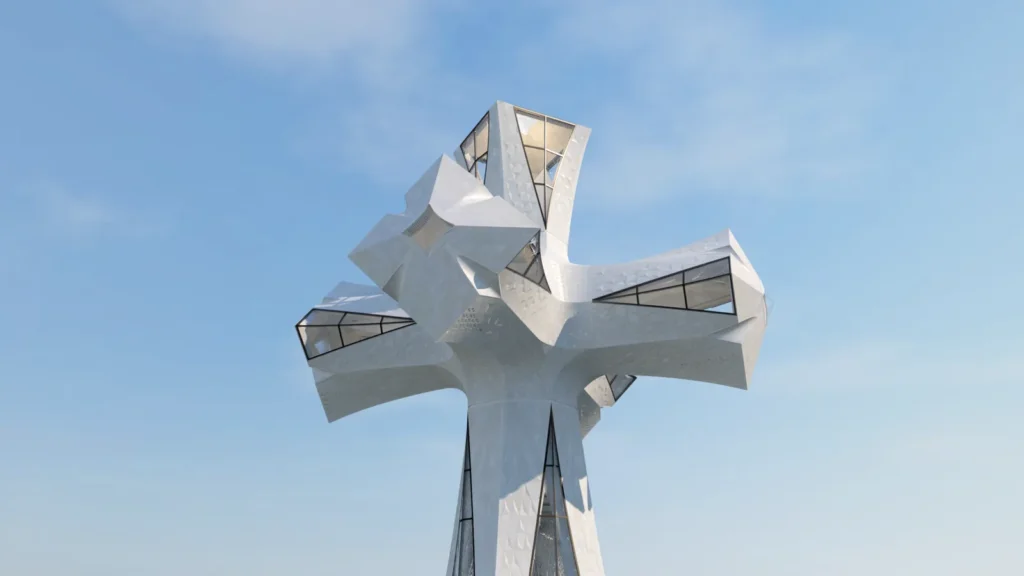
“My house shall be called a house of prayer for all peoples” (Isaiah 56:7)-this promise frames Barcelona’s year-long Gaudi centenary, launched as the Bascillica de la Sagrada Familia completed its 172.5-metre Tower of Jesus Christ.
The Foundation’s Programme-masss, concerts, exhibitions unfolding from autumn 2025 to Christmas 2026, ties the centenary of Antoni Gaudi’s death to the push for funds that will carry the basilica’s decorative work through to 2034.
The program, running from autumn 2025 through Christmas 2026, features solemn masses, concerts, exhibitions and open-door events aimed at neighbors as much as tourists, according to the Foundation’s centenary plan.
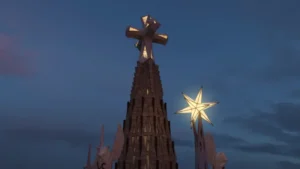
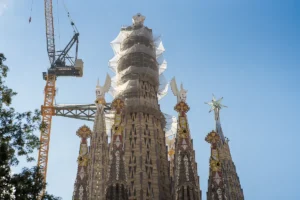
The symbolism sharpened on 20 February 2026, when workers installed the upper arm of the cross on the 172.5-metre Tower of Jesus Christ — the basilica’s highest point and final external element.
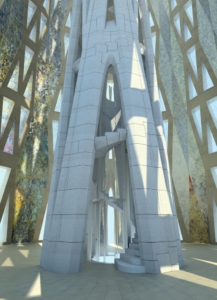
According to Vatican News, the cross, measuring 4.5 × 4.5 × 4.9 meters, was assembled from German-made modules clad in Catalan ceramic and stained glass, crowning a twelve-sided tower surrounded by the Evangelists’ and Virgin Mary’s towers.
The ensemble is now complete externally, though interior work will continue through 2028.
For the centenary, officials say the events are “not only an architectural milestone, but also a celebration, a remembrance and a collective tribute.”
Highlights include a March 19 Saint Joseph Mass with the Orfeó Català, an April–July Palau Robert exhibition on 144 years of shared history, and December concerts with Montserrat’s choir lighting the Nativity façade. This autumn’s light show will honor the Tower of Barnabas, the only spire Gaudí saw finished in his lifetime.
Funding remains entirely private — tickets, donations, collaborators — about 5 million visitors a year generate €150 million, half reinvested.
The board hopes the centenary’s emotional pull will keep cash flowing for the Glory Façade and the Agnus Dei sculpture destined for the cross’s heart. Chief Architect Jordi Faulí told Vatican News the tower’s completion is “a concrete commitment to the future,” embodying years of studying Gaudí’s legacy.
Controversy lingers: the planned 60-metre entrance staircase would require demolitions in the neighborhood, a legacy debate Gaudí left behind. Still, for most Barcelonans the basilica is a living workshop. “My client is not in a hurry,” Gaudí once joked.
A century later, the city has set a deadline — and thrown itself a year-long party to meet it.
For Catholics, the Sagrada Família is more than a monument—it’s an active basilica and expiatory temple where Mass is celebrated daily, drawing pilgrims who see its forest of columns, stained-glass light and Passion façade as a stone catechism of Christ’s life.
It embodies Gaudí’s blend of deep faith and nature symbolism, so believers experience architecture as prayer.
Globally, it’s a universal cultural magnet: still unfinished after 144 years, funded entirely by visitors, and soon the world’s tallest church. UNESCO recognized it as a World Heritage masterpiece, and its annual 4–5 million guests make it Barcelona’s most visited site.
The basilica links local Catalan identity, modernist art history and a shared human story of perseverance—rooting Catholic heritage in a narrative that resonates far beyond the Church.
Who is Antoni Gaudi I Cornet?
Antoni Gaudí i Cornet (1852–1926) was a visionary Catalan architect and the leading figure of Modernisme. Born near Reus, he graduated in Barcelona in 1878 and soon developed an organic style inspired by nature, geometry and his Catholic faith.
Gaudí designed landmarks like the Sagrada Família—which he devoted the last 12 years of his life to—Park Güell, Casa Batlló and Casa Milà. He died on 10 June 1926 after being struck by a tram, and is buried in the crypt of the Sagrada Família.
Seven of his works are UNESCO World Heritage Sites.
According to antiquity, the seven Antoni Gaudí works named UNESCO World Heritage Sites are: Park Güell – Barcelona, Palau Güell – Barcelona, Casa Mila (La Pedrera) – Barcelona, Casa Vicens – Barcelona, Sagrada Família (Crypt and Nativity façade at time of inscription) – Barcelona, Casa Batlló – Barcelona and
Colònia Güell Crypt Santa Coloma de Cervelló (near Barcelona).
 They were inscribed in 1984 (with Casa Vicens added in 2005) as masters of Catalan Modernisme.