






















“An orderly city is not an accident—it is law obeyed, spaces respected, and trade conducted where it belongs.”
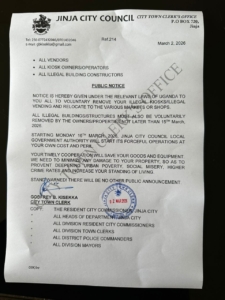
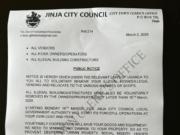
That punchy line opens Jinja City’s bluntest circular in years, signed by the City Town Clerk Godfrey B. Kisekka and copied to every security desk from the RCC Richard Gulume Balyainho and his deputies Martin Kasonzi Basalirwa and Amis Nagayi Kiganira to Division mayors.
The circular headlined PUBLIC NOTICE, leaves no wiggle room; remove illegal kiosks, street vending and unsanctioned structures by 15 March, or face forceful operations at your own cost and peril starting 16 March,2026.
The March 2 notice leans on Uganda’s Physical Planning Act (2010), which prohibits development without approved plans, and the KCCA Act (2010) standards Jinja mirrors for trade order—no person may hawk or erect works in a public place not designated for the purpose.
The Act declares the entire country a planning area and makes development permission mandatory, meaning no building, kiosk or sub division without approval from the urban or district physical planning committee.
It criminalizes building in road reserves, wetlands, public land or against an approved plan and obstructing officers, court magistrates may jail offenders up to two years or impose daily fines with demolition ordered at owner’s cost.
The Physical Planning (Amendment)Act No 2 of 2020 added concrete duties that owners must provide paved frontages, slash compound grass and display signage or face fines up to UGX 2 million- or one-year imprisonment.
The amendment also tied local-government-funding to compliance, rewarding implementers and sanctioning laggards.
In practice: vendors must shift to gazetted markets or rented shops; owners of makeshift buildings must demolish them themselves.
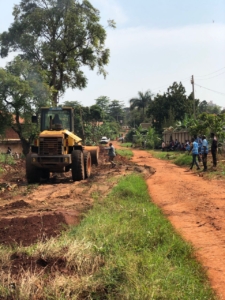
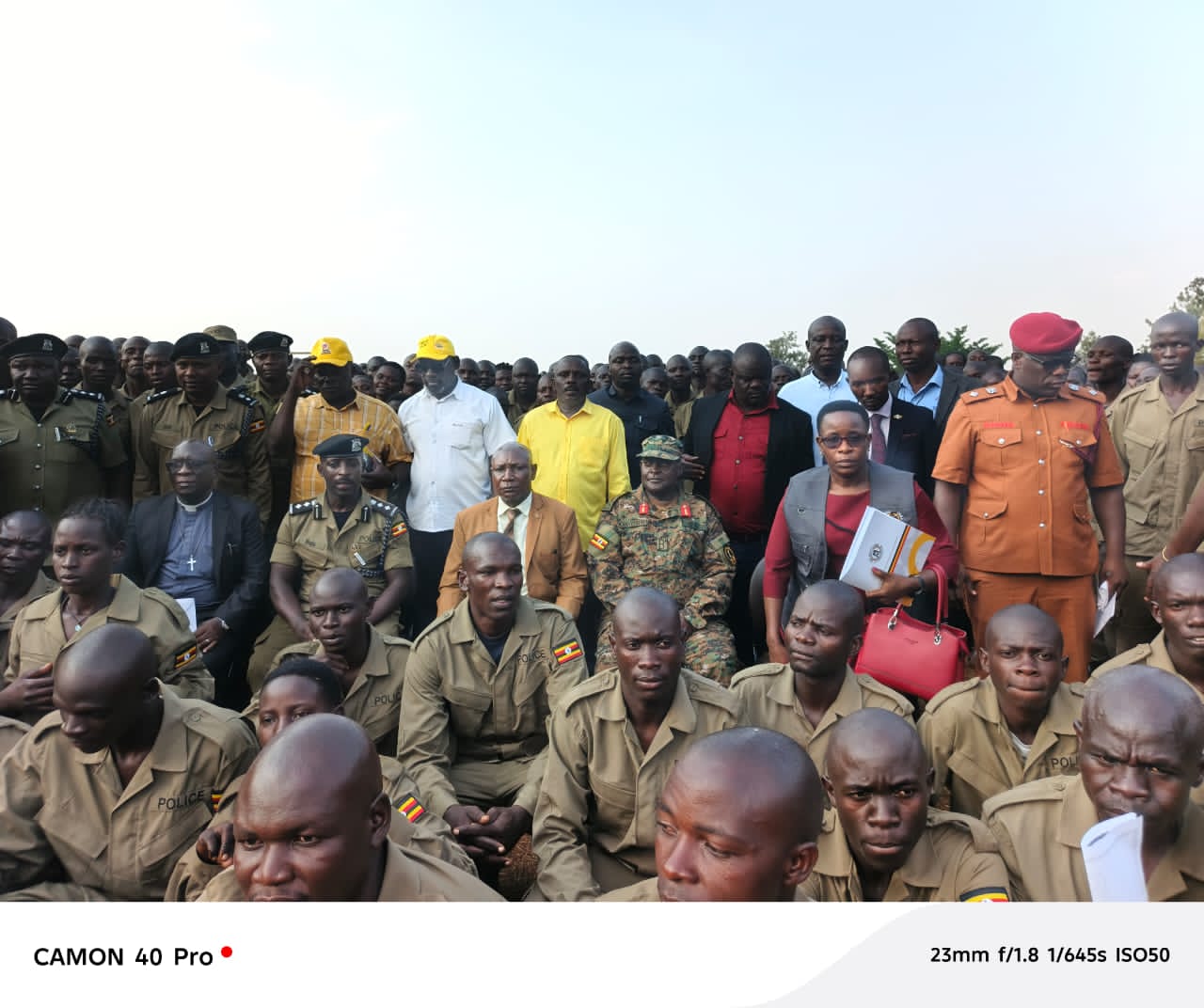
After the deadline, the no nonsense Kisekka warns that council crews headed by the UPDF-backed Sowali Omulyangere and police will act, so the snapshot “stand warned” is not boilerplate.
Locally, it means de‑risking lives: informal stalls fused to power lines, blocked drains that flood arcades, and shop‑front cages that hide muggings.
“Your peril” underscores liability—goods impounded, structures razed, costs billed to the operator, and no further announcements.
Kisekka frames the clean‑up as poverty prevention, not punishment: save inventory, avoid broken tools, reduce cover for theft, keep walkways open when rains come.
“Your timely cooperation will save your goods and equipment. We need to minimize any damage to your property, so as to prevent deepening urban poverty, social misery, higher crime rates and increase your standard of living.”, the one-page circular reads in part.
The phrasing of the circular is well-crafted and stern because bargaining windows have closed before: notices posted, meetings held, markets built.
This is not only a Jinja City matter, because even Kampala Capital City Authority (KCCA) has already cleared vendors from its CBD and is moving next on boda‑boda stages and taxi touts whose commands increasingly ignore traffic order.
Information available in the public domain indicates that Mbale, Lira and Gulu are scripting similar sweeps. Officials, off the record, call it Operation Orderly City now that the elections are behind us, they say, and governing can resume.
For now, Kisekka’s circular gives a last yard of rope: compliance by Sunday, enforcement on Monday, and a city trying to choose planning over peril.
However, analysts in Jinja City are already asking the next question: does order pay for itself? Even supporters want to see the ledger, how much trade-order enforcement collects in fees, licenses and fines versus fuel, overtime and impound costs. If allowances outrun revenue, the sweep looks punitive rather than profitable.
Critics are urging the Town Clerk’s office to publish a simple return: arrears recovered, stalls regularized, receipts banked. In a city that markets itself to tourists, that kind of transparency would turn “operation Orderly City” from a warning into a success story-law enforced, corridors opened, and the treasury visibly stronger.
There is also a structural test: are shopkeepers whose verandas were once buried in tarpaulins now posting better records to Uganda Revenue Authority (URA)? Has Uganda Registration Service Bureau (URSB) seen a bump in business registration as vendors move into formal arcades? And are trading-license desks busier because compliance feels safer than cat-and-mouse.
Planners argue yes saying visible corridors and verandas encourage rent contracts, contracts encourage registration and registration eases tax filing. If those links hold, the operation is not just a clean-up, it is a funnel from pavement to payroll.
Supermarkets Sagas.
The equity test sits at the supermarket fronts. In several Jinja City estates, indigenous‑owned marts preside over verandas packed with vegetable vendors—yet enforcement tiptoes past, officers picking up “crumbs” rather than orders.
To city dwellers that looks less like planning and more like hierarchy: youth, widows and single mothers swept off pavements while powerful owners negotiate by presence.
It undercuts the president’s promise that even 50,000 shillings should earn a start with his comic comment: “In Uganda even a fool can survive”.
If Operation Orderly City only clears the weak, it will not clean the city; it will certify the sense that the law is sharp for some and blunt for others.
The Exposure Uganda (TEU) Editorial: The Calculus of Order.
Jinja City’s PUBLIC NOTICE is popular—and precarious. Popular because residents are tired of tarps swallowing walkways and “rent collectors” taxing darkness; precarious because enforcement often runs ahead of alternatives.
Town Clerk Kisekka is right that planning saves livelihoods—impounded goods deepen poverty, blocked drains deepen floods. Yet popularity fades if allowances eclipse revenue and if shop arcades stay empty while pavements stay bare.
The ask is simple. Publish the numbers. Show URA filings tick upward, URSB registrations rise, license desks fill because regularization helps, not hurts.
Make “forceful operations” a last resort, not a first headline. If Operation Orderly City links cleaner pavements to fuller ledgers, Jinja will not just look better for tourists—it will work better for traders. That is the order worth applauding.