



























Jinja City authorities have referred to police a case of alleged sexual misconduct at Masese Seed Secondary School after an internal probe found the matter “rather criminal” and called for “deeper investigations.”
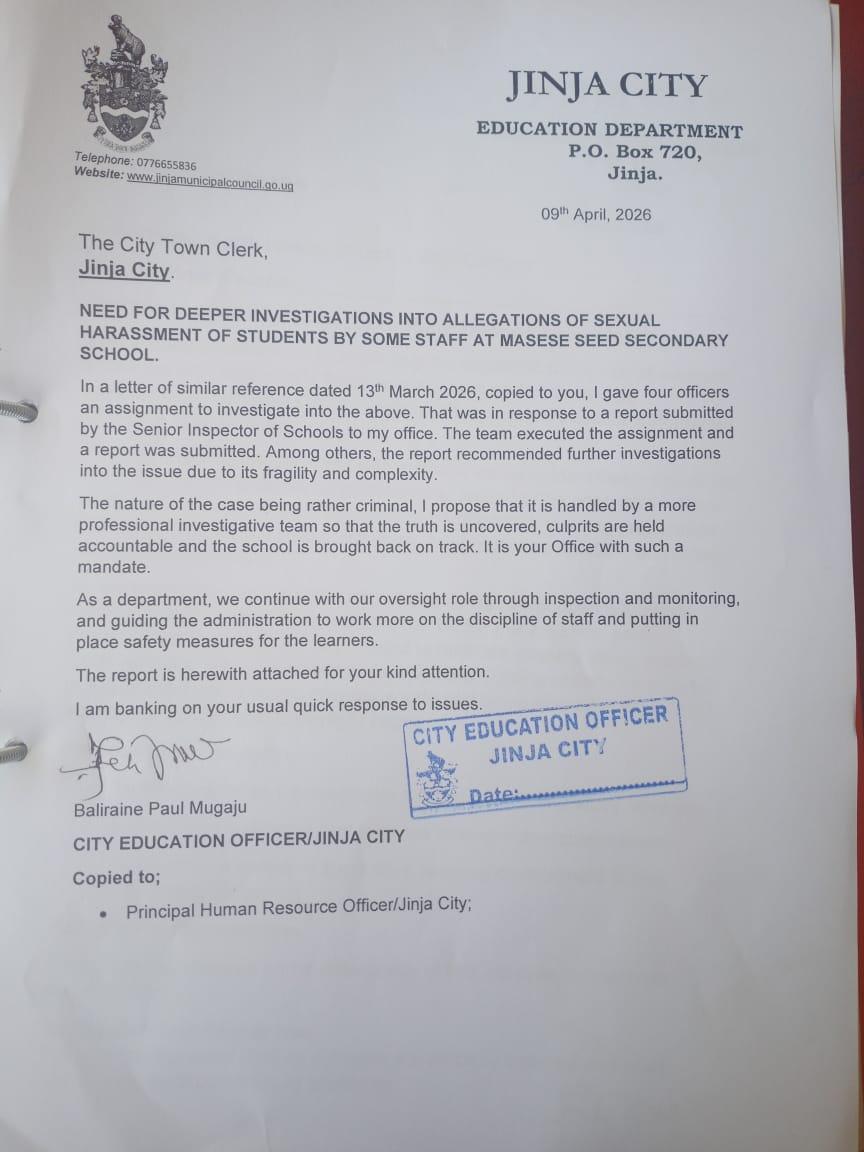
The City Education Officer Baliraine Paul Mugaju, in a 9th April 2026 letter to the City Town Clerk Godfrey B Kisekka seen by TEU, said a four-officer team had completed its investigation but recommended escalation “due to its fragility and complexity.”
“The nature of the case being rather criminal, I propose that it is handled by a more professional investigative team so that the truth is uncovered, culprits are held accountable and the school is brought back on track,” Mugaju wrote.

TEU has not seen the internal report the CEO referenced in his 9 April letter. The identities of the four officers assigned to the internal investigation and their terms of reference have also not been disclosed.
The trigger: The probe began after the headteacher Ms. Aisha Male suspended a computer technician identified as Nasser Wampande last month following a viral video appearing to show him kissing a female student on school premises.
“Relationships between staff and students are strictly prohibited at this school,” Ms Aisha Male told a national daily. She confirmed the staff member “is on suspension pending a final administrative decision.”
It remains unclear how Kisekka the TC will expedite the matter. The case has drawn anger from Jinja residents, some of whom were evicted from street vending spots and now struggle to pay fees for children they fear are being abused or diverted from studies by the very staff meant to guide them.

The law: Under Penal Code Act Section 129, sexual acts with a person under 18 constitute defilement, a capital offense. The Teachers’ Professional Code of Conduct, 2012 bans all sexual or romantic relationships between staff and learners. The Children Act Cap 59 compels adults to report suspected abuse of minors to police or probation officers.
The ethics: Schools act in loco parentis in place of parents. The power imbalance makes consent legally and ethically impossible. Public Service Standing Orders classify such conduct as gross misconduct punishable by dismissal.
THE TEU EXPLAINER.
The phrase loco parentis is Latin which literally means “in the place of a parent”.
What it means in law.
When a child is under the care of someone who isn’t their parent — teacher, school, coach, matron, or chaplain that person legally takes on some parental duties. The law does not care about job titles.
Loco parentis applies to all school staff and the Children Act Cap 59 puts a duty on ‘every person’ not ‘every teacher’.
The school delegates care to every adult it employs on site. If you have access to learners because the school hired you, you are in loco parentis during school hours, period.
This is because the crime exists because of power and access, not a teaching certificate, diploma or degree. A computer technician controls grades if he handles the system, controls access to the labs and can promise favors or threaten exposure.
A student, more so a female can not consent freely to someone who controls part of the school life.
They must: Protect, supervise, and discipline the child as a reasonable parent would.
Where Loco Parentis Come From.
In 1765, England where William Blackstone wrote it in “Commentaries on the Laws of England”. He said a father “may delegate part of his parental authority… to the tutor or schoolmaster of his child; who is then in loco parentis.”
Judges before that used the idea, but Blackstone gave it the name everyone still cites.
How Uganda Uses It:
We inherited it through English common law in 1902. Today it’s baked into:
Education Act – schools have duty of care, Children Act Cap 59, adults must protect minors.
Teachers’ Professional Code of Conduct, teachers stand _in loco parentis_ from the time a learner reports to school until they leave
Baliraine Mugaju said his department would continue “inspection and monitoring and guiding the administration to work more on the discipline of staff and putting in place safety measures for the learners.”
Allegations are under official investigation. No individual has been charged or convicted.
TEU does not identify minors who are alleged victims of abuse, per the Children Act Cap 59. All parties have a right of reply. We Expose. You Decide.