





























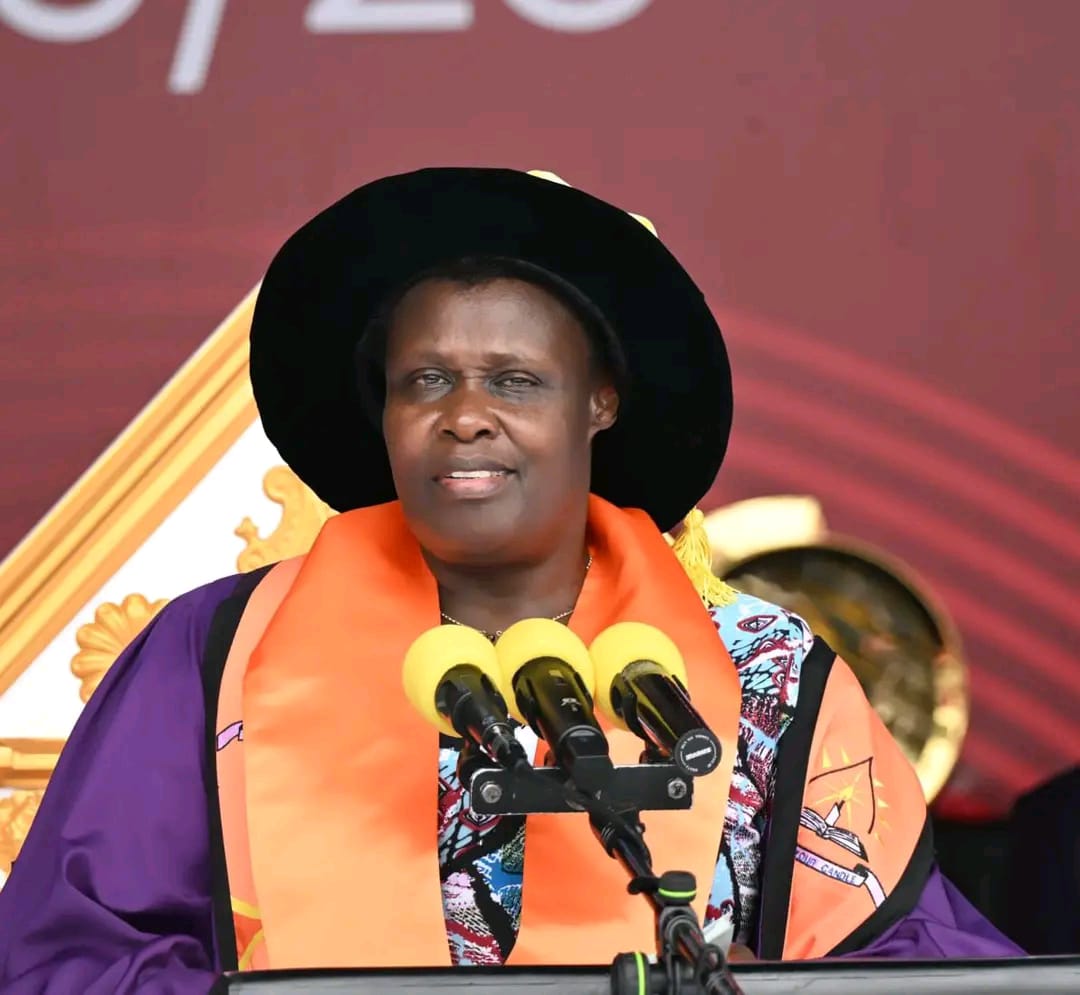
Uganda’s Vice President Maj (Rtd) Jessica Alupo used St. Lawrence University’s 16th graduation to press a point she keeps returning to: Artificial Intelligence belongs in lecture halls and labs, but only if it serves Competency‑Based Education and community need.
“Technology without values is dangerous,” she told graduands, parents and faculty, urging graduates to treat AI as a tool for practical problem‑solving—not as a crutch.
“Competency‑Based Education, supported by AI, gives learners practical skills, entrepreneurial mindsets and adaptive capabilities essential for job creation and sustainable development”, Alupo said.
In her reading, that means agriculture apps that raise yields for smallholders, health‑information tools that help clinics in Mukono or Mbale, and business platforms built by students who have spent time in communities rather than just in libraries.
The message dovetailed with St. Lawrence’s theme— “Integrating Artificial Intelligence in Competence‑based Curriculum”—and the university’s pledge to co‑design programmes with government, industry and NGOs so learning stays applied.

Dr Charles Masaba, the Vice Chancellor, said every programme is being redesigned for competence—learners prove they can do, not just recall.
Council chair Mike Ssebalu warned that competence minus integrity produces clever harm: “knowledge with character, innovation with responsibility.” Justine Maria Tuliana, Board chair, flagged concrete next steps—a hostel, sports facilities, an endowment—to keep learners anchored while the university pushes ICT‑led redesign.

Alupo linked the agenda to government policy: liberalized higher education meant to widen access while private providers innovate.
She reminded graduands that certificates bring responsibility—to use knowledge ethically, embrace technology wisely, and serve communities faithfully.
For parents who funded fees through lean years, the VP offered direct thanks; for new graduates, a charge: be bold, be creative, be solution‑driven, and never stop learning, because the country’s shift from memorization to skills needs keepers as well as designers.

What Is AI? Is It a Tool or an Answer?
According to experts, it’s a tool like a smartphone, machete or any others, very versatile one which can draft answers, pot patterns and take routine work off your plate but it does not ‘know’ things the way people do.
Think of it as a powerful apprentice, give it context and direction, check the results and use your judgement for the final call.
Some describe AI as a double-edged sword, a lever that can build or bruise. A phone connects you but also distracts, a machete clears brush or causes harms.AI amplifies what we ask of it, helpful when we are clear and careful, risky when we are vague or careless. The edge is ours to steer.