






The Exposure Uganda Preamble.
Andrew Mwenda the CEO of The Independent Magazine/PLU promoter has already put his product on the public shelf. His label reads: “The Military Strongman.” Ingredients: Less democracy, executive command, military discipline to defeat corruption. Best before: Now. Warning: Do not debate.
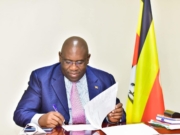
On the other hand, Hon. Asuman Kiyingi is now the counter-salesman. He is not launching a new product.
He is holding Mwenda’s up to the light, checking the batch number, the expiry date, and Uganda’s medical history with this exact formula.
Hon. Asuman Kiyingi’s Inspection Report:
According to Asuman Kiyingi, Mwenda’s assertion that “Gen. Muhoozi Kainerugaba is very powerful”, is not only flawed but misleading and exaggerated. Kiyingi argues that individuals should not be above institutions — that is the rule in a democratic nation. The moment individuals sit above institutions, you are no longer in a democracy. You are in a different system altogether.
Kiyingi’s Deeper Audit finds:
Uganda’s medical history is clear: the 1966 crisis, 1971 Amin coup, 1985 Tito Okello-short-lived military junta. Each arrived promising discipline and anti-corruption. Each left with constitutional collapse and institutional death. When the gun is above the Constitution, institutions decay.
Mwenda contradicts himself: He once wrote with Roger Tangri that “military corruption was the result of government and army leaders not being subject to public accountability.” Secrecy and impunity caused ghost soldiers and junk helicopters, not democracy.
The African shelf is full of this brand: Sudan’s cycles of coups. Nigeria’s military-era mega-scandals. Burkina Faso’s Traoré praised online, but flagged by observers for secrecy, detentions, and shrinking freedoms.
Military populism reorganizes corruption, it doesn’t end it.
The PLU contradiction: A movement claiming moral renewal cannot use mobilizers like Hon Michael Mawanda who carry public controversy over cooperative funds. Moving from civilian patronage to military patronage only changes who benefits.
Singapore is not a barracks: East Asia’s success was civilian bureaucracies, rules, and merit — not social media decrees or public humiliation of Parliament.
TEU Supermarket Rules remain the same:
Fit Uganda’s diet: Democratic governance, socio-economic, cultural, and spiritual nourishment within the constitutional framework. That’s our nutrition label.
No expired goods: 1966, 1971, 1985 already tested. Side effects: coups, collapse, institutional death.
No dumped goods: Foreign recipes for “hard men” never calibrated for our laws.
No poison labeled as medicine: Secrecy, impunity, and rule by force cause lawlessness. That’s a health upset.
No personal brands above institutional shelves: In a democracy, the Constitution is the manager, not any general.
And TEU recognizes the customer’s fatigue:
Ugandans are tired of “democracy” laced with populism. The moment government touches an official for abuse of office, the kith and kin scream! “Leave Our Son! Leave Our Daughter! He’s being witch-hunted!”.
Tired of road, school, and hospital money swallowed by the “untouchables” who hide behind legal technicalities while citizens go hungry and angry.
So, if Mwenda’s claim is that only the military can bring sanity where civilian systems have failed, then let that be clear on the packaging. Let the customer see it, test it, and weigh the cost.
At TEU, we do not shout. We do not force. We Expose.
Mwenda has marketed and Hon. Kiyingi is countering. The ingredients are now on the counter: history, evidence, the Constitution, ghost soldiers, junk helicopters, Sudan/Nigeria/Burkina case studies, the PLU contradiction, and the principle that no individual should tower over institutions in a democracy.
We Expose, You Decide.
Inspect before you ingest. Uganda has survived food poisoning before. It cannot afford another, but it also cannot keep eating rot and calling it democracy.
Hon Kiyingi puts this question directly to Mwenda:
The CDF office should be configured so that the next generals to occupy it can freely execute their duties unfettered-because there is a well-laid-out system, not because of who sits in it’s Mwenda answer this:
What happens if another CDF who is not a First Son takes office?
He argues that if the system only works when a specific individual is in command, then it is not a system, it is a personality cult wearing military uniform.
Kiyingi’s point is that corruption and indiscipline are not cured by hoping the ‘right man’ gets the chair. They are cured by building a chair so strong, so rule-bound that even the wrong man cannot sit crooked.
Mwenda’s military Strongman model fails this test, it bets Uganda’s security on individuals, not institutions.
Editorial Note At TEU:
At TEU, we have no shortage of adjectives, analogies, or metaphors. We are a revolutionary digital platform, not a boring, recycled news stall.
We use language as a flashlight, to expose, to clarify, to make you see the ingredients clearly. If the truth sounds sharp, it’s because expired goods sting.
Invitation To Customers:
Dear Reader, come armed with your shopping list. Bring your Constitution, your memory of 1966/1971/1985.
TEU is not a sermon, it’s a self-service counter, touch the product, read the label. Compare the expiry dates.
We have exposed the ingredients. You do the shopping. If the “Military Strongman” fits your diet, buy it. If it doesn’t, leave it on the shelf. But do not buy blind.
The Illusion of the Military Strongman: Why Uganda Cannot Fight Corruption Through Martial Politics.
A Rebuttal to Andrew Mwenda
By Asuman Kiyingi
In a recent essay, Andrew Mwenda attempted to justify what is becoming an increasingly dangerous trend in Uganda’s politics: the growing dominance of military influence over civilian institutions.
His argument is simple but deeply flawed. He claims Uganda has outgrown President Yoweri Museveni’s old politics of compromise and now needs a harder, more forceful system under General Muhoozi Kainerugaba — one driven by military discipline, executive command, and less regard for democratic procedures.
According to Mwenda, military-style decisiveness is necessary to defeat corruption and push Uganda toward economic transformation. He presents reported security operations against Speaker Anita Among, public threats against parliamentary leaders, and direct military involvement in political questions as signs of a new and necessary order.
But history — especially Uganda’s history — tells us the exact opposite.
The idea that corruption can be defeated by concentrating more power in the hands of soldiers or politically connected military elites is one of the oldest and most dangerous myths in African politics.
Almost every military intervention on the continent has come wrapped in the language of discipline, patriotism, anti-corruption, and national salvation. Yet the result has almost always been the same: weaker institutions, greater fear, deeper corruption, and eventual instability.
Uganda itself is a painful example.
The 1966 Ugandan constitutional crisis was justified as necessary to overcome political paralysis and strengthen national unity. Instead, it destroyed constitutional order and elevated military power above civilian institutions. That collapse opened the road to the 1971 Ugandan coup d’état by Idi Amin, who also arrived promising discipline, efficiency, and an end to corruption. What followed was economic collapse, mass repression, and the destruction of state institutions.
The 1985 military junta claimed it was rescuing Uganda from misrule. It instead deepened instability and fragmentation. Even the 1986 NRM takeover, which promised a “fundamental change” built on rule-based governance and accountability, with the Constitution of Uganda as the supreme law, increasingly struggles today with the very problems it once pledged to eliminate.
The lesson from Uganda’s history is therefore very clear: whenever the gun becomes more powerful than the Constitution, institutions decay and personal rule expands.
Mwenda’s argument is also contradicted by his own earlier work. Long before becoming a defender of militarized politics, he built his reputation as an investigative journalist exposing corruption within Uganda’s political and military systems. Together with scholar Roger Tangri, Mwenda documented how lack of public accountability within the military created conditions for corruption to thrive. And Uganda’s own experience proves the point.
The UPDF has over the years faced repeated allegations and scandals involving ghost soldiers, classified expenditure abuses, procurement controversies, and the infamous junk military helicopter scandal of the late 1990s. These were not failures caused by “too much democracy.” They were failures made possible by secrecy, impunity, and lack of oversight.
As Roger Tangri and Andrew M. Mwenda wrote in their 2003 study Military Corruption & Ugandan Politics since the Late 1990s:
“We argue that the prevalence of military corruption was the result of government and army leaders not being subject to public accountability.”
That earlier analysis was correct — and it completely discredits Mwenda’s current position.
A system dominated by military power cannot easily fight corruption because unchecked power itself becomes the source of corruption. When institutions are weakened and decisions depend on loyalty to individuals rather than transparent rules, accountability disappears. The people enforcing the law become insulated from the law.
This is why the claim that Uganda needs “less democracy” to fight corruption is so dangerous. Corruption does not grow because Parliament debates too much or because courts exist. Corruption grows where there is secrecy, fear, impunity, and concentration of power without oversight.
The experience of other African countries confirms this.
In Sudan, military interventions repeatedly claimed to be correcting civilian failure, yet they produced cycles of dictatorship and civil conflict. In Nigeria, successive military governments promised discipline while overseeing some of the largest corruption scandals in Africa’s history.
Today in Burkina Faso, Captain Ibrahim Traoré is praised by many online supporters as a revolutionary anti-corruption leader. Yet independent observers and rights organizations continue to raise concerns about shrinking civic freedoms, lack of transparency, arbitrary detentions, and growing secrecy around security expenditures.
Military populism often looks attractive in moments of public frustration like we are experiencing in Uganda today. But once accountability is weakened in the name of patriotism or discipline, corruption simply reorganizes itself around the new centers of power.
The PLU Contradiction.
The contradiction at the heart of the Patriotic League of Uganda (PLU) is impossible to ignore. Mwenda presents the movement as a clean break from the old politics of patronage and corruption. Yet many of the figures surrounding the project are themselves products of the same political system they claim to oppose.
One prominent example is Hon Michael Mawanda, an important mobilizer within PLU circles, who has faced serious public controversy and legal proceedings linked to allegations surrounding cooperative compensation funds. Whether courts ultimately convict or acquit him is beside the point. The deeper issue is political credibility.
A movement claiming to represent moral renewal cannot convincingly present itself as an anti-corruption vanguard while relying on networks already associated in the public mind with patronage politics, wealth accumulation, and political deal-making.
The same public skepticism extends to several vocal figures orbiting the PLU project whose public profiles have long attracted controversy regarding influence, patronage, and proximity to power. This is why many Ugandans increasingly suspect that the struggle is not really against corruption itself, but over who controls the state, the security apparatus, and Uganda’s future oil and mineral wealth.
Moving from civilian patronage to military-centered patronage does not end corruption. It simply changes who benefits from it.
Supporters of authoritarian politics often point to countries like Singapore or South Korea to argue that strong states require hard leadership. But this comparison is misleading.
The East Asian success stories were built on disciplined civilian bureaucracies, predictable rules, merit-based institutions, and long-term state planning — not social media decrees, military intimidation, or the public humiliation of civilian institutions.
Economic transformation requires strong institutions, not rule by fear.
Uganda’s future cannot be secured by weakening constitutional governance in favor of military-centered politics. Once soldiers begin openly shaping parliamentary leadership, public contract awards, budget priorities, and succession politics, civilian authority becomes symbolic rather than real. And once power becomes dependent on force rather than law, no citizen or institution remains secure.
The answer to corruption is not unchecked military influence. It is stronger courts, independent oversight bodies, transparent public finance systems, professional civil service institutions, and equal application of the law.
Uganda has already travelled the road of militarized politics before. The country knows where it leads. The challenge now is not to romanticize strongmen, but to build institutions strong enough that no individual — civilian or military — stands above the Constitution.
The writer is a Senior Advocate and former MP/ Minister.