





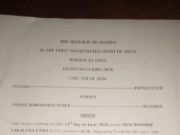









A flyer is making rounds again on WhatsApp and Facebook, the same one that surfaced in 2024 claiming that 30 Members of Parliament would be summoned to CID Kibuli on Monday, 17th June 2024 at 10:30 am and thereafter arrested for corruption in the 11th Parliament.
The names are listed in full: Hon Joel Ssenyonyi (former LOP), Hon Ibrahim Ssemujju Nganda, Hon Fox Odoi-Oywelowo, Hon Florence Asiimwe, and at number 5, Hon. Iddi Isabirye, former MP for Bunya South. The document looks urgent, but it has no letterhead, no signature, no case reference number, and no stamp of the Uganda Police Force.
Only one problem with this urgency: 17th June 2024 came and went, no summons was issued, no arrests were made, and CID Kibuli did not publish any statement on the matter.
The Uganda Police dismissed the document in 2024 as fake and misleading, reminding the public that criminal investigations are communicated through official channels and not through graphics designed for viral sharing.
Hon. Iddi Isabirye has since scoffed at his inclusion on the list, describing it as a product of idle haters. He noted that he served Parliament for two terms of five years each, acted as Vice Chairperson of the ICT Committee for five years, and walked those years without a shred of scandal, because real accountability has records, not rumors.
His reaction points to something deeper that is being lost in the digital age: in African society, and in scripture, it was taboo to spread rumors or propaganda about others, especially elders and leaders.
African Custom, Scripture, and the Sanctity of the Dead.
While the fake list circulates, another ugliness is unfolding. In sections of Kayunga and Jinja, some users are celebrating the death of Presidential Advisor Moses Kalisa Karangwa, who died on May 18 in a road accident.
Instead of condolences, they posted videos mocking the accident. Instead of silence, they turned the funeral into content.
For centuries across African societies, death was handled with deep sensitivity, collective mourning, and restraint. Among the Baganda, Basoga, Lango, Acholi and many other communities, the dead were not ridiculed because death was understood as a sacred passage, not a political weapon.
Elders taught that to mock the dead was to invite misfortune upon the living, and to spread falsehood about a person, living or dead, was to break the moral fabric that held the clan together.
The Bible reinforces this ethic in several places. Proverbs 11:13 warns that: “A gossip betrays a confidence, but a trustworthy person keeps a secret”, while Ephesians 4:29 instructs believers to “Let no corrupting talk come out of your mouths, but only such as is good for building up.”
Ecclesiastes 7:1 says, “A good name is better than precious ointment, and the day of death than the day of birth”, reminding us that dignity in death outweighs the noise of life. To celebrate a man’s death or to circulate a lie about his colleagues is to violate both custom and scripture.
What Scholars and Researchers Say About Death, Leaders, and Elders.
Anthropologists and social researchers have documented how African societies treated death and leadership with reverence because leaders embodied collective memory.
In his study African Religions and Philosophy, John S. Mbiti (Kenyan theologian and author) observed that among Africans, “Death is not the end of life, but a transition to the community of the living-dead, and therefore it demands respect, not mockery.”
To dance on a grave was not just cruel; it was cosmological disorder.
Political scientist Prof Mahmood Mamdani, writing on the post-colonial state in Africa, noted that when institutions weaken, “public discourse is replaced by rumor, and rumor becomes the currency of political struggle.”
The fake 30-MP list is exactly that: rumor weaponized to destroy reputations without trial, evidence, or due process.
Nigerian Communications scholar and media researcher Prof Nnamdi Ekeanyanwu, in research on social media and African values, found that: “the erosion of communal ethics on digital platforms has led to the normalization of grave-dancing, where the death of public figures is celebrated as victory.”
He warned that this culture will eventually turn on the celebrants themselves, because a society that does not bury its dead with dignity cannot protect its living with justice.
The Link Between the Lie and the Grave.
The recycled list and the celebration of Karangwa’s death are not separate issues. They are two expressions of the same collapse. One destroys the living through falsehood, the other disrespects the dead through mockery. Both are fueled by cheap data and a culture where people sacrifice money for supper to buy bundles, not to build up others, but to pull them down.
When custom breaks, law is next. Under the Computer Misuse Act, spreading false information about criminal proceedings is an offense, and content intended to ridicule the dead violates both the law and the communal values that the Constitution seeks to protect. More importantly, when a society loses the ability to mourn together, it loses the ability to govern together.
The Key Takeaway.
The 30-MP list is false. Police said so in 2024, the date has passed, and nothing in it happened. Do not forward it.
Moses Kalisa Karangwa is dead. He deserves respect, his family deserves privacy, and Ugandans deserve to remember him without the noise of digital grave-dancers.
Uganda has real corruption to fight. It has IGG files, DPP charges, and SH-ACU operations that move with evidence, not flyers. It also has a cultural and biblical tradition that says you do not spread rumors about others, you do not dance on graves, and you do not sacrifice your name for a moment of online applause.
Rest in peace, Moses Kalisa Karangwa. Our condolences to the family.
To the authors and forwarders of fake lists and death memes: custom is watching, scripture is clear, and the law is awake.
The TEU Position Statement. On Digital Grave-Dancing, Recycled Hoaxes, and the Erosion of Civic Decency.
At TEU, we do not flinch from hard truths, and we do not mince words when the public square is desecrated.
The dual spectacles unfolding on our timelines, a recycled 2024 hoax listing 30 MPs for phantom arrests, and the grotesque celebration of Presidential Advisor Moses Kalisa Karangwa’s death in Kayunga and Jinja are not mere “online banter.” They are symptoms of a civic pathology that must be named, condemned, and excised.
We Condemn the Manufacture and Circulation of Fake Lists.
The document purporting to summon and arrest 30 MPs on 17th June 2024 was debunked by Uganda Police in 2024. It has no letterhead, no case reference, no legal standing. Its resurrection is deliberate disinformation: a counterfeit brief designed to assassinate character, stoke panic, and pollute the discourse on real anti-corruption work by IGG, SH-ACU, and DPP.
To propagate it is to become a co-conspirator in a smear campaign. It is libel by retweet, defamation by forward. TEU considers this a direct assault on due process and the presumption of innocence.
We Condemn Digital Grave-Dancing as Moral Bankruptcy.
The mockery of Moses Kalisa Karangwa’s death is not political critique. It is negrophilic glee. It is the digital equivalent of dancing on a freshly dug grave.
For centuries, African cosmology treated death as a sacred threshold, not a spectator sport. Elders taught that to ridicule the departed was to invoke collective misfortune. Scripture concurs: “A good name is better than precious ointment, and the day of death than the day of birth” (Ecclesiastes 7:1).
What we are witnessing is the inversion of this ethic: a culture where data bundles are used to weaponize grief and monetize malice.
The Connecting Thread: Ethics Collapse, Institutions Bleed.
Both acts the hoax and the mockery are cut from the same cloth. They replace evidence with innuendo, and condolence with content. They treat reputations as disposable and mortality as a meme. Scholars like Mbiti and Mamdani have warned that when rumor replaces record, and when elders are not accorded reverence, the social contract frays.
A society that cannot mourn cannot govern. A citizenry that cannot verify cannot self-rule.TEU’s Call: Digital Self-Restraint and the Law of the Leveler.
We urge all digital users to exercise radical self-restraint. Verify before you virilize. Pause before you post. Remember that sickness and death are the ultimate social levelers. No title, no tribe, no political card immunizes anyone from the hospital bed or the hearse.
Today you celebrate another man’s funeral. Tomorrow, your own family may be the trending topic. The algorithm has no loyalty, and the internet has no memory for apologies.
TEU Verdict: The 30-MP list is FALSE-cycled hoax, dismissed by Police in 2024, void ab initio.
Celebrating Karangwa’s death is INHUMANE. It violates Ugandan custom, constitutional dignity, and basic humanity.
Final Word.
TEU stands for forensic truth, not frenzied fiction. For institutional accountability, not individual humiliation. For journalism that illuminates, not platforms that incinerate.
To those trading in fake lists: Cease. To those dancing on graves: Desist.
Because in the end, the smartphone is not a sword, data is not a license for cruelty, and no one is beyond the reach of mortality.
Rest in peace, Moses Kalisa Karangwa. Condolences to the bereaved.
To purveyors of hoaxes: The law is awake. History is recording.
We Expose. You Decide.