



























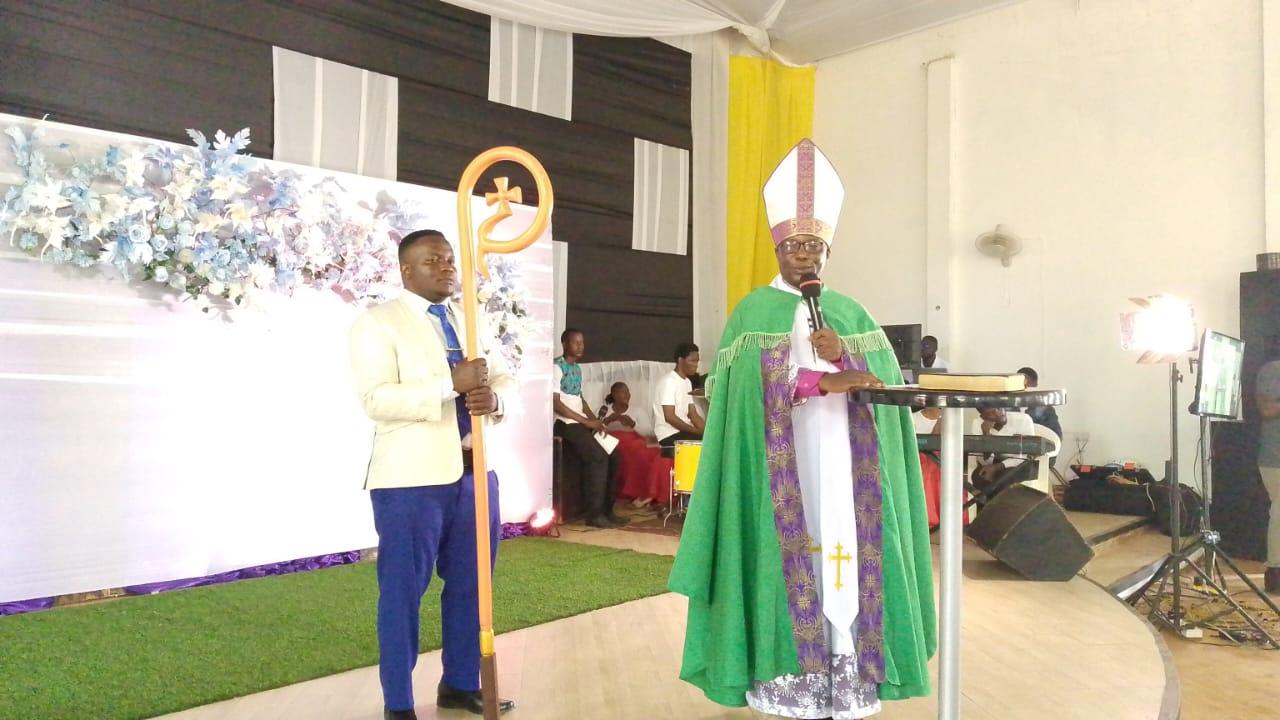
As Easter sets in, Archbishop-Elect Professor Mugume Bagambaki Richard the Ecclesiastical Episcopal Conference Archbishop of Upper City Covenant Churches wades into the annual bunny-versus-resurrection debate similar with the calm of a four-star general.
The academically and theologically decorated professor who is also President of Five-Fold Episcopal World Federation and President/Chancellor of UCCSAT University counsels Christians to spend less energy policing eggs and more joyfully proclaiming an empty tomb.
At The Exposure Uganda (TEU), We Expose, You Decide, and we bring you our esteemed readers his Easter reflection in full:
Easter Sunday, also called Resurrection Sunday, is one of the most significant Christian holidays on the calendar.
The day commemorates the resurrection of the Lord Jesus Christ, who showed Himself alive after three days in the tomb.
The first Easter Sunday changed everything, and every Easter Sunday after that reflects the joy, amazement, and worship those early disciples had when they first saw the risen Lord.
St Luke gives the account of what transpired that first Easter Sunday as the women followers of Jesus discovered the empty tomb: “On the first day of the week, very early in the morning, the women took the spices they had prepared and went to the tomb.
They found the stone rolled away from the tomb, but when they entered, they did not find the body of the Lord Jesus. While they were wondering about this, suddenly two men in clothes that gleamed like lightning stood beside them.
In their fright the women bowed down with their faces to the ground, but the men said to them, ‘Why do you look for the living among the dead? He is not here; he has risen!’” (Luke 24:1–6).
The Bible teaches that the resurrection of Jesus Christ was a physical raising of His body back to life (see Luke 24:39).
In Christian belief, Easter Sunday proved Jesus’ deity, confirmed His prophecies, validated the Scriptures, triumphed over the forces of evil, provided for our justification (Romans 4:25), and guaranteed the resurrection of all who trust in Christ.
Like Christmas, Easter Sunday is observed in various ways, religious and secular. On the secular side, Easter Sunday involves visits from the Easter Bunny (or the Easter Bilby in Australia); dyed eggs, hidden to be found later (or hung from trees in Germany); new clothes; family meals; and lots of candy.
On the religious side, Easter Sunday is about worshiping Jesus, attending church—including sunrise services—singing praises, and reading Scripture.
Christians often refer to Easter Sunday as Resurrection Sunday to emphasize the reason for the day’s observance.
Easter Sunday comes in the spring of each year (or in the autumn in the southern hemisphere) in March or April (or, in the Eastern Orthodox Church, in April or May).
Easter always roughly corresponds to the Jewish celebration of Passover, since Jesus was slain at Passover time (Luke 22:15; John 13:1; cf. 1 Corinthians 5:7) and rose again three days later.
Indeed, Easter is sometimes called Pascha, a word derived from the Hebrew pesach, meaning “Passover.”
Easter Sunday marks the end of Holy Week, the end of Lent, and the last day of the Easter Triduum (which starts the evening of Monday, Thursday and continues through Good Friday, Holy Saturday, and Easter Sunday).
On the liturgical calendar, Easter Sunday marks the beginning of the Easter season, a 50-day period that includes the Easter octave (the first eight days of the Easter season), the following five Sundays, the Ascension of the Lord, and Pentecost Sunday.
Various churches, including Roman Catholic churches, Anglican, Pentecostal, among others observe everything from Lent through Pentecost.
Other churches observe Easter Sunday and possibly mark Good Friday. It’s not a matter of legalistic obligation but of conscience: “One person considers one day more sacred than another; another considers every day alike. Each of them should be fully convinced in their own mind” (Romans 14:5).
Whatever date Easter falls, it is always on a Sunday. All of the Gospels state that Jesus rose from the dead on the first day of the week (Matthew 28:1; Mark 16:2; Luke 24:1; John 20:1, 19). And that event is foundational to all we believe as Christians:
“If Christ has not been raised, our preaching is useless and so is your faith. . .. And if Christ has not been raised, your faith is futile; you are still in your sins” (1 Corinthians 15:14, 17).
Jesus’ resurrection is certainly worthy of being celebrated (see 1 Corinthians 15).
Whether we use the term Easter or Resurrection Day or Pascha, it is good to commemorate the event that sealed our salvation and changed the world forever.
However, we choose to celebrate Easter Sunday, we should not allow the associated fun and games to distract our attention from what the day is truly all about—the glorious resurrection of Jesus from the dead.
Christ Himself should be celebrated every day, not just Easter Sunday. He is the Resurrection and the Life (John 11:25), and He is worthy of praise more than once a year.
Why should we a must celebrate Easter?
Easter is celebrated in countries throughout the world. For some, the traditional festivities center on welcoming the spring season, whereas in other countries the festivities are more religious in tone.
For many, Easter is simply a cultural holiday, a time to enjoy other people and eat festive food.
Church attendance might be part of the Easter celebrations of many, even if such religious observance is not a regular part of their lives.
For many Christians, Easter is a celebration joyfully anticipated throughout the year. It is often a time when those who don’t know Jesus Christ become curious about who He is.
Easter is a time when it might feel easier to share the good news of the salvation He brings. It is also a corporate celebration of the reality of Jesus’ resurrection and the life we have in Him.
Though we celebrate that reality all year long, Easter is a special time of remembering.
While the word Easter may have pagan origins and certain Easter traditions have absolutely nothing to do with the Bible, the real reason to celebrate Easter is to remember the work of Jesus Christ on the cross and to celebrate the reality of His resurrection.
Celebrating Easter is about rejoicing in the risen Christ. In the days leading up to Easter, we recount His horrific death on the cross. It is a death Jesus died willingly (Mark 10:45; John 10:18).
He came to earth as a baby in order to live a perfect human life and one day die as the sacrifice for sin.
At Easter time, generally on Good Friday, we remember His sacrifice and thank Him for it.
But it is not only Jesus’ death on the cross that is important. Jesus’ resurrection proclaims His victory over sin and death. Jesus was crucified, died, and was buried. Then He rose back to life, proving He is who He says He is and that He accomplished what He came to earth to accomplish.
Jesus Christ is fully God, fully human, and our only Savior. It is because He is risen that we can trust in His sacrifice for our sins and receive new life in Him.
His resurrection also demonstrates that His promise to resurrect us one day will come true.
The apostle Paul wrote, “For what I received I passed on to you as of first importance: that Christ died for our sins according to the Scriptures, that he was buried, that he was raised on the third day according to the Scriptures, and that he appeared to Cephas, and then to the Twelve.
After that, he appeared to more than five hundred of the brothers and sisters at the same time, most of whom are still living, though some have fallen asleep. Then he appeared to James, then to all the apostles, and last of all he appeared to me also” (1 Corinthians 15:3–8).
It is this important reality that we pause to focus on and rejoice in at Easter.
Easter is the time to celebrate Jesus’ victory and to celebrate the new life He gives. All can have their sins forgiven and experience new life in Him if they will receive Him in faith. It is fitting that Easter occurs in the springtime.
Much like spring is the time when new life grows after the death brought about by winter, so Jesus brings new life to those who were formerly dead in sin (Ephesians 2:1–10).
The life Jesus brings is eternal. We celebrate the reality of His death and resurrection every day, and especially at Easter. We can trust Him and worship Him all year through because He is risen!
Is it in order now Christians to celebrate Easter Sunday?
Yes, here we are, Easter Sunday approaching, and some days we receive more questions about the Easter bunny than we do about the death and resurrection of Jesus Christ.
Among Christians, there is a significant divide in convictions regarding Easter Sunday. Some Christians have the conviction that the Easter bunny and Easter eggs are innocent cultural traditions that can be incorporated into Easter Sunday. Other Christians are vehemently opposed to the Easter bunny and Easter eggs, pointing to horror stories involving pagan rituals and child sacrifices to spring fertility goddesses.
It is entirely true that the Easter bunny and Easter eggs traditions have decidedly non-Christian origins. There is some debate as to the precise origins, but it is pretty much universally accepted that their origins are in spring fertility rituals.
Why bunnies? Bunnies are very fertile creatures. Why eggs? Eggs symbolize new life about to blossom. Why spring? Winter symbolizes death, spring symbolizes a fresh start.
While there were undeniably some evil practices in some cultures regarding spring, and of course these practices should be completely avoided, the core concepts behind celebrating the arrival of spring are not inherently evil.
In a sense, spring can even be understood to symbolize the resurrection. Where there was once death (Jesus’ death and burial), there is now new life (Jesus’’ resurrection).
So, while Christians should never allow bunnies and eggs to become the focus of Easter Sunday, I do not think Christians should crusade for the absolute abolishment of such things. We must remember that the non-Christian world around us is just that — non-Christian.
We should not expect non-Christians to have the same beliefs, practices, and traditions as Christians.
Non-Christians see Christians boycotting Easter eggs due to spring fertility rituals that occurred 1000+ years ago as inane. Non-Christians inherently view the things of God as foolishness (1 Corinthians 2:14).
We do not need to add to this spiritual blindness (2 Corinthians 4:4) by behaving foolishly ourselves.
It is sad to see some Christians fighting so strenuously against Easter Sunday that they do not have time to celebrate what the day is supposed to be all about — the resurrection of Jesus Christ.
Fine, let’s start calling it Resurrection Sunday. But, if we are going to do that, shouldn’t we actually focus on celebrating the resurrection? Maybe if non-Christians see us joyfully and wholeheartedly celebrating the resurrection instead of harassing anyone who dares to paint an Easter egg or eat a chocolate bunny, maybe, just maybe, they might be curious as to what is different about us.
Imagine that! Christians being called peculiar for celebrating our relationship with Jesus Christ (1 Peter 2:9).
Christians being identified by their love for God and love for each other (John 13:35; 1 John 2:7-17).
Christians being known for what they stand for, not for what they stand against.
Ugandans have long been described as joyful party animals who celebrate anything from births, rains, promotions, birthdays of security officers, of boda-boda riders and Easter is another golden opportunity.
For Archbishop Mugume Bagambaki, that energy or zeal is not the issue, it is the way Ugandans remember and repeat: He is risen! He is risen indeed! Hallelujah!
About the author:
Archbishop-Elect, Professor Mugume Bagambaki Richard, heads the Ecclesiastical Episcopal Conference Archbishop of Upper City Covenant Churches, President of Five-Fold Episcopal World Federation, and serves as President/Chancellor UCCSAT University.
He is a prolific author with over 370 Christian books, literatures and teaching materials with works widely translated into more than 100 languages and circulated through Upper City Covenant Churches and UCCSAT University.
The same profile calls him “the most widely translated Ugandan author” in some institutional notes with writings on theology, discipleship and practical spirituality.