






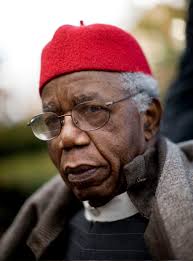
“When brothers fight to the death, a stranger inherits their father’s estate.” — Chinua Achebe, Arrow of God, Chapter 19.
In that scene, Ezeulu, Chief Priest of Ulu, warns the elders of Umuaro as colonial officers and missionaries watch their land. Divided, he tells them, they invite others to rule what should be theirs.
That warning from Achebe’s 1964 novel, written two years after Uganda’s independence, still speaks to African security today.
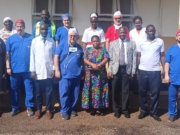
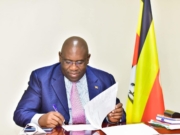
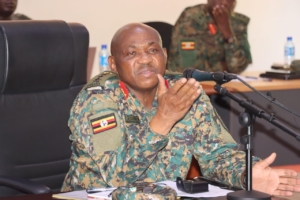
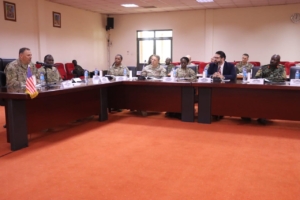
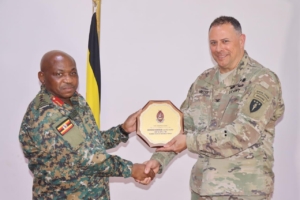
It framed the subtext of Friday’s engagement at the Chieftaincy of Defense Intelligence and Security (DIS)formerly called CMI in Mbuya, Kampala, where Uganda – US Defense ties were strengthened as Lt Gen Jack Bakasumba, Chief Joint Staff of the Uganda Peoples’ Defense Forces, hosted a delegation from the U.S. Army War College on behalf of Chief of Defense Forces Gen Muhoozi Kainerugaba.
Speaking during the meeting, Lt Gen Bakasumba offered the visitors an in-depth understanding of Uganda’s defense evolution, capacity building, and regional security contributions, a record that directly answers Ezeulu’s warning.
Rather than letting “strangers inherit” the region’s crises, Uganda’s 19-year deployment to Somalia, its operations in DRC and South Sudan, and its military-to-military partnership with the United States show brothers standing together so no one else claims the estate.
He traced the UPDF’s transformation from the early post-independence years, explaining that when Uganda gained independence on 9th October 1962, the British left behind a small but disciplined foundation through the “King’s African Rifles”, which later transitioned into the Uganda Army, then National Resistance Army, and now the Pro-people UPDF.
“Our history is long, complex, and transformative,” he said, further noting that “at every stage, we have grown stronger, more organized, and more professional.”
On training and capacity development, the CJS emphasized UPDF’s increasing need to attain self-reliance.
“Today, we are able to train our personnel from the basic level all the way to advanced strategic courses. However, we continue to welcome partnerships that enhance our capabilities and interoperability,” Lt Gen Bakasumba explained.
The CJS highlighted Uganda’s prominent role in regional missions, particularly its historic deployment to Somalia in 2007 under AMISOM to ATMIS and now AUSSOM, noting that Uganda became the first African country to deploy to the mission and has sustained its presence for 19 years.
“Somalia is almost 800 nautical miles away, but we responded because Africa needed us,” he said.
He commended the United States for its support in logistics, equipment, and training to UPDF, stressing that the mission remains “one of the UPDF’s proudest contributions to continental peace and security” while reaffirming Uganda’s strong defense cooperation with the United States.
He described the Uganda – US Defense partnerships as “one of our most important and reliable military-to-military partnerships.”
Lt Gen Bakasumba further highlighted UPDF’s ongoing operations in South Sudan and in the Democratic Republic of Congo, where Uganda continues to pursue the ADF at the invitation of the Congolese government.
“When your neighbor’s house catches fire, you help to put it out,” he said, underscoring Uganda’s Pan-African approach to shared security — the direct refutation of Ezeulu’s fear.
The head of the U.S. Army War College delegation, Col Miller Ronald, expressed his deep gratitude for the engagement, noting that learning directly from UPDF leadership was invaluable. He added that the team was impressed by Uganda’s role in promoting regional peace and stability.
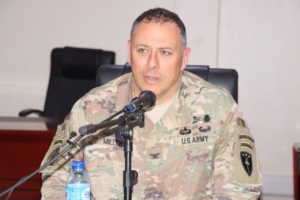
“The UPDF is widely recognized for its active contribution to peace and security across the region,” he remarked.
He noted that the U.S. Army War College has, in recent years, intensified efforts to expand its Africa-focused academic programs for the benefit of its allies.
“For a long time, Africa-related content within the institution remained limited, leaving many upcoming American strategic leaders inadequately informed about the continent’s evolving geopolitical importance. With Africa’s influence growing globally, this knowledge gap needed urgent attention,” Col Miller Ronald stressed.
Col Miller underscored the importance of understanding UPDF’s contribution to stabilizing the region, ranging from operations in the Democratic Republic of Congo (DRC) to counterterrorism efforts against ADF, engagements in Somalia, and monitoring of regional conflicts such as the situation in Sudan.
“Uganda is always a key destination for us,” he added, emphasizing that the visit helps future American strategic leaders understand Africa’s realities better.
The meeting was also attended by Brig Gen Godwin Karugaba, Joint Staff Logistics; Col Simon Mwebaza, Joint Staff Communications and Technology; Lt Col Christian Noumba, US Defense Attaché; and other senior officers of the UPDF.
Sixty years after Achebe wrote Ezeulu’s warning and sixty-four years after the King’s African Rifles became the UPDF, the message in Mbuya was unambiguous: Africa’s estate will not be inherited by strangers because its soldiers refuse to fight as brothers divided.
From Mogadishu to the Semiliki valley, Uganda runs toward the fire while others watch. And when the United States which is the world’s strongest military sends its future generals to study that doctrine at DIS, it is not charity but recognition.
As Lt Gen Bakasumba put it, this is ‘one of the most important and reliable military-to-military partnerships’ not because Uganda needs saving but because brothers who put out each other’s fires together secure the whole estate.