

















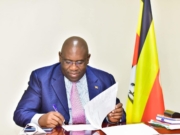




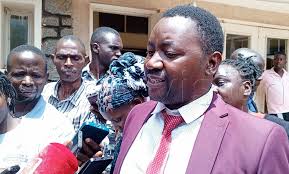
As the judiciary celebrated Court of Appeal Justice Dr. Fredrick Steven Martins Egonda Ntende’s retirement recently, the jurist used his farewell speech to issue a rare public rebuke: judicial officers must resist becoming “enablers” of rights violations by the powerful.
His remarks have now drawn fresh attention to the case of Jinja City Councilor-elect Julius Kayiira, alias Nabambula, who has spent nearly three months in Kirinya Prison on charges of criminal trespass and inciting violence.
This article does not address the merits or demerits of any pending criminal matter. It examines the broader concern raised by Justice Egonda Ntende: whether Uganda’s lower bench and law enforcement are consistently applying the principle of equal protection before the law, particularly when political and economic interests collide.
“Team Judiciary, which society treats its children like this?”
Speaking at a luncheon hosted by the Judiciary at its headquarters, Dr. Egonda Ntende urged colleagues to “stand firm” and let “nothing move you” from the constitutional duty to administer justice without fear or favor.
Without naming him directly, the judge referenced the detention of NUP deputy spokesperson Alex Waisswa Mufumbiro, whose children buried their mother (Edith Katende) while their father remained in custody.

He described the continued detention beyond the constitutionally mandated bail threshold as a failure of judicial courage.
“Team Judiciary, I am here to ask us to reflect on the question— which society treats its children like this?” he asked, invoking the biblical call to pursue what is “true, noble, right, pure, lovely and admirable.”
Justice Egonda Ntende’s remarks were widely reported by the independent Daily Monitor under the Nation Media Group (NMG), Mulengera News (owned by veteran journalist John Serwaniko), and other outlets, amplifying the debate on judicial independence ahead of his retirement to his farm in Jinja.
The Nabambula Case: Competing Complaints, Divergent Outcomes.
Councilor-elect Julius Kayiira has been in detention since early this year 2026. Police charged him with criminal trespass and inciting violence, allegations arising from a wetland issue in Jinja City and a not so clear election related one.
What has fueled public debate is the sequence of events preceding his arrest. Late last year, Kayiira filed a complaint with the National Environment Management Authority (NEMA) and petitioned the President, alleging malicious damage and wetland degradation against businessman Patel M. Magan, who owns multiple industries in Jinja and Busoga, including the former Odokomit Cotton Ginnery in Lira, now Nile Agro Industries Ltd
Patel was arrested by armed men in military uniform and taken to Kampala following a NEMA order.
Hours after the arrest, NEMA issued a brief statement owning the arrest of Patel: “five suspects including the investor reported to be of Asian origin were arrested during an operation conducted on Sunday 28th December, 2025 and transferred to Kampala to facilitate further investigations. In the course of the operation, five Sino trucks and two tractors suspected to have been used in the illegal activity were impounded. Two of the suspects were later released on police bond on medical grounds”, the press release read.

Kayiira had also lodged a formal complaint at CPS Jinja on the same matter with regards to fish ponds that were allegedly damaged.
 According to sources familiar with the file, that complaint has since been “permanently closed” after the officers handling it were allegedly “well facilitated.”
The Exposure Uganda (TEU) has not independently verified the circumstances of the closure, and no official statement has been issued by Uganda Police Force as of press time.
Shortly afterward, Patel’s associate, Francis Baganzi, lodged a complaint of alleged criminal trespass against Kayiira leading to his arrest by police attached to the Flying Squad.
It is that complaint that has kept the councilor-elect in Kirinya Prison for about three months, with no clear indication of when bail or trial will proceed.
Legally, both matters involve cognizable offenses under the Penal Code Act and NEMA Act. The question for observers is procedural consistency: if one complaint can proceed to arrest and detention, why has the counter-complaint been closed without public explanation?
A Systemic Question Beyond One Case.
The concern is not limited to Kayiira. Legal aid lawyers and rights groups in Busoga and beyond have long argued that many Ugandans languish on remand over petty offenses because the complainant is well-connected, or simply because the accused is poor, politically isolated, and lacks the means to secure legal representation or bail.
When a complaint by a person of influence moves swiftly through the system while a similar complaint by a lesser-known citizen stalls or disappears, it breeds the perception of a two-tier justice system.
Article 21 of the Constitution prohibits discrimination and guarantees equal protection of the law. Article 28 guarantees the right to a fair and speedy hearing. Where those principles are not visible in practice, public trust erodes.
Justice Egonda Ntende invoked the precedent of Chief Justice Emeritus Benedicto Kiwanuka and Chief Magistrate Kityo’s stand against Idi Amin’s directive to jail women for wearing miniskirts.
He reminded the bench that the doctrine of separation of powers applies even in the absence of Parliament, and that sanctioning judicial officers lies with the judiciary, not the executive.
“The required level of courage by individual judicial officers is achievable once each one of them puts Godliness over and above all their respective fears,” he said.
The Legal Principle at Stake.
The doctrine of nemo judex in causa sua a Latin for “no one should be a judge in their own cause”, which underpins the expectation that state actors resist external influence. Judicial officers and police are bound by the Judicial Code of Conduct and Police Standing Orders to avoid both actual bias and the appearance of bias.
Section 14 of the Judicature Act empowers courts to grant bail, and Article 23(6) of the Constitution makes bail mandatory after 60 days for offenses triable by the High Court and 48 hours for others, unless sufficient cause is shown.
Where those timelines are exceeded without clear justification, the burden shifts to the state to demonstrate why continued detention serves the interests of justice.
TEU’s Stand: Journalism Without Fear or Favor.
At The Exposure Uganda, our mandate is clear: we do not fear to tackle any topic, however sensitive. We are not for or against any individual, political party, or business interest.
Our role is to inform the public with facts, ask the questions that matter, and hold power to account within the bounds of the law.
We execute this work with fairness, professionalism, and objectivity. Where allegations are made, we seek verification. Where responses are due, we give space for them. Our loyalty is to the truth and to the public’s right to know, not to personalities or patronage.
What Next?
Justice Egonda Ntende’s parting shot was a question, not a judgment: “Team Judiciary, what happened? Where is your Kityo and Wambuzi at this hour?”
For Jinja, the immediate test lies with the magistracy handling Kayiira’s matter and with the Uganda Police Force’s Directorate of Professional Standards Unit(PSU).
Will the court determine bail and trial dates in line with constitutional timelines? Will the DPP review why the complaint filed by Kayira against Patel was closed, and whether reopening it is warranted in the public interest?
For the justice system nationally, the test is whether Justice Egonda Ntende’s call for courage translates into consistent application of the law, regardless of who the accused or complainant is, and regardless of whether the accused is known or unknown, rich or poor.
As the saying goes, justice must not only be done, but must be seen to be done. In a democracy, the sight of justice is as important as its substance.
TEU Editor’s Note: This article report is on public statements made by a retiring judge at a public judicial event and on allegations regarding police case files that are circulating in the public domain.
It does not seek to adjudicate the guilt or innocence of any party. The principle under discussion is equal application of the law under Article 21 and 28 of the Constitution of Uganda.