



















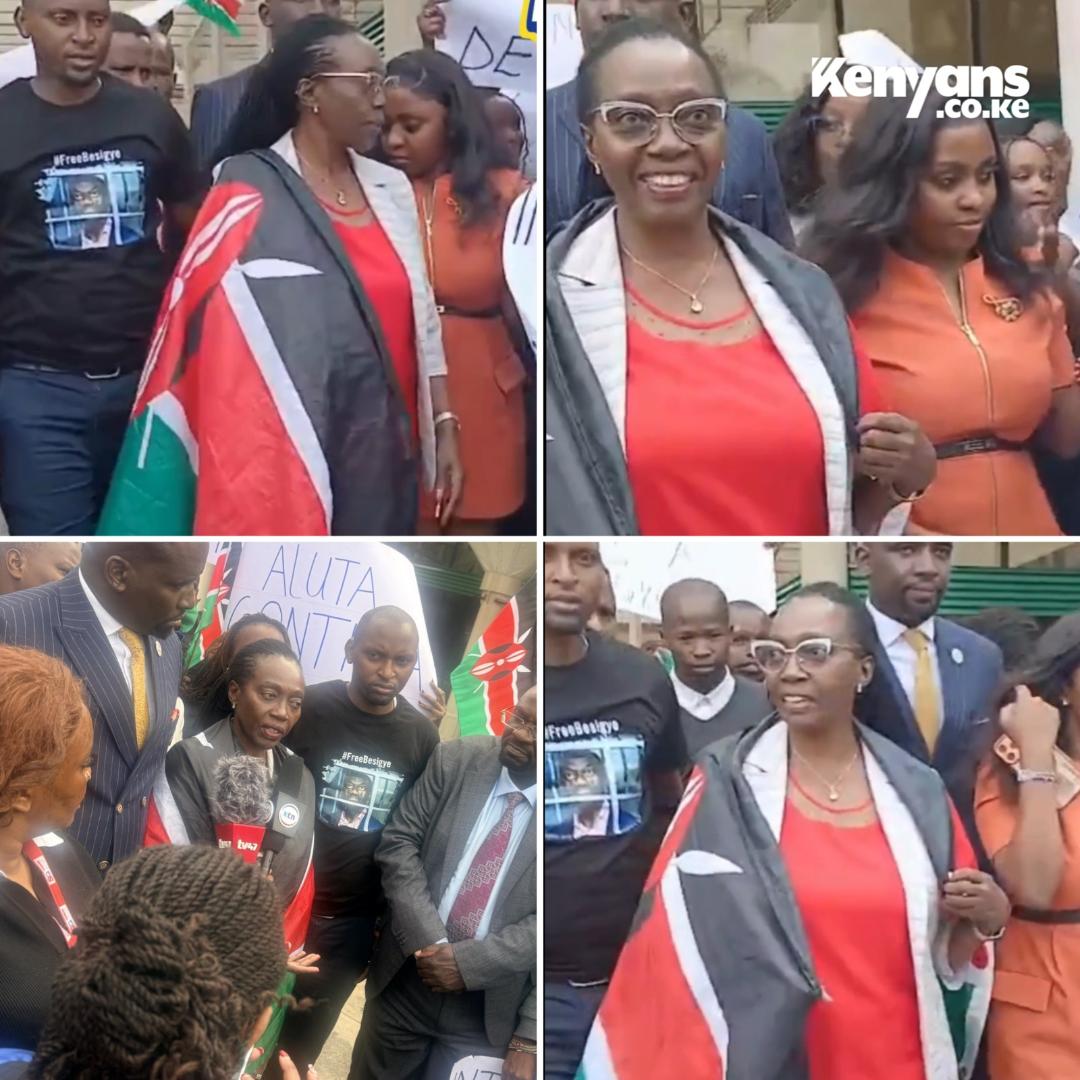
The decision on Monday 22 June, 2026 by Ugandan immigration officials to deny entry to Kenyan Senior Counsel Martha Karua at Entebbe Airport has set off two parallel debates. One is about law and treaty obligations. The other is about politics and motive. At the center of both is a Latin phrase rarely used outside diplomatic circles: persona non grata.
Lubogo: The Legal Test of Sovereignty and Due Process.
Legal scholar Isaac Christopher Lubogo argues that the Karua incident should be read first as a constitutional and regional law question, not a political one. He does not dispute Uganda’s sovereign right to control its borders. Every state can admit or exclude non-citizens. His concern is how that power was exercised.

Under Uganda’s Constitution, administrative decisions that affect rights must be just, fair, and give reasons. Lubogo stresses that a person denied entry should know the legal basis for the decision, not just receive a label. The label used in Karua’s case was “persona non grata.”
Lubogo points out that this term comes from diplomatic law, specifically Article 9 of the 1961 Vienna Convention on Diplomatic Relations. In that context it applies to accredited diplomats declared unwelcome by the host state. Uganda’s Citizenship and Immigration Control Act has no standalone category of “persona non grata” for private citizens, lawyers, or service providers.
For Lubogo, the principle is simple: in law, a label cannot substitute for a reason. Without citing a specific statutory ground such as threat to public security, the decision risks being arbitrary.
The timing makes the legal question sharper because Karua had previously received authorization to appear before Ugandan courts as lead defence counsel for Col Dr. Kizza Besigye and Hajji Obeid Lutale in treason proceedings.
Her exclusion happened immediately before critical court appearances. Lubogo connects this to Article 28 of Uganda’s Constitution, which guarantees the right to legal representation of one’s choice, and to the broader principle of access to justice. Blocking defense counsel at the border, even temporarily, touches the integrity of the judicial process, he argues.
His strongest argument rests on the East African Community. The EAC Treaty commits Partner States to the rule of law, good governance and respect for human rights. The Common Market Protocol guarantees free movement of persons and services across borders.
It allows restrictions only on grounds of public policy, public security or public health, and only if those restrictions are lawful and proportionate. Lubogo cites the East African Court of Justice ruling in Samuel Mukira Mohochi v Attorney General of Uganda in 2011, where the Court held that Uganda could not deport a Kenyan lawyer based on sovereignty alone without due process and stated reasons.
For Lubogo, Karua’s case poses the same fundamental question: must all public power remain subordinate to law, or can it operate beyond accountability in the name of sovereignty?
Law Box: What the 1993 Act Says.
Immigration officials cited Uganda’s Citizenship and Immigration Control Act, Cap 66 of 1993 as the basis for denying Martha Karua entry. Under Section 13, an immigration officer may refuse entry to any non-citizen who lacks proper documents or who is considered a threat to public security, public order, or public health.
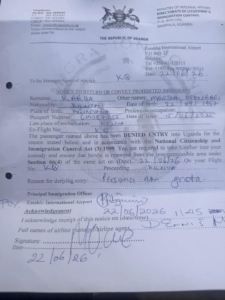
Section 15 goes further: it allows the Minister to declare a person a “prohibited immigrant” if their presence is believed to be “contrary to national interest” or “prejudicial to peace, order or good government.” Once refused, Section 18 gives officers power to detain and remove the person on the next available flight.
Note on wording: The phrase “persona non grata” allegedly used at Entebbe does not appear in the 1993 Act. That term comes from the 1961 Vienna Convention on Diplomatic Relations and applies only to accredited diplomats. Under Ugandan law, the correct legal description for a private citizen denied entry is “refused entry as a prohibited immigrant” or “denied entry on grounds of public order/security under Section 13/15.”
Legal analysts argue that citing the specific section and ground makes the decision easier to test in court and aligns better with Uganda’s constitutional duty to give reasons for administrative actions.
The Counter View: Political Positioning and “Political Hygiene”.
A different school of thought among Ugandan political analysts reads the incident through a political lens. From this perspective, Karua’s frequent presence in Uganda’s courts is not only about legal advocacy.
These commentators argue that Karua is leveraging the legal dispute to rebuild her political profile after her 2022 fallout with Kenya’s Independent Electoral and Boundaries Commission.
Karua had challenged the declaration of William Ruto as president, and the contest left her political standing bruised. With Kenya’s 2027 general elections approaching, they contend she is repositioning herself domestically as a champion of law, order and constitutionalism.
By appearing in high-profile regional cases, she presents herself as a defender of rights while projecting the image of a political angel who stands with the oppressed across borders.
They also point to her media strategy where Karua is, in their view, quick to grant interviews before and after every court session. That visibility, they argue, serves a dual purpose: it keeps her name in regional headlines and reinforces her image as a fearless legal voice. From this angle, the “legal excuse” becomes a platform for political branding.
On sovereignty, this school of thought insists that Uganda has every right to guard its political space. They describe the NRM government as a revolutionary one that came to power when few expected it to, and argue that it cannot be intimidated by noise or agitation.
The term they use is “political hygiene”, the idea that states must prevent the importation of external political contests that could destabilize domestic order. Karua’s role in Kenya’s political wars, they say, makes her presence in Uganda’s sensitive trials a potential conduit for imported agitation. Borders, they argue, protect more than territory, they protect political stability.
What Is “Persona Grata” and Where Does It Come From?
The phrase at the heart of the dispute has a specific legal history. Persona grata is Latin for “acceptable person.” Its opposite, persona non grata, means “unwelcome person.”
The concept entered modern international law through the 1961 Vienna Convention on Diplomatic Relations, which governs how states treat each other’s diplomatic missions. Article 9 of the Convention allows a receiving state to declare any member of a diplomatic mission “persona non grata” at any time, without giving reasons.
Once declared, the sending state must recall the person or terminate their functions. The rule exists to give host states a tool to remove diplomats deemed to have abused their privileges, while avoiding a public legal battle.
The key point is scope. The Vienna Convention applies only to diplomats and official representatives of foreign governments. It does not apply to ordinary travelers, lawyers, journalists, or business people.
Immigration law for non-diplomats operates under different statutes. In Uganda, the Citizenship and Immigration Control Act sets out specific grounds for refusal of entry, such as lack of documents, threat to public security, or prior immigration violations.
Declaring a private citizen “persona non grata” has no direct basis in that Act.
That is why Lubogo and other legal analysts argue the term was misapplied. If Uganda had security concerns, the Act provides grounds that can be cited. Using diplomatic language for a non-diplomat, they say, creates confusion and weakens the legal justification.
East Africa’s Unfinished Argument.
The Karua case now sits at the intersection of law and politics. Lubogo and legal analysts will keep asking whether the action met constitutional and treaty standards for due process and free movement. Political commentators will keep asking whether states must protect themselves from imported political contests, even if it means limiting movement.
The East African Court of Justice may eventually decide the legal side if a petition is filed. The political side will be settled in public opinion. For now, Entebbe Airport has become the stage where East Africa is debating the same question it has debated since 1999: how much sovereignty can a state keep while still honoring the promise of integration.
Conclusion: Sovereignty, Law and the Promise of Community.
The standoff at Entebbe leaves East Africa with a question older than the EAC itself: can a state be both sovereign and open? The answer will shape not only the fate of one lawyer at a border, but the future of how Partner States treat each other’s citizens in moments of political tension.
On sovereignty, the Westphalian tradition still echoes. French political philosopher Jean Bodin defined sovereignty in 1576 as “the absolute and perpetual power of a commonwealth.”
For Jean Bodin, the essence of a state was the final authority to decide who enters and who is excluded. That logic still drives the “political hygiene” argument: a revolutionary government that came to power against the odds cannot survive if it surrenders control of its political space.
Yet sovereignty without limits quickly becomes isolation. German philosopher Immanuel Kant argued in Perpetual Peace that the law of world citizenship must be limited to conditions of universal hospitality.
Kant’s principle was simple: no state has the right to treat a foreigner with hostility simply because they arrive on its soil. Hospitality, for Kant, was the first step toward a lawful community of nations. Applied to East Africa, that is the promise of the Common Market Protocol: that Partner States owe each other more than tolerance. They owe process.
Modern legal thinkers sharpen that point. Lord Bingham of Cornhill, one of Britain’s most respected judges, wrote that the rule of law means “all persons and authorities within the state, whether public or private, should be bound by and entitled to the benefit of laws publicly made.”
In Isaac Christopher Lubogo’s terms, that is the demand for reasons. Power, even at the border, must speak in the language of law, not just labels.
And on inclusiveness, South Africa’s Justice Albie Sachs, who helped draft the post-apartheid Constitution, put it this way: “Democracy is not just about voting. It is about creating a culture where everyone feels they belong.”
The EAC Treaty borrowed that spirit. It does not promise a merger of governments, but it does promise a community where a Kenyan lawyer can stand in a Ugandan court without being treated as a threat by default.
So, the Counsel Martha Karua case becomes a mirror where one side sees sovereignty as a wall. The other sees it as a gate. Bodin reminds us why states build walls. Kant and Bingham remind us why they must leave gates with keys. Sachs reminds us that the point of both is to build a home where citizens of the region feel they belong.
East Africa will decide which philosopher it listens to most. But history suggests that states which choose walls alone rarely prosper, and communities that leave gates unguarded rarely survive. The task is balance. And that balance will define whether the EAC remains a treaty on paper, or becomes what its founders imagined: a community of law, dignity, and shared destiny.
We Expose, You Decide.