





193 UN Member States to Lock in 2030 Targets at High-Level Meeting on AIDS | Uganda’s Winnie Byanyima Leads Global Call.
New York/Kampala- All 193 United Nations Member States will convene at the UN Secretariat in New York on Monday June 22 and Tuesday June 23, 2026, for the High-Level Meeting on HIV/AIDS #HLM2026AIDS.
Held every five years since 2001, the HLM is the UN’s primary political mechanism for accountability and commitment in the global HIV response.
According to an email sent to The Exposure Uganda (TEU) by UNAIDS Communications, UNAIDS issued a correction confirming the official HLM dates as June 22-23, with side events beginning Sunday June 21, 2026.
The meeting will review progress against HIV since 2021 and adopt a new UN Political Declaration on HIV and AIDS to set global targets for 2030.
The 193 Member States: Why Geography Matters.
The UN comprises 193 sovereign states. By continent, the distribution is: Africa 54, Asia 46, Europe 46, North America 23, Oceania 14, South America 12. Africa’s 54 votes matter most because the continent carries the highest HIV burden, while Western Europe & Others control most donor funding. The Political Declaration requires consensus across all blocs.
Current Global HIV Status: 2024 Data. According to WHO/UNAIDS 2025 estimates:
Global burden: 40.8 million people were living with HIV globally at the end of 2024. An estimated 0.7% of adults 15-49 years worldwide live with HIV, but the WHO African Region remains most severely affected with 3.1% prevalence. Since the epidemic began, 91.4 million people have been infected and 44.1 million have died from HIV-related causes. In 2024 alone, 630,000 people died from AIDS-related illnesses.
Treatment gap vs 2030 targets: The global benchmark is the “95-95-95” target, launched by UNAIDS in 2014 ahead of the 2015 Sustainable Development Goals. It requires 3 steps: 95% of people living with HIV know their status, 95% of those diagnosed are on antiretroviral therapy, and 95% of those on treatment have suppressed viral loads.
When multiplied, 95% × 95% × 95% = 86%. The real goal is therefore 86% of all people living with HIV globally must be virally suppressed — the level at which new infections drop sharply because “Undetectable = Untransmittable”, or U=U.
In 2024, the world stood at 87% who knew their status, 77% on ART, and 73% virally suppressed. Uganda is ahead of the global curve, achieving 94-96-92 on the cascade in 2024.
Uganda: High Burden, Early Wins, Funding Pressure.
Uganda remains among the 10 countries with the highest number of people living with HIV. The Ministry of Health (MOH/UBOS 2024 data shows adult HIV prevalence at 5.2% with approximately 1.59 million Ugandans living with HIV. Key populations and young women aged 15-24 still face disproportionate risk.
But Uganda also counts breakthroughs: 96% of diagnosed Ugandans are on ART and 92% are virally suppressed. Mother-to-child transmission rates have dropped below 2%. Community-led testing and differentiated service delivery models pioneered in districts like Jinja are now cited as best practice by UNAIDS.
Uganda’s delegation at HLM2026 is expected to push two things: 1) protection of domestic HIV financing as donor assistance declines, and 2) fast-tracked access to long-acting prevention like lenacapavir for adolescent girls and key populations.
Scientific and Research Breakthroughs in Treatment & Prevention
The 2026 HLM arrives as science delivers new tools:
Lenacapavir: According to the UNAIDS email to The Exposure Uganda, UNAIDS described lenacapavir as “the most significant HIV prevention breakthrough in a generation”.
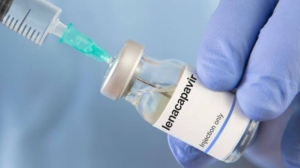
The twice-yearly injectable provides 6 months of protection and showed near 100% efficacy in trials. UNAIDS stated: “It exists because decades of science, political will, community advocacy and global investment converged at exactly the right moment”.
Uganda became one of the first 10 high-burden countries globally to receive lenacapavir, the twice-yearly injectable HIV prevention drug developed by Gilead Science.
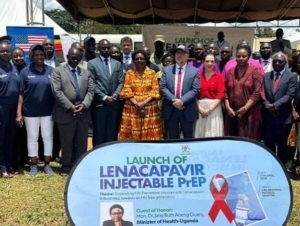
Uganda’s National Drug Authority (NDA) approved lenacapavir for use on 5 January,2026 after the US Food and Drug Administration(FDA) approval in June 2025.The first consignment of 19,200 doses donated by the Global Fund arrived on 24 February,2026, marking the launch of a new phase in HIV prevention under the US-Uganda partnership.
The Ministry of Health then under Dr Ruth Jane Aceng Ocero who is also the Lira City Woman MP officially launched the nationwide rollout at Lira Regional Referral Hospital.
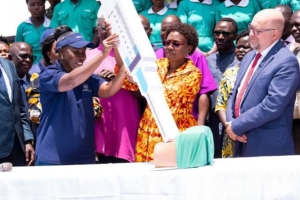
Dr Jane Ruth Aceng Ocero now the Government Chief Whip called it a historic milestone in Uganda’s journey toward ending AIDS as a public health threat by 2030.
Phase 1 started in April 2026 through 103 trained health facilities with plans to expand to 300 facilities by December 2026.
By April 2026 Uganda had distributed about 19,000 doses to more than 104 health facilities, prioritizing adolescent girls, young women, pregnant and breastfeeding mothers, sex workers, truck drivers and people in HIV-discordant relationships.
Clinical trials in Uganda showed lenacapavir was over 99% effective at preventing HIV when used as prescribed. Uganda is now among 8 African countries that had introduced lenacapavir for PrEP by April 2026.
Long-acting ART: Injectable antiretroviral therapy administered every 2 months is now approved and replaces daily pills for 31.6 million people on treatment. The HLM thematic panel on June 22, 16:30-18:00 ET will address equitable access to these innovations.
mRNA vaccine and bNAb research: Multiple clinical trials are advancing mRNA-based HIV vaccine candidates and broadly neutralizing antibodies, building on COVID-19 vaccine technology. While no cure exists yet, researchers report the strongest pipeline since 1981.
Funding Crisis Threatens Gains.
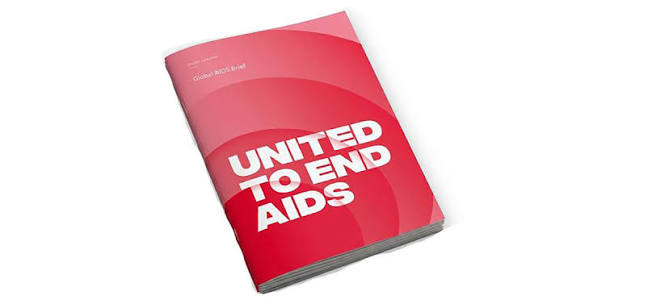
UNAIDS’ Global AIDS Brief released ahead of HLM2026 warns that development assistance fell by 23% in 2025, the sharpest drop on record.
HIV testing programmes dropped 22% in high-burden settings, PrEP uptake fell 38% across 62 countries, and condom funding was cut by more than 90% in some cases.
UNAIDS also documented a rollback of rights, with criminalization of marginalized populations increasing for the first time since tracking began.
Winnie Byanyima: Ugandan Voice Leading UNAIDS.
UNAIDS Executive Director and Under-Secretary-General of the United Nations Ms. Winnie Byanyima, a Ugandan national, is leading the global response at HLM2026.
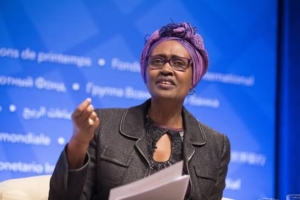
She is married to opposition political icon Col. Dr. Kizza Besigye, who is currently battling treason charges at Luzira Maximum Prison where he has spent more than 400 days.
Quoting directly from the UNAIDS HLM2026AIDS newsletter/email sent to The Exposure Uganda, Byanyima stated:
“Our job is to remind the world that now is not the time to step back. It is the time to finish what humanity started decades ago with such courage and solidarity. The Political Declaration agreed at this High-Level Meeting matters because it is how we recommit governments to shared responsibility and measurable progress.”
She added that the convergence of science and political will is “now under threat” and described the HLM as “the most consequential HLM since 2001” because political will and funding, not science, are what is being lost.
HLM2026 Program Highlights
June 22, 15:00-16:30 ET: Thematic Panel 1 on resilient systems and sustainable financing.
June 22, 16:30-18:00 ET: Thematic Panel 2 on equitable access to science, technology and innovation.
June 23, 10:00-11:30 ET: Thematic Panel 3 on community leadership.
Side events include “Delivering the HIV prevention ambition” on June 22, 13:15-14:30 ET and “One-person, multiple diseases” on June 23, 13:15-14:30 ET.
All events will stream live on webtv.un.org.