


























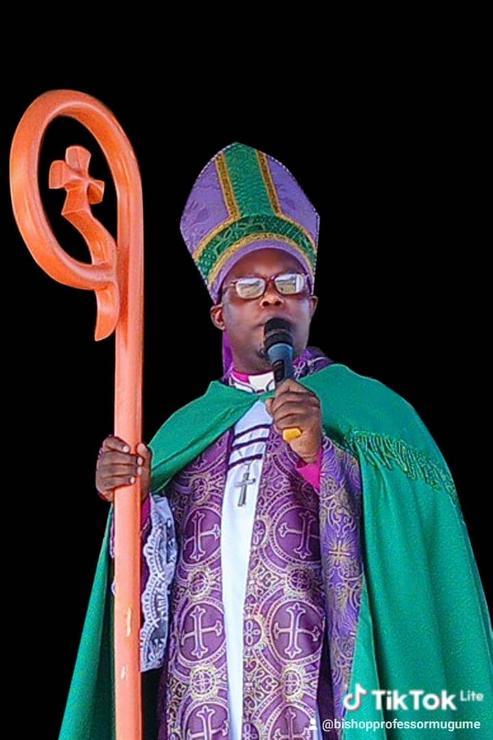
The Most Rev. Archbishop-Elect Professor Mugume Bagambaki Richard has waded into the heated debate over tithing, saying the Church must not throw away biblical giving because of abuse, but must teach it with truth, grace and accountability.
Speaking during Part 2 of his series “Biblical Principles Challenging a Christian Life”, the Ecclesiastical Patriarch of Five-Fold Episcopal World Federation and Archbishop of Upper City Covenant Churches said the growing claim that tithe and offerings are outdated “Old Testament taxes” with no spiritual value is both misleading and dangerous.
The Theology of Stewardship: Nothing Is Ours.
At the heart of the teaching, Archbishop Mugume placed the question of stewardship. “We came into this world with nothing, and we will leave with nothing, everything belongs to God. He has simply appointed us as stewards to serve Him and to serve humanity,” he said.
That, he explains, is why giving is not about losing, but about returning. Tithe acknowledges God’s ownership. Offering expresses our love and gratitude. Both remind believers that money, time, and talents are not personal property but resources entrusted to us.
“The question is never ‘how much of mine should I give to God?’ The question is ‘how much of God’s should I keep for myself?’” the archbishop says.
Understanding The Terms.
To bring clarity, Archbishop Mugume returned to the Hebrew. Ma’aser or Dekate means “a tenth” — 10% and it was fixed. Leviticus calls it holy to the Lord, meaning it already belonged to God before it was given. Korban or Dorea means “a gift, a voluntary present.” It had no fixed amount.
Historically in Israel, Ma’aser sustained the Levites who had no land, supported the Temple, and provided for the poor every third year. Korban was brought when someone wanted to worship, give thanks, make a vow, or restore fellowship. One addressed covenant duty. The other expressed covenant love. “Tithe trains us in priority, offering trains us in sacrifice,” the archbishop maintains.
Addressing The Criticism.
In recent years, some scholars and theologians have argued that tithing belonged only to Israel’s Temple system and Levitical priesthood. With no Temple today, they say the practice expired.
Others have been harsher and they argue that whatever believers give as tithes or offerings never reaches God, but only ends up with reverend fathers, pastors and lay readers. Some dismiss the Church altogether as a social club or business entity employing workers called clerics.
They quote(out of context) John 4:24 — “God is spirit and those who worship Him must do so in truth and spirit” — to say money has no place in worship.
Archbishop Mugume does not dismiss the concern. He agrees that pressure, guilt and secrecy have wounded many believers.
“When accounts are hidden and the poor are ignored, that is not worship. That is exploitation. Critics are right to be angry at abuse. But they are wrong to throw away Scripture because of it,” he said.
He explains that biblically, giving has always passed through human hands to accomplish God’s purposes. In the Old Testament, grain, animals and money did not ascend to heaven. They fed priests, sustained the Temple, and cared for widows and strangers. Yet Scripture calls it “a pleasing aroma to the Lord.”
“God chose to work through people, when you support the House of God, the Man of God, and the Poor, you are giving to God,” he says.
Jesus Himself affirmed this in Matthew 25: “Whatever you did for the least of these, you did for me.” The New Testament does not command dropping money from the sky. It teaches support for those who labor in the Word and for those in need. “The worker deserves his wages” 1 Corinthians 9:14.
On the claim that the Church is a business, the archbishop draws a distinction. “A business exists to make profit. The Church exists to make disciples. A social club exists for members only. The Church exists to serve the world.” He warns leaders against treating members as customers and offerings as revenue.
What Offerings Were For In The Old Testament.
Archbishop Mugume teaches that offerings were never primarily about money but are about relationship. They provided atonement for sin to restore fellowship, worship and thanksgiving for God’s provision, dedication and covenant to consecrate people to God, fellowship where families ate before the Lord, and provision for ministry and the poor. “It was and should be a lifestyle of worship, not a transaction.”
Who Was Supposed To Pay?
In Israel, offerings were open to all: rich and poor, men and women, individuals, families, and the whole nation could bring them. Even foreigners were allowed. The requirement was not wealth but willingness — “from a willing heart.” That same principle carries into the New Testament where every believer is called to present themselves as a living sacrifice. The widow with two mites remains the model, not because of the amount, but because of the heart.
Who Benefited?
The beneficiaries were layered, God received the worship, the priests and Levites received portions to sustain full-time service. The worshiper and family ate from fellowship offerings. The poor, widows, orphans and strangers were provided for through gleanings and first fruits. “That same order should guide us today: The House of God, the Man of God, and the Poor.”
The Types And Timing.
The five main offerings in Leviticus spoke to different needs. The Burnt Offering was total dedication. The Grain Offering was thanksgiving for daily work. The Peace Offering celebrated fellowship. The Sin Offering dealt with unintentional sin. The Guilt Offering required restitution. Beyond these were freewill offerings, first fruits, wave offerings, vow offerings, and the Temple tax.
Timing was constant. Daily morning and evening offerings, weekly Sabbath offerings, monthly New Moon offerings, annual feasts, and offerings as needed when someone sinned or made a vow. The Temple never stopped. Giving was woven into the rhythm of life.
Tithe And Offerings in The New Testament.
The archbishop says the New Testament does not re-impose the Levitical tithe on the Church, but it does not cancel the principle of proportion and priority. Abraham tithed before the Law. Jesus affirmed generosity while condemning hypocrisy. The apostles taught systematic, proportional giving on the first day of the week, and emphasized cheerfulness over compulsion.
“The early church practiced radical generosity. They gave as they purposed in their heart. Paul’s instruction was clear: give willingly, cheerfully, and not under compulsion,” he said. “That is the shift from law to grace. From obligation to devotion. From 10% to 100% surrender.”
Accountability, Transparency and The Danger of Coercion.
Archbishop Mugume then turned to one of the most painful areas in the current debate: how church resources are used and how believers are treated.
He condemned practices where Christians are coerced into giving or made to feel guilty if they do not meet financial targets.
“Christians should not be coerced into giving or tithing. They should be taught. God loves a cheerful giver, not one who gives because he is afraid or embarrassed,” he said.
The archbishop expressed concern over reports that in some churches, reverends and lay readers are punished through transfers or denied allowances because they have not met targets set by leadership. He also decried the culture of multiple baskets and constant appeals during Sunday services that leave believers strained.
“When people leave church more anxious about money than they came in, we have undermined the purpose of Sunday fellowship. Worship becomes a marketplace,” he said.
He called for full accountability and transparency in the utilization of resources given by Christians. Churches must publish budgets, explain expenditures, and allow questions. Leaders must show that money is used for the House of God, the Man of God, and the Poor — in that order.
“If we demand faith from the people, we must also demand integrity from ourselves. Transparency builds trust. Secrecy breeds suspicion,” Archbishop Mugume said. “Any leader who uses fear, threats, or manipulation to extract money is not representing Christ.”
Accountability, Transparency And the Danger of Coercion.
The most pointed part of the address deals with how church resources are used and how believers are treated.
Archbishop Mugume condemned practices where Christians are coerced into giving or made to feel guilty for not meeting financial targets.
He expresses concern over reports that some clergy are punished through transfers or denied allowances for failing to meet financial targets called quotas. He also criticizes the culture of multiple baskets and repeated appeals during services.
“When people leave church more anxious about money than they came in, we have undermined the purpose of Sunday fellowship. Worship becomes a marketplace,” he said.
He calls for full transparency saying that churches must publish/announce budgets, explain expenditures, and welcome questions. “If we demand faith from the people, we must also demand integrity from ourselves, transparency builds trust. Secrecy breeds suspicion, any leader who uses fear, threats, or manipulation to extract money is not representing Christ”, he counsels.
Academic Backing: Scholarship on Malachi 3:6-12.
The archbishop’s position finds support in recent scholarship. In a 2026 study published by Dr. Job Oluremi Okunoye of the Department of Religion and Development Studies at Ajayi Crowther University, Nigeria, the researcher argues that Malachi 3:6-12 must be read within its covenant context.
Dr Okunoye writes that for ancient Israel, tithe was tied to agricultural produce and its failure affected the entire community’s wellbeing. The “storehouse” existed to provide for ministry staff and for widows, orphans, foreigners and the poor.
Applying what he terms “principlism,” Okunoye contends that the Church today should not copy-paste agrarian law, but should retain the underlying values: sustenance for ministry, care for the poor, and acknowledgment of God’s ownership.
He argues that in the New Testament, tithing is subsumed into the broader principle of giving that is voluntary, generous and cheerful as taught in 2 Corinthians 9:7.
For context: principlism is an approach to applying Old Testament laws to today’s context. It says extract the enduring principle behind the law, then apply that principle in a new covenant way.
Writing against the backdrop of economic decline, poverty and inflation, Okunoye urges the Church to reclaim giving as a tool for poverty alleviation and job creation, not just for institutional survival. He also warns against preaching Malachi legalistically to create fear of curse.
Pastoral Application.
Archbishop Mugume closed with an appeal to both believers and leaders. Teach both tithe and offering without manipulation, he said. Tithe teaches that God owns everything. Offerings reveal the posture of the heart.
“God is not after your money. He is after your heart. When the heart is right, stewardship follows. We are managers, not owners. We serve a God who gave everything, so we give back in worship,” he said.
“The problem is not the tithe. The problem is sometimes the heart of the giver, and sometimes the heart of the receiver. Let us correct both. We don’t give to get. We give because Christ gave all for us. That is the gospel of generosity.”
For teachings contact:
The Most Rev. Archbishop Elect Professor Mugume Bagambaki Richard
Ecclesiastical Patriarch, Five-Fold Episcopal World Federation
Archbishop, Upper City Covenant Churches
Tel: +256 775 050183 | Email: fivefoldepiscopalworldfederati@gmail.com
Reference
Okunoye, J. O. (2026). The exegetical and theological significance of tithe and offering in Malachi 3:6-12 for the survival of the Church in a declining economy. Department of Religion and Development Studies, Ajayi Crowther University, Oyo, Nigeria.