













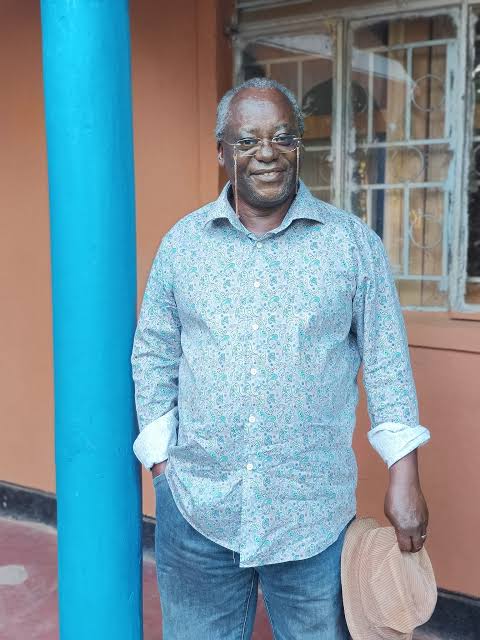
By Oweyegha-Afunaduula F C (Center for Critical Thinking and Alternative Analysis Uganda).
Every morning, Kampala and major cities and towns choke on smoke. Every rainy season, drains block and the cities flood. Far in Kigezi, Lake Bunyonyi, once Uganda’s postcard jewel, now turns brown, smells foul, and carries an oily film with white foam that clings to canoes. Government tests confirm critically low oxygen. Parliament debates, NEMA issues reports, and nothing changes.
Why?
A new scholarly article by Conservation Biologist Oweyegha-Afunaduula F C of the Center for Critical Thinking and Alternative Analysis Uganda, September 2026, titled Why Environmental Perception Matters in Righting the Wrongs in Environmental Management: Uganda in Perspective, argues the answer is not lack of laws or lack of money. It is lack of right perception.
Where Is This Lake and What Kind Of Lake Is It?
For a reader who has never been to southwestern Uganda, Lake Bunyonyi needs proper introduction.
It is located 7 kilometers west of Kabale town, on the border of Kabale and Rubanda districts in the Kigezi highlands, about 410 kilometers southwest of Kampala and very close to the Rwanda border. It sits at 1,962 meters above sea level, higher than most of East Africa, ringed by terraced mountains that rise 600 meters above its surface.
It is not an ordinary lake. It is a lava-dammed lake, formed about 18,000 years ago when a volcanic eruption from the Virunga chain blocked a river valley near present-day Muko village. The blocked river had nowhere to go and became a lake 25 kilometres long and 7 kilometres wide, covering 61 square kilometres. It is the largest and highest of the three small Kigezi lakes, alongside Lake Mutanda and Lake Mulehe.
Bunyonyi is famous for four reasons. It has 29 islands, including the infamous Punishment Island where the Bakiga once abandoned unmarried pregnant girls. Its name means place of many little birds and it hosts over 200 bird species. It is one of the few lakes in East Africa free of bilharzia, crocodiles and hippos, so people swim in it. And it appears on Uganda’s old 5,000-shilling note and is marketed as Africa’s second deepest lake. Scientific literature quotes a maximum depth of 40 meters, but tourism brochures insist it is 900 meters deep, which would make it second only to Lake Tanganyika.
That mythologized status is why when it turned brown in 2024-2025, Uganda paid attention. Government chemists found high Biological Oxygen Demand and Chemical Oxygen Demand, a signature of organic pollution from decaying vegetation and wastewater, and critically low oxygen threatening fish and domestic water.
The Ministry of Water and Environment ruled out volcanoes and listed culprits: uncontrolled runoff from bare steep slopes and deforestation, stone quarrying and iron ore mining within the catchment, poor sanitation at Harutindo landing market, and possible waste discharge from 46 hotels now on the shoreline. Parliament deferred debate after Shadow Minister Christine Kaaya called the rapid assessment shallow and reactive.
Uganda’s Numbers As Perception Failure.
If you want to understand Bunyonyi, look up from the water to the hills. Those hills used to be forest. According to the National Forestry Authority, Uganda’s forest cover has collapsed from 24 percent in 1990 to just 12.7 percent today. The FAO’s Global Forest Resources Assessment 2025 shows from 4.55 million hectares in 1990 to 2.37 million hectares in 2025, a 48 percent reduction, with Uganda still losing an average of 38,000 hectares every year between 2020 and 2025.
The forest is not just shrinking, it is thinning. The volume of living trees fell from 447 million cubic metres in 1990 to 233 million cubic metres in 2025. At the same time, Uganda generates more than 600 tonnes of plastic waste daily, with less than 40 percent properly collected, while 94 percent of households still cook with wood biomass.
Bunyonyi is not alone. It is just the most photographed example of a national pattern, and this is a pattern Africa knows too well.
Other Lakes That Suffered The Same – And Where They Are Now.
To show this is not a Kigezi problem but a perception problem, it helps to look at other water bodies that experienced similar colour changes, shallowing or shrinkage from the same mix of deforestation, mining, farming and waste:
Lake Victoria, Africa’s largest freshwater lake, shared by Uganda, Kenya and Tanzania and source of the Nile at Jinja, has dropped by about a meter since the early 1990s.
At Murchison Bay where NWSC draws water for Kampala, nutrient-rich runoff, municipal sewage and silt have turned water green. In 1992 NWSC used 25 milligrams of alum per litre to treat water, today about 75 milligrams, costing 950 shillings per kilogram for 150 million litres daily. Current status: alive but eutrophied, expensive to treat.
Lake Chad in West Africa, once the eighth largest lake in the world shared by Chad, Nigeria, Niger and Cameroon, has shrunk by nearly 90 percent according to UNEP Atlas, from a vast inland sea to a swampy patchwork due to overuse of source waters and deforestation. Current status: functionally a wetland, not a lake.
Lake Nakuru in Kenya, a Rift Valley soda lake famous for millions of pink flamingos, suffered large-scale deforestation around its catchment plus industrial effluent that poured sediments into a shallow lake only 2.8 meters deep. Current status: flamingo numbers fluctuate wildly, often abandoning the lake for years.
Lake Baringo in Kenya, a freshwater Rift Valley Lake originally about nine meters deep, has reduced to about one meter in many parts due to siltation from overgrazed and deforested hills. Current status: heavily silted.
Lake Bunyonyi itself, even before the brown water, had in 2019 already lost 1.2 meters of depth due to silting from poor farming, threatening crayfish and tourism, and locals started planting vetiver grass to hold soil. Current status: still iconic and swimmable, but under a phased government plan for buffer zones and mining regulation.
What links all five is poor management of water catchments leading to excessive erosion and reduction of economic life.
The Paper That Says We Are Blind In One Eye.
In his paper, Afunaduula proposes what he calls the 4-Dimensional Environmental Framework, or 4-DEF. Environment is not a backdrop. It is a unified living system that is four-dimensional at once. The ecological-biological dimension is trees, fish, water and soil. The socio-economic dimension is how we farm, mine and build hotels. The socio-cultural dimension is what we believe about them, the taboos and indigenous knowledge. The temporal dimension is time itself.
When management focuses on only one dimension, the solution selected becomes a new wrong.
To explain why we see fragments, he leans on a tradition that began with British geographer William Kirk, a Scottish-born scholar and Professor of Geography at University of Leicester who in the early 1950s became one of the founders of behavioral geography.
In his seminal 1951 paper on the concept of the behavioral environment and later works between 1952 and 1963, Kirk argued that there are two environments operating at once.
There is the phenomenal environment out there, the hill and the water measurable by instruments, and there is the behavioral environment inside our heads, the same hill filtered through our senses, experience, culture and purpose, which is where we actually make decisions. For a farmer a forest is livelihood, for an industrialist it is raw material, for a tourist it is scenery, and that is why the same catchment produces conflict.
That insight was deepened by American-born, British-based historian and geographer David Lowenthal, who lived from 1923 to 2018 and was Emeritus Professor of Geography at University College London from 1972 to 1986.
A Harvard history graduate of 1944 who served as a geographer in the US Army in WWII, took his MA under the legendary Carl Sauer at UC Berkeley and his PhD at Wisconsin-Madison on conservation pioneer George Perkins Marsh, Lowenthal became world-famous for his books Geographies of the Mind and The Past is a Foreign Country, which won the British Academy Medal in 2016 and helped make heritage studies an academic discipline.
UNESCO described his work as revolutionary. Lowenthal argued that environmental awareness comes from personal perceptions and he gave geography its three realms, the nature of the environment, what we think and feel about the environment, and how we behave in the environment.
If Kirk gave us the filter through which we see, Lowenthal gave us the feeling that shapes what we see, and together they explain why a miner and a fisherman can look at the same Bunyonyi catchment and see two completely different lakes.
Afunaduula extends this into a Perception-Action Spectrum, from environmental knowledge to awareness to concern to wisdom to action, citing Ajzen’s Theory of Planned Behavior to explain the awareness-action gap where Ugandans are informed but fail to act.
From “I Am Because We Are” To “I Take Because I Can”
Most environmental perception studies reflect Western philosophy that casts humans as separate from environment, a position of dominion but always outside nature. This anthropocentrism is ontologically wrong, the paper argues, because humanity is integrated in food chains.
As corrective, he returns to Ubuntu, or Unhu in Zimbabwe, the philosophy that says I am Because We Are. If my personhood is made through my relationships with people and with lake and forest, then poisoning lake is self-poisoning.
Ancient African societies did not separate environmental knowledge, awareness, concern, wisdom and action. They were one spectrum designed to keep society inside its environment.
Modernisation has replaced collective perception with individualistic perception. What matters now is my benefit, my convenience, my immediate need.
How Do We Learn To See Again?
Afunaduula’s answer is not another ban. It is education. He takes UNESCO’s four pillars, learning to know, to do, to live together and to be, and retools them, adding learning to be a critical thinker and learning to use AI as partner.
He imagines new universities: interversities, crossversities, transversities that bring village elders and scientists to same table, and extraversities focused on action, alongside Team Science Learning Centres where biologists, economists, cultural leaders and young coders solve one catchment like Bunyonyi together. He ends with Timbuktu, not as myth of old books, but as model of holistic learning where moral, vocational and environmental knowledge were taught as one whole.
His final principle is simple: Beyond Scope Does Not Exist. Everything Is Connected to Everything Else.
CONCLUSION: The Brown Water Is Us — And Time Is Running Out.
Lake Bunyonyi did not poison itself. It was poisoned by how we see.
We see a hill and we see charcoal and quick money, not a catchment that holds soil. We see a mine and we see jobs and votes, not silt that will bury crayfish and swallow a tourism economy worth billions.
We see a lakeshore and we see a hotel plot, not a buffer that filters faeces before it reaches the water our children swim in. We see a forest as timber to be cut today, not as 233 million cubic metres of living capital that decides whether Kampala will breathe or flood tomorrow.
That is fragmented perception, and it is more dangerous than the polluter because it makes pollution logical. When you perceive environment as external to you, you can foul it without feeling you are fouling yourself.
The tragedy of Bunyonyi, Victoria, Chad, Nakuru and Baringo is not that we lacked science. The science was there: BOD, COD, alum costs, 90 percent shrinkage, flamingos fleeing. The tragedy is that we acted as if ecological, economic, cultural and future dimensions could be managed in separate ministries.
Until Uganda restores a whole way of seeing, we will keep writing perfect reports about dying lakes. We will count forest loss to one decimal place while we lose the forest. We will ban polythene bags while 600 tonnes of plastic are dumped daily because the person dumping sees convenience, not catchment.
Beyond scope does not exist. Everything is connected to everything else. A farmer’s hoe on a bare slope in Rubanda is connected to a tourist’s cancelled booking in Kabale. A vote to license iron ore on a hillside is connected to white foam clinging to a canoe. A decision to cook with charcoal today is connected to a child coughing in Kampala tomorrow.
The lake forgot how to be blue because we forgot that we are the lake.
If we want to right the wrongs, we must first right how we see.
The lake forgot how to be blue because we forgot how to see it whole.
At The Exposure Uganda, our slogan is We Expose, You Decide.