

















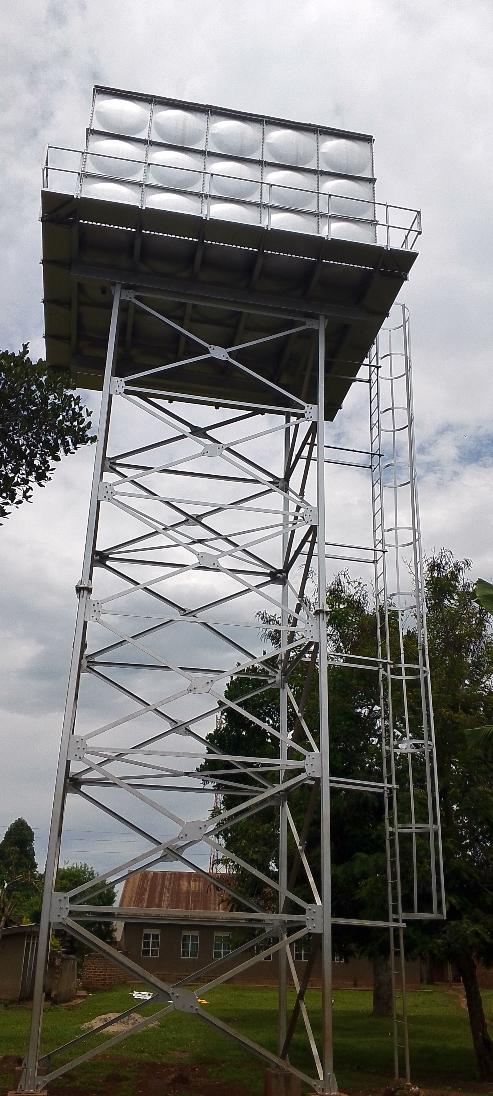
Jinja district has an adequate number of clean and safe drinking water sources including piped water. Yet 56,000 of its people still have nowhere to pupu. Every morning, 7.1 tons of fresh human faeces land in its bushes, banana plantations and on the shores of Lake Victoria and River Nile, the very water sources that feed the taps.
The Last Mile Contradiction.
That is the contradiction District Water Officer Alex Kyombo Fredrick is battling. Safe water coverage has risen to 78 percent including all safe sources that is piped water, boreholes, shallow wells and protected springs. The sanitation chain, however, breaks at the last mile. About 10 percent of homesteads still have no latrine.
“In the past people walked miles to look for water. Today water looks for the consumer,” Kyombo says. “Families now sit and wait for water in their homes. That is how far Jinja has come. But we have turned on the tap and forgotten the toilet.”
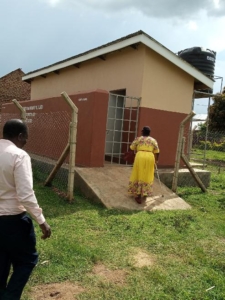
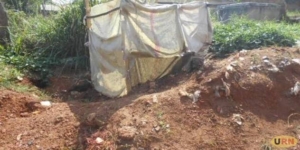 Courtesy photo of a makeshift pit latrine in Apac.
Kyombo says the reason for low latrine coverage is both poverty and beliefs. Even with increased awareness, a small section still believes it is culturally dangerous to pupu in a pit latrine. For the poorest, the cost of digging a proper pit and raising a slab remains out of reach.
“Two things keep us in the bush, poverty and mindset,” he says. “For some, the pit is still seen as a cultural taboo. For others, the pocket is empty. You cannot preach hygiene to a man who cannot afford a slab.”
Why The Bush Still Wins.
That belief shows in what exists on the ground. Some have dug a hole but left it open without a superstructure to support privacy, meaning during day time it cannot be used because it is open and the bush comes in handy. Others have built with poor structures like banana fibers and torn sacks that collapse when it rains.
Most latrines that exist are poorly maintained with swarms of flies welcoming anyone entering. Even where a latrine exists, handwashing after visiting is rarely practiced.
The Daily Tonnage.
The volume is staggering. World Health Organization studies show a normal adult produces 100 to 250 grams of faeces per day, average about 128 grams. Jinja’s combined population from the 2024 Census is 560,089 people. If 10 percent defecate in the open as the district estimates, that is about 56,000 people.
At 128 grams each, that is 7,168 kilograms or 7.1 tons every single day. That translates to about 215 tons a month and about 2,616 tons a year washed by rain into shallow wells and Lake Victoria.
Nationally, without visitors, Uganda’s 45.9 million people produce about 5,876 tons per day on the conservative average, and up to 11,476 tons per day on a high fiber diet of matoke and vegetables.
Piped Water Brings a Gender Dividend.
There is a slow shift. As piped water coverage extends, quite a number of families and communities are embracing water-borne toilets. Women and children no longer move far to water sites. That has a hidden gender dividend.
“A tap at home and a toilet at home is security for our women and girls,” Kyombo notes. “When girls no longer walk far to fetch water at dusk, we reduce defilement. When women no longer queue for hours at a borehole, we reduce domestic violence at home.”
New fears have come with that shift. Apart from the water bills, some people get frightened by the idea of a toilet inside a house where human beings live. They were raised to believe faeces must be far from the home. Others find it strange to sit and pupu because they are used to squatting.
Kyombo says sensitization campaigns are ongoing with a multi-sectoral approach embracing health workers, public health officers, the Ministry of Water and Environment, community development officers, social workers, religious and cultural leaders who now say culture is not static but dynamic.
Politicians have also come on board although some of them appear lukewarm during campaigns, fearing to squeeze voters on compliance and enforcement because they could lose elections. It is what many call populism, yet a leader should not fear guiding his people with the truth.
Policy Mandate & The Reactionary Cycle.
That district effort sits within a broader national mandate. According to its official website mwe.go.ug, the Ministry of Water and Environment is responsible for setting national policies, standards and managing water and environment resources to ensure sustainable management, development and equitable access to water and sanitation services for all Ugandans. Its Vision is a Transformed Ugandan Society with environment and natural resources sustainably managed. Its Mission is to promote efficient and effective utilization of water and environment resources for a healthy, wealthy and climate resilient population. On sanitation specifically, the Ministry lists as its Strategic Objective Number Two to increase access to safe water and improved sanitation facilities.
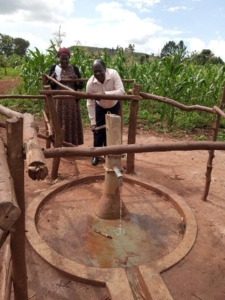
“We should not wait for cholera, Ebola or COVID to remember handwashing,” Kyombo warns. “For years we only wash hands and dig latrines when a pandemic is killing us. The moment the epidemic curve falls, we slide back to the bush. Sanitation is not an emergency response. It must be a daily discipline, in peace time and in crisis time.”
The practice is dangerous and risky in many ways. It spreads diseases to the family and community, it exposes people to snake bites and other dangerous insects like wasps in the bush, it is a sign of backwardness, and it is counter-productive to anti-poverty campaigns.
The Link Between Sanitation & Disease – Latest WHO Evidence.
This is the background that global health agencies have warned about for years. The WHO Fact Sheet on Sanitation updated on 21 March 2024 is categorical that poor sanitation is linked to transmission of diarrheal diseases such as cholera and dysentery, as well as typhoid, intestinal worm infections and polio. It exacerbates stunting and contributes to the spread of antimicrobial resistance.
One gram of infected faeces can contain 10 million viruses and 1 million bacteria, according to WHO. When openly dumped, rain washes it into shallow wells and Lake Victoria, flies carry it to food, and children ingest it while playing in bushes.
The latest global count is in the WHO/UNICEF Joint Monitoring Programme Report titled Progress on Household Drinking Water and Sanitation 2000-2024, released during World Water Week on 26 August 2025.
Global access to safely managed sanitation rose from 48 percent in 2015 to 58 percent in 2024, meaning 3.4 billion people still lack safely managed sanitation, including 354 million who still practice open defecation, down from 419 million in 2022. 1.7 billion people still lack basic hygiene at home. People in least developed countries are more than twice as likely to lack basic drinking water and sanitation.
The death toll is rising again. WHO Global Cholera Statistics published on 5 September 2025 show reported cholera cases rose by 5 percent and deaths by 50 percent in 2024 compared to 2023. Sixty countries reported cholera in 2024, up from 45 in 2023, with more than 6,028 deaths and 560,823 cases. Africa accounted for the highest deaths with a case fatality rate rising from 1.4 percent in 2023 to 1.9 percent in 2024.
The crisis deepened in 2025. Between 1 January and 28 September 2025, WHO recorded 518,324 cholera cases and 6,508 deaths from 32 countries, already surpassing the 2024 total. Eastern Mediterranean recorded the highest cases, Africa the highest deaths.
WHO notes cholera is caused by Vibrio cholerae which spreads rapidly through faeces-contaminated water, and that conflict, climate change, population displacement and long-term deficiencies in water, sanitation and hygiene infrastructure continue to fuel the rise. Safe drinking water, sanitation and hygiene are the only long-term sustainable solutions.
Beyond cholera, inadequate sanitation is a major factor in neglected tropical diseases including intestinal worms affecting more than 1.5 billion people, schistosomiasis and trachoma, according to WHO 2024. WHO estimates that every one dollar invested in sanitation returns nearly six dollars in lower health costs, increased productivity and fewer premature deaths.
The 2024 Census still puts open defecation at 6.7 percent of households nationally, 9.2 percent rural and 3.0 percent urban, well above the global average of 5 percent reported in JMP 2025.
From Shame to Wealth.
Uganda can now step-up efforts to turn that burden into a productive raw material as is being done in some developed economies where even municipal wastewater is recycled.
What Jinja sees as shame, other economies see as energy, fertilizer and protein. Swedish cities now generate 80 percent of biogas for city buses from sewage sludge, while Japanese utilities use human waste biogas to power hundreds of homes in Kobe. Thames Water in the United Kingdom generates electricity from London’s sludge to run 30,000 homes.
Israeli treatment plants now convert 90 percent of sewage sludge for use as fertilizer for orchards and forests, with treated wastewater recycled to irrigate more than half of farmland. Milwaukee in the United States has sold Milorganite, a product made from sewage, as lawn fertilizer since 1926. Singapore recycles municipal wastewater into ultra-clean drinking water through its NEWater project.
Uganda is starting to walk that path. National Water’s Bugolobi Sewage Treatment Plant in Kampala now captures biogas for power. Across Busoga, NGOs are building biogas latrines where pupils’ pupu powers the kitchen that cooks their lunch. Youth groups in western Uganda and here in Jinja are drying sludge into briquettes that burn longer than wood charcoal. Companies like ProTeen in Kampala feed fecal sludge to black soldier fly larvae which grow into 40 percent protein maggots for chicken and fish feed.
Science From Makerere Proves It Pays.
The science for farming is already proven here in Uganda by Makerere University. A peer-reviewed study titled Efficacy of Fecal Fertilizers on Growth, Nutrient Uptake and Yield of Maize, published in the African Journal of Food, Agriculture, Nutrition and Development, Volume 18, No. 3, 2018, found that fecal compost increased maize yield by up to 45 percent in comparison with the control, with performance comparable to inorganic DAP fertilizer.
Another study titled Fecal Sludge-Derived Pellet Fertilizer in Maize Cultivation, published in the Journal of Water, Sanitation and Hygiene for Development, IWA Publishing, 2017, found that the nitrogen-enriched co-composted pellet coded EC-SDFS-PG at 210 kgN per hectare produced the highest maize yield of 4.4 tons per hectare, higher than mineral fertilizer at 3.9 tons per hectare.
Building on this evidence, Makerere University’s Department of Civil and Environmental Engineering, College of Engineering, Design, Art and Technology, under Assoc. Prof. Charles B. Niwagaba, is leading a four-year project worth 518,823 Euros titled Clean and Prosperous Uganda – Fecal Sludge and Solid Waste Management for Improved Livelihoods, launched in 2020. Its successor, the FLOWERS Project – Facilitating Local Organic Waste Exchange for Regenerative Systems, running from 2026 to 2028, also led by Prof Niwagaba, is now mapping food waste flows in Greater Kampala for conversion into animal feed and fertilizer.
If Jinja’s 2,616 tons of openly dumped faeces were collected and composted, it would yield about 650 tons of organic fertilizer worth about Shs 390 million annually, plus biogas enough to cook for thousands of families.
From Coron & Bailo to Global Toilet History.
The pit itself tells a history in its names and in human civilization. In Busoga and much of Eastern Uganda it is called Coron, corrupted from the Kiswahili word Choo for toilet which spread along the railway line. In Lango and parts of Northern Uganda it is called Bailo, from the colonial enforcement phrase by-law. When British chiefs enforced the Public Health by-law that every home must have a latrine, locals heard it as an order to dig a bailo. The name stuck to this day.
Archaeology shows the pit latrine is the oldest toilet in the world, not an African invention. The first known pit latrines date to Mesopotamia around 4000 BCE, deep pits lined with permeable ceramic cylinders that held solids and let liquids seep.
Uruk city had documented pit latrines by 3200 BCE, while Mohenjo-Daro in the Indus Valley had brick toilets connected to drainage by 2600 BCE.
The modern technical pit latrine we know today, a hole with a slab, a drop hole and a superstructure for privacy, was developed in present-day developed nations in the early 1900s to stop indiscriminate pollution that was spreading cholera. It only spread globally after WHO and UNICEF campaigns in the late 1940s and 1950s.
Pit latrines are therefore a stage in sanitation development, not an African identity. More than 1.8 billion people worldwide still use them. Rural Alaska still relies on outhouses and honey buckets because permafrost makes sewers impossible. Every major national park system in the United States still uses pit and vault toilets, including Rocky Mountain, Yellowstone, Denali and the Boundary Waters where each designated campsite has an open-air pit latrine.
European countries have largely stopped using basic uncovered pits and now use improved versions. Twin-pit composting latrines, batch-bin composting privies and urine-diverting dry toilets remain common in mountain huts, farms, ecological reserves and remote islands across Scandinavia, Eastern Europe and rural Mexico.
The difference is that those economies upgraded from basic pit to ventilated improved pit, to composting toilet, to sewered toilet, to resource recovery, while Jinja remains stuck between stage one and open bush.
The Exposure Uganda (TEU) Editorial: Stop Being Reactionary, End Open Defecation Now.
The time for polite talk is over. Jinja, the source of the Nile and Uganda’s Adventure Capital, cannot market itself to the world as a city of opportunity while 7.1 tonnes of human pupu rot in its bushes every morning.
The country must not wait for the next COVID-19 or Ebola to force citizens to wash hands, dig latrines and observe SOPs. For years Uganda only remembers sanitation when a pandemic is killing. Handwashing stations are put up, sensitization is intensified, and fear takes over. The moment the epidemic curve falls, the country slides back to the bush.
Sanitation cannot be an emergency response. It must be a daily culture, a daily discipline, enforced in peace time as in crisis time. If SOPs can be observed to avoid a virus, SOPs can be observed to avoid cholera, typhoid and dysentery that have been present every day for decades.
Every stakeholder must now step up. The Ministry of Water and Environment, the Ministry of Health, district leadership, community development officers, public health officers, cultural and religious leaders, politicians, landlords, schools, youth groups and every homestead head must act.
A toilet in every home must stop being a by-law on paper and become a reality on the ground, with a tippy tap, soap and an emptiable pit. Enforcement must not go on recess during campaigns.
The country must work so that open defecation becomes a thing of the past, where grandchildren should only be able to read about coron and bailo from old videos, scripts or archives in a museum, not witness it live.
Today it is not history. Unfortunately, it is being witnessed by the roadsides in villages, in the drainages of paved streets where some town dwellers use them as restrooms, facilities that have cost taxpayers billions of shillings to build, and in the backstreets of cities and towns which are now no-go zones because they are littered with open pupu or concealed in polythene bags and kaveeras.
Any mistake of walking through them is similar to stepping on landmines in a war zone. That should not be the case in cities and towns designated as places of opportunities, dignity and business.
Jinja has turned water into wealth for a century. It is time to turn pupu into wealth as well. The Exposure Uganda (TEU) recommends action now, not after the next outbreak.