


















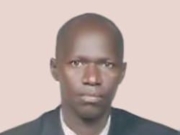
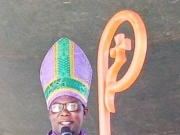



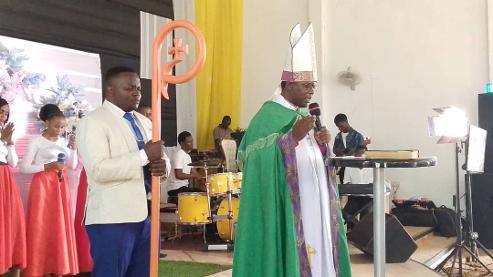
The Most Rev. Archbishop-Elect Professor Mugume Bagambaki Richard, Ecclesiastical Patriarch of the Five-Fold Episcopal World Federation FFEWF, Archbishop of Upper City Covenant Churches, and President & Chancellor of UCCSAT University, has called believers back to the three marks of genuine faith: Light, Love, and Truth.
Preaching from 1 John 2:1-29 under the theme “Walking In Light, Love and Truth”, the Archbishop described John’s letter as a father’s letter. “He is not writing to scold. He is writing to protect and to give assurance,” he said. “If Genesis is the book of Beginnings, 1 John is the book of Assurance — that we may know we have eternal life.”
Defining Light, Love and Truth.
The archbishop paused to answer the three questions directly, noting that “even Pontius Pilate asked, ‘What is Truth?’” John 18:38.
“A word can have more than one meaning,” he taught. “But in Scripture, context gives it meaning.”
Renowned scholar D.A. Carson affirms this principle of interpretation: “A text without a context is a pretext. Meaning is determined not by a dictionary but by context.” (Exegesis Fallacies, 1996).
So, what did John mean by Light, Love, and Truth to his audience?
Light is God’s holiness, purity, and truth. To walk in light means to live with no hidden sin. “God is light, and in him is no darkness at all” 1 John 1:5. Light exposes, heals, and guides.
Love is God’s nature lived out in relationships. “God is love” 1 John 4:8. To walk in love is to choose unity over bitterness, people over pride, and the family of God over the system of the world.
Truth is reality as revealed in Christ and confirmed by the Spirit. Truth is not an idea. It is a Person — Jesus Christ “the way, the truth, and the life” John 14:6. To walk in truth is to hold to sound doctrine and reject lies.
The Context: John Writing to A Greek World.
Archbishop Bagambaki explained that John wrote around 85-95 AD to churches in Asia Minor, most of them non-Jewish Greeks.
This was a culture that boasted in wisdom, philosophy, and secret knowledge. The rise of Gnosticism was teaching that the body was evil, Jesus could not have come in flesh, and one could have “special knowledge” and still live in sin.
“That is why John’s language is philosophical,” he noted. “He answers them with contrasts they understood: Light vs Darkness, Truth vs Lie, knowing vs Not Knowing. And he opens with Logos (Word), because to Greeks, that meant ultimate Reason. He was telling them: The Wisdom you seek has a name — Jesus Christ.”
Gnosticism was a false teaching and movement that was a big problem in the early church, especially in Asia Minor around 85-95 AD-the exact time John wrote 1 John.
The word Gnosticism comes from the Greek gnosis which means ‘secret knowledge’. Gnostics claimed they had special, hidden spiritual knowledge that ordinary Christians did not have. They taught that salvation came not by faith, but by unlocking this secret knowledge.
The three main things Gnostics taught were that the body is evil, the spirit is good and so they believed everything physical or material was created by an inferior god, meaning the body was a ‘prison’ for the spirit.
They also taught that Jesus seemed to have a body called ‘Docetism’ from dokeo which means ‘to seem’. And so, to them, if the body is evil, God could never take on a body. This is exactly what John attacks in 1 John 4:2-3.
Lastly Gnostics also taught that because the body was evil anyway, what you did with your body did not matter. You could sin physically but still be ‘spiritually enlightened’. John answers this is 1 John 1:6: “If we say we have fellowship with Him while we walk in darkness, we lie and do not practice the truth”
Why John Wrote Against It.
Bible scholar F.F. Bruce observed that “John’s Gospel and Letters are addressed to a world that thought in Greek categories, and he meets them with the claim that in Jesus the Logos has become flesh.”
He put it this way: “John is combating an early form of Gnosticism which denied the reality of the incarnation and separated knowing from doing”. So, John answers them with contrasts Greeks understood very well. He opens with Logos which is word to tell them that gentlemen look here, the true wisdom and reason you are looking for is not secret knowledge. It is a Person-Jesus Christ who came in flesh.
In one sentence Gnosticism taught:” Save your spirit, ignore your body and chase secret knowledge”. John answers them: “Walk in the Light, Love one another and hold to the Truth that Jesus came in flesh”. And that is why 1 John is called “the book of Assurance” because John was protecting believers from teachings that looked spiritual but denied Christ.
Readers should take note that Asia Minor, today’s Turkey, where cities like Ephesus and Smyrna are located.
Walking In The Light: Our Advocate And Our Obedience.
From verses 1-11, the archbishop taught that sin must be handled, not hidden.
“My little children, I am writing these things to you so that you may not sin. But if anyone does sin, we have an advocate with the Father, Jesus Christ the righteous” v1
On the Advocate: In the Roman-Greek legal system, an advocate or paraklētos was one “called alongside” to defend you in court. A client had to admit guilt. The advocate would then argue the case before the judge based on law, mercy, and payment made.
“That is Christ,” the archbishop said. “He does not deny our sin. He presents His blood. He is also the propitiation v2 — He satisfied God’s wrath. Not for us only, but for the whole world.”
New Testament scholar I. Howard Marshall explains 1 John this way: “The purpose of the letter is pastoral assurance. John gives tests so believers may know that they know God.”
On obedience: “By this we know that we have come to know him, if we keep his commandments” v3. Carson again warns here: “We must not read our modern definitions into ancient words. Obedience in John is not legalism, it is the evidence of a relationship with the Father.” (The Letters of John, PNTC).
“Whoever says he abides in him ought to walk in the same way in which he walked” v6.
On love: “Whoever hates his brother is still in darkness” v9.
FFEWF & UCCSAT Charge: “Theology without love is darkness. We can be doctrinally right and relationally wrong.”
Walking In Love: Knowing Your Stage And Resisting The World
Verses 12-17 address the family of God in three stages: Children, Young Men, and Fathers.
Children know forgiveness. Young Men are strong, the Word abides in them, and they have overcome the evil one. Fathers know Him who is from the beginning — they carry depth and stability.
“We need all three in the church,” the archbishop said. “Children for joy, Young Men for warfare, Fathers for wisdom.”
He then warned: “Do not love the world or the things in the world” v15.
He defined “the world” as the system opposed to God, not God’s creation. He identified its traps as the lust of the flesh, the lust of the eyes, and the pride of life.
“The world is passing away along with its desires, but whoever does the will of God abides forever” v17.
Commenting on this, theologian John Stott wrote: “The world is not God’s beautiful creation, but the godless society which is in rebellion against God.”
Upper City Covenant Churches Charge: “We are in Kampala, but we must not be of Kampala’s value system. Set your heart on eternal things.”
Walking In Truth: Discerning The Antichrist And Abiding In Christ
Verses 18-29 were presented as the most urgent word for 2026.
“Children, it is the last hour” v18.
An Antichrist is anyone who denies that Jesus is the Christ, the Son of God v22. John said “they went out from us, but they were not of us” v19 because they were never rooted.
But believers are not left defenseless: “You have been anointed by the Holy One, and you all have knowledge” v20.
The Holy Spirit is the teacher. “You don’t need to chase every new doctrine. Test it with the Word and the Spirit.”
The goal is to abide: “And now, little children, abide in him, so that when he appears we may have confidence and not shrink from him in shame” v28.
“Everyone who practices righteousness has been born of him” v29.
On this, Karen Jobes, a scholar of the Johannine letters, notes: “To abide is to remain in fellowship with Christ. Assurance is not a feeling but the result of a continuing relationship marked by obedience, love, and truth.”
Prophetic Applications for The Church.
The archbishop charged FFEWF, Upper City Covenant Churches, and UCCSAT to return to biblical priorities. He said pastors must preach for transformation and not mere information. Young ministers must arm themselves with the Word to overcome the evil one. The Church must guard love because division and bitterness is darkness. And this generation must practice discernment because many antichrists and false teachings are already here.
Conclusion: The Three Marks of Genuine Faith:
John gives a threefold test: Moral Test: Do you obey? — Walking in Light
Social Test: Do you love? — Walking in Love
Doctrinal Test: Do you confess Christ? — Walking in Truth
If these are present, you can have assurance.
Altar Call: “Are you in darkness or light? Are you loving the world or loving the Father? Are you abiding in Christ or have you drifted? Come back to the Advocate. Come back to the Word. Come back to Love.”
Benediction: “And now, little children, abide in him, so that when he appears we may have confidence…”
Contact:
+The Most Rev. Archbishop Elect Professor Mugume Bagambaki Richard
Five Fold Episcopal World Federation | Upper City Covenant Churches | UCCSAT University
WhatsApp: +256775050183
Email: fivefoldepiscopalworldfederati@gmail.com / uppercitycovenantchurches@gmail.com