






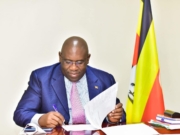

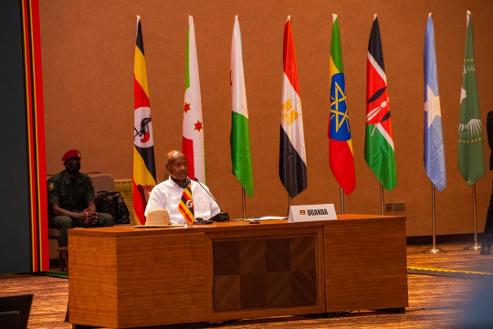
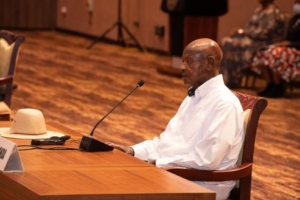
With those words, President Yoweri Kaguta Museveni opened the closing session of a three-day Heads of State summit in Kampala, reaffirming Uganda’s unwavering commitment to Somalia and declaring that the African Union Support and Stabilization Mission in Somalia, AUSSOM, remains a test of Pan-African solidarity, not just a security operation.
The summit brought together leaders from Uganda, Ethiopia, Kenya, Djibouti, Egypt, and Burundi — the six troop-contributing countries to AUSSOM. It followed technical deliberations by Chiefs of Defense Forces (CDFs) and Defense Ministers (DFs) who laid the groundwork for what may be the most consequential transition in Somalia’s post-conflict journey: the planned drawdown of the United Nations Support Office in Somalia, UNSOS, by December 31, 2026.
A mission rooted in principle, not proximity.
President Museveni used the platform to address a question that has followed Uganda’s deployment for nearly two decades: why Somalia, when Uganda does not share a border with it?
His answer was framed in two pillars. First, the rejection of religious extremism that seeks to impose a narrow, chauvinistic ideology on plural African societies. Second, tangible solidarity with neighbors whose instability inevitably spills across the region.
“Extremist groups want to tell Africans how to live, what to believe, and how to govern themselves,” Museveni said. “That is not the African way. Our history is one of diversity, of clans and faiths living side by side, with respect. When one country is attacked by that kind of intolerance, all of us are attacked.”
He traced the ideological threat back to Khartoum in the 1990s, arguing that the same extremist networks that once found space in Sudan later metastasized in Somalia. Left unchecked, he warned, they would not stop at Mogadishu.
The President also framed Uganda’s presence as an act of direct solidarity with Ethiopia. With insurgent and terrorist groups operating across porous borders, he argued, the security of Addis Ababa, Nairobi, Djibouti, and Kampala is inseparable from the stability of Mogadishu. “When Ethiopia is pressured, Uganda is pressured. When Kenya is threatened, Burundi is threatened. That is the logic of our region,” he said.
From AMISOM to AUSSOM: 20 years of sacrifice.
Chairperson of the African Union Commission, H.E. Mahmoud Ali Youssouf, opened his remarks with tribute. He called Uganda “one of the pillars of Africa’s engagement in Somalia for close to 20 years” and praised the professionalism and sacrifice of all troops and police who have served under the AU flag.
“Your leadership and the sacrifices borne by your forces command our deepest appreciation,” Youssouf said. “Because of your courage, Somalia has been able to advance along the path to stability. We must now preserve those gains.”
The mission’s evolution from AMISOM to ATMIS and now to AUSSOM reflects both progress and fragility. Somali security forces have taken on more responsibility, major towns have been liberated, and federal institutions are functioning. Yet al-Shabaab retains the capacity to launch deadly attacks, and vast rural areas remain beyond state control.
That is why the upcoming UNSOS closure looms large. Since 2009, UNSOS has provided logistics, fuel, medical evacuation, and force enablers that keep AU troops operational. Its exit on December 31, 2026, forces troop contributors to answer a hard question: who pays, who equips, and who sustains the mission next?
Military chiefs demand African-led solutions, fast.
The answer, according to the Chiefs of Defense Forces, must be African-led and urgently financed.
Gen. Muhoozi Kainerugaba, Uganda’s Chief of Defence Forces who chaired the CDF meeting, told his counterparts that the window for planning is closing.
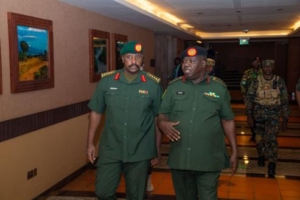
“These are difficult circumstances, but they also call for our unity, creativity, and resolve,” Gen. Kainerugaba said. “We cannot wait for partners to decide our fate. We must fast-track African-led alternative arrangements for funding, logistics, and enablers.”
The CDFs recommended a hybrid support model: assessed contributions from AU member states, supplemented by bilateral agreements and a dedicated trust fund. They also proposed regional logistics hubs in Uganda, Kenya, and Djibouti to reduce dependence on external contractors.
Defense Ministers endorsed the recommendations and forwarded them to the Heads of State, who directed the AU Commission to begin immediate diplomatic engagement with the UN Security Council, the EU, the US, and Gulf partners to secure predictable, sustainable funding.
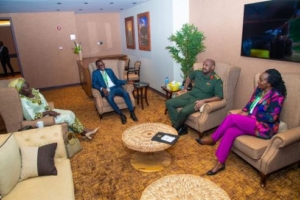
The Ideological Battle: Diversity vs. Imposition.
Beyond logistics, President Museveni returned repeatedly to ideology. He argued that the fight in Somalia is not only military, but civilizational.
Referencing past conversations with former Sudanese President Omar al-Bashir, Museveni noted that African and Islamic traditions both contain concepts of prohibition and morality.
The difference, he said, is method. “In Africa, we persuade. We do not impose by the gun. We respect that a Muslim will not eat pork, and a Christian will not observe Ramadan, and we live together. That is strength.”
He warned that groups seeking to force a single interpretation of religion or politics onto diverse communities will ultimately fail, because they attack the social fabric that holds nations together. “Somalia’s future must be Somali-led, but it must also be Somali-inclusive,” he said.
What comes next for AUSSOM.
The summit communique outlined four immediate priorities:
Force generation and sustainment: Maintain current troop levels through 2026 while gradually transferring more security responsibilities to the Somali National Army.
Financing: Mobilize an AU Peace Fund window and lobby for a UN-assessed contribution mechanism to replace UNSOS support.
Political track: Support the Somali government’s national reconciliation and state-building agenda, with emphasis on local governance in liberated areas.
Regional coordination: Strengthen intelligence sharing among the six TCCs to counter cross-border recruitment and financing of extremist groups.
Youssouf assured Somalia that the AU Commission will “continue mobilizing the necessary political, diplomatic, and financial backing.” He also paid tribute to fallen soldiers, noting that their sacrifice “has bought time for Somalia to build.”
Why Uganda’s Message Matters Now.
Uganda’s stance carries weight because it has been consistent. Since 2007, Ugandan troops have been the backbone of AU operations in Somalia, often the first to deploy and the last to leave. More than 1,000 Ugandan soldiers have died in the mission.
By anchoring the intervention in Pan-Africanism rather than self-interest, Museveni is making a case to both domestic and international audiences. To Ugandans, he is explaining the cost. To partners, he is arguing that abandoning Somalia now would undo 20 years of gains and embolden extremists across the Horn.
“Africa will not abandon Somalia,” he concluded. “Not because it is easy. But because it is right. And because if Somalia falls, the idea of an African solution to African problems falls with it.”
As delegates departed Kampala, the message was clear: the military phase is not over, but the political and financial phase is beginning. With UNSOS set to exit in 17 months, troop contributors have agreed the continent must step up, or risk watching Somalia slide backward.
For now, the pledge holds. The guns, the logistics, and the diplomacy must follow.
The Road to AUSSOM: How Somalia’s Collapse Brought African Troops to Mogadishu.
By the time the first Ugandan and Burundian soldiers landed at Mogadishu’s airport in March 2007, Somalia had not had a functioning central government for 16 years.
What began as a political crisis in 1991 had hardened into state collapse, famine, piracy, and eventually a terrorist insurgency that spilled across the Horn of Africa. The African Union mission in Somalia was not born out of ambition. It was born out of necessity.
Somalia’s troubles trace back to the fall of President Siad Barre in January 1991. His 22-year dictatorship ended when clan-based rebel groups overthrew him. But instead of building a new state, the victors turned their guns on each other. Mogadishu fractured into militia fiefdoms. Courts, schools, the army, and the police vanished overnight.
With no authority to manage food distribution or aid, a famine in 1992 killed an estimated 300,000 people. That humanitarian disaster drew the first international intervention — a US-led UN operation. It ended in 1995 after the infamous “Black Hawk Down” battle, and the world largely pulled out. Somalia was left to the warlords.
The vacuum had consequences. Off the coast, with no navy to patrol its waters, foreign trawlers looted Somali fish stocks and dumped toxic waste. By the early 2000s, desperate coastal communities turned to piracy. By 2008, Somali pirates were hijacking ships as far as 1,000 nautical miles from shore, forcing navies from around the world to patrol the Indian Ocean.
On land, a different threat was growing. In 2006, an alliance of Sharia courts known as the Islamic Courts Union swept through southern Somalia and brought a brief period of order to Mogadishu. Ethiopia, fearing a hostile Islamist state on its border, invaded in December 2006 with US backing and routed the ICU.
From the ICU’s ruins emerged a younger, more radical faction: Al-Shabaab. Meaning “The Youth,” the group rejected clan politics and pledged to impose a strict version of Islam by force. Within two years it controlled most of south-central Somalia and was within shelling distance of the weak Transitional Federal Government in Mogadishu.
That is what pushed the African Union to act. In March 2007, the AU deployed the African Union Mission in Somalia, AMISOM. Uganda and Burundi provided the first troops. Their mandate was simple and dangerous: protect the Somali government, secure aid delivery, and fight Al-Shabaab.
For Uganda, the decision was framed in regional terms. Leaders in Kampala under the war-hardened President Yoweri Museveni argued that a terrorist haven in Somalia would not stay in Somalia.
The 2013 Westgate attack in Nairobi, the 2015 Garissa University massacre in Kenya, and repeated bombings in Mogadishu proved the point. Ethiopia also joined, followed by Kenya in 2011, Djibouti, and later others. At its peak, AMISOM had more than 22,000 troops.
The mission worked, slowly. By 2012, Al-Shabaab had been pushed out of Mogadishu, Kismayo, and Baidoa. A permanent federal government was established in 2012. Somali security forces began to grow. But Al-Shabaab did not disappear. It retreated to rural areas, taxed trade, and continued suicide attacks.
In 2022, AMISOM was re-hatched as ATMIS, the African Union Transition Mission in Somalia, with a clear exit plan: train and hand over to Somali forces, and draw down.
That transition continues today under AUSSOM, the African Union Support and Stabilization Mission in Somalia, launched in 2025. The force is smaller, more advisory, but still in combat alongside Somali troops.
The biggest pressure point now is money and logistics. Since 2009, the UN Support Office in Somalia, UNSOS, has paid for the fuel, rations, medical evacuation, and equipment that keep AU troops running. UNSOS is scheduled to close on December 31, 2026. Without a replacement, the mission risks collapse.
It was that deadline that brought Presidents and Defence Chiefs from Uganda, Ethiopia, Kenya, Djibouti, Burundi and Egypt to Kampala this week. The message from President Yoweri Museveni was blunt: Africa cannot walk away. “We did not come to Somalia because we share a border. We came because we share a destiny,” he said.
For nearly 20 years, Uganda has paid the highest price in blood. More than 1,000 Ugandan soldiers have died in Somalia. Yet the argument in Kampala remains the same one made in 2007: an ungoverned Somalia is a threat to all of East Africa.
Today Somalia has an elected government, a national army, and towns that were once Al-Shabaab strongholds now back under state control. But the insurgency persists, and the Somali army is not yet able to stand entirely alone.
The AU’s plan is now clear. Somali forces take the lead. African troops provide support, intelligence, and specialized operations. And the continent, not outside contractors, must find a way to fund it after 2026.
From the collapse of 1991 to the summit in Kampala in 2026, the line is direct. State failure created extremism. Extremism created a regional threat. And that threat created the longest peacekeeping deployment in African Union history.
Whether AUSSOM succeeds will depend on whether that same solidarity can now pay the bills as well as it paid the sacrifices.