


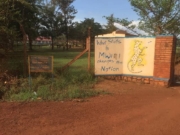





It was easy for any stranger passing by Viva College on the foothill of Mwiri Hill on Sunday 4th October 2026 to easily mistake the school for a newly established taxi park.
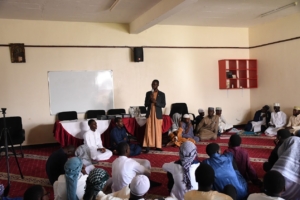
There was hardly any parking space left. Parents had turned up in large numbers for the dedication service for their sons and daughters in Senior Four and Senior Six who are about to sit for UNEB examinations. A day earlier, on Saturday, Muslim candidates had held their own dedication prayers.
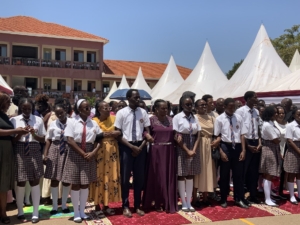
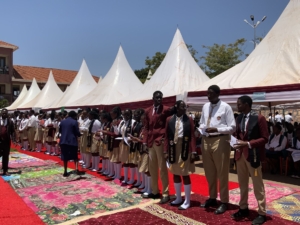
This time the Mass was not held in the main hall. It was held in the basketball court. The day was hot, unusually hot, and even though tents had been erected, they could not accommodate everyone.
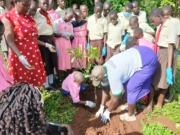
Some parents were forced to move away from the tents to sit under the many trees that surround the court. It is one of the things that makes Viva College stand out, an environmentally friendly school that has preserved its trees, and on this day those trees provided shade and relief.
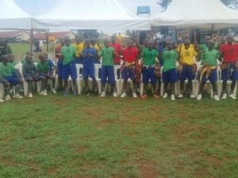
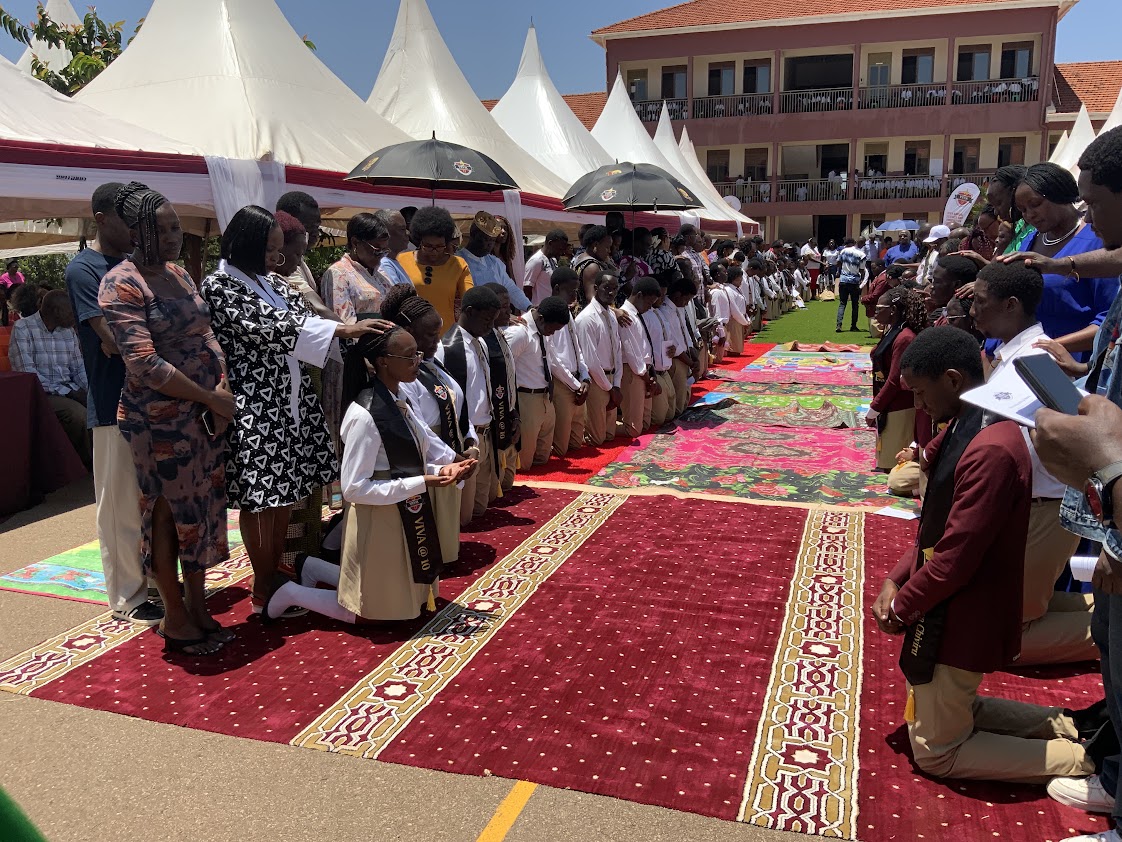
Over three hundred candidates bravely sat in the middle of the scorching court in uniform, with parents standing behind them, teachers on the sides and invited guests in front. The main celebrant was Rev Fr Kenneth Orom of Lubaga Parish in Jinja Catholic Diocese, a youthful priest popularly known as “Fr Finest”.
Fr Orom started by defining the word battle. He said like all words, the word ‘battle’ carries different meanings depending on context. Dictionaries give it three meanings. It can be a hostile encounter between opposing military forces, it can be a lengthy contest or controversy, and it can be a struggle to succeed or survive. Its root is from the Latin word battuere which means to beat.
He said many people today when they hear the word battle think of Israel/US and Iran, Israel and Hamas, Hezbollah and the Houthis in Yemen, or the wars in Democratic Republic of Congo, Somalia, Sudan and South Sudan. That is the first dictionary meaning, a meaning stained with blood and displacement.
But at Viva College, he said, there was another battlefield. A battlefield without guns. He told the candidates that they were already in the middle of an academic battle and they must fight to win not only in exams but in life.
For his homily, Fr Orom based his preaching on the Book of Isaiah, Philippians chapter four verses six to nine and Matthew chapter thirteen verse six. His message was about rejection and pain and how God uses them.
He dwelt on the scripture that says the stone the builders rejected has become the cornerstone. He explained its Old Testament background. In ancient Israel, the cornerstone was the most important stone in a building. It was the first stone to be laid and it determined the alignment and strength of the whole structure. Builders would examine stones from the quarry and reject those that looked rough or unsuitable for their immediate plan.
Psalm 118 where that line comes from was a Passover psalm, a song of thanksgiving for deliverance. At that time Israel itself was the rejected stone, despised by powerful empires like Egypt and Babylon, but chosen by God to carry salvation history.
The prophet Isaiah later picks the same image when he says “behold, I lay in Zion a stone for a foundation, a tried stone, a precious cornerstone, a sure foundation”.
The theological lesson, Fr Orom said, is that what man rejects, God often anoints. Rejection is not the end of the story; it is God’s way of editing the story.
He gave the example of Joseph. Joseph was rejected by his own brothers, sold into slavery, falsely accused in Potiphar’s house, imprisoned and forgotten. He had every reason to sink into self-pity and bitterness. But he did not. He used rejection as a springboard. In the end the rejected brother became Prime Minister of Egypt and the cornerstone for the survival of his family during famine and that is how the Israelites went to Egypt. As Genesis says, you intended to harm me but God intended it for good.
In the New Testament, Fr Orom noted, Jesus applied the same psalm to himself. The religious leaders (Pharisees, Sadducees and Priests of the day) who were the builders of that time rejected him, but God made him the cornerstone of salvation. Peter repeats it in Acts and in his first letter, that to those who believe he is precious but to those who disbelieve he is the stone that causes stumbling.
Turning to the candidates, Fr Orom said at times life can be difficult. Even subjects like Physics, Chemistry, Biology and Mathematics can turn against you and reject you. Friends can reject you; relatives and family can reject you. But like Joseph, you must remain firm and focused. Do not sink.
He then quoted Philippians chapter four where Paul says do not be anxious about anything but in every situation by prayer and petition with thanksgiving present your requests to God and the peace of God which transcends all understanding will guard your hearts. Fr Orom told the candidates that anxiety, not the exam paper, is the real enemy. Many fail not because they did not read but because fear paralyzes them inside the exam room.
From Matthew thirteen verse six he warned them not to be like seed that withered because it had no root. A student who has no deep roots in discipline, revision, prayer and consultation with teachers will wither when the heat of UNEB comes, just like the heat that was beating down on the basketball court that afternoon.
To drive the point home, Fr Orom spoke about himself. He said at A Level he had three conflicting dreams. First, he wanted to be a musician because at that time music was paying and not many musicians were dying. Then he wanted to be an engineer because he admired an uncle who used to come home with protective gear and tools. Then there was a quieter desire to be a priest to preach the Word of God.
He said he fought that battle of discernment and eventually dropped what was glamorous for what was Godly. He recalled that when legendary musician Elly Wamala died in August 2004, it made him reflect deeply on life. Today after completing his studies and being ordained deacon and now priest, he has found peace of heart because he fought to win the right battle.
He also gave the example from politics of a close friend who contested four times and lost, was laughed at and called a serial loser, but refused to accept defeat as his identity and won decisively on the fifth attempt.
That story, he said, mirrors the journey of Hon Grace Paddy Kirya Wamzala who lost four times before winning on January 15 and is now Member of Parliament for Butembe Constituency in Jinja.
Hon Wamzala could not attend the Mass due to official duties but was represented by one of his Political Assistants Nekemia Dhamuzungu who is also a journalist with Bridge FM in Jinja City.
Dhamuzungu delivered a package from the MP, a cash contribution of two hundred thousand shillings to support the candidates during their examination period, a gesture that was received with loud applause from parents, teachers and students.
Fr Orom told the candidates that a soldier goes to the battlefield not to lose but to win, whether navy, air force or infantry, the target is to subdue and overcome the enemy. In the same way their target must be a better future. He gave them battle commands.
He said they must know their real battlefield. The enemy is not their classmate but laziness, fear, distraction and exam malpractice. Their weapon is not a gun but the pen, the book, discipline and prayer. And their commander must be God, because unless the Lord builds the house, the builders labor in vain.
He also reminded them that the first granary of blessing is at home from parents. He said as a priest, whenever he goes home his parents still bless him even when they call him Fr. It was therefore good that parents turned up in big numbers to join in the blessing.
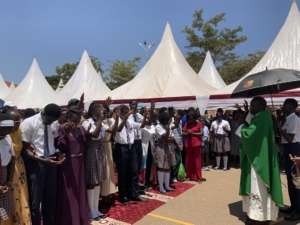
At the climax of the Mass, Fr Orom sprinkled holy water on the more than three hundred candidates as their parents stood behind them with hands on their shoulders, a powerful symbol of moral and emotional encouragement meant to deflect what many call exam fever.
It was a battle without guns. A battle of faith, focus and resilience. And under the trees of Viva College, on a hot afternoon in a basketball court that had become a cathedral, the message was clear. Do not sink in self-pity. Turn your rejection into your cornerstone and fight to win.
Happiness was written all over the face of the Executive Director Madam Farida Kisame who broke into intermittent smiles, while the Principal Denis Alfred Anguyo was lost at words and could only smile as his face was lit with satisfaction because the day was successful.
The Deputy Principal in charge of Administration Abdul Karim Ssenyondo and the Deputy in charge of academics Jordan Lugolobi and heads of departments, teachers and the entire Viva College fraternity were seen hugging and appreciating one another for a job well done as they wait for a bigger celebration next year after results are out.