























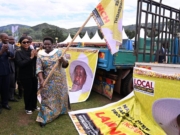


The High Court in Masaka has upheld the election of Hon Justine Nameere as the District Woman Representative for Masaka City and dismissed the petition that sought to nullify her victory, in a ruling that settles the political contest between the ruling National Resistance Movement (NRM) and the opposition National Unity Platform (NUP) in one of Buganda’s most competitive constituencies, even as the judge found that the vote recount that produced her was conducted irregularly.

In his judgment delivered on Wednesday 21st October 2026, Justice Bernard Namanya ruled that although the Electoral Commission failed to keep ballot boxes safe and the Chief Magistrate continued with a recount after discovering tampered materials, that failure was not enough to overturn the election because the numbers show it did not change who won.
Hon Nameere is the Minister of State for Local Government.


The case arose from the January 15th 2026 parliamentary election. The Returning Officer initially declared Nalubowa Rose, who contested on the National Unity Platform ticket, winner with 25,443 votes against Nameere Justine of the National Resistance Movement who had 20,324 votes.
For NUP, which has dominated Masaka in the last two election cycles, it was confirmation of its grip on the city, while for NRM it was a familiar loss in a region where it has struggled to regain ground. Nameere challenged that declaration, arguing that results from several polling stations had been left out of the final tally.
The Chief Magistrate of Masaka, His Worship Asiimwe Abert, ordered a recount of all 314 ballot boxes, and on 1st February 2026 issued a certificate declaring Nameere the winner with 25,502 votes against Nalubowa’s 23,176 votes, a dramatic reversal of more than seven thousand votes.
Ms Nalubowa went to the High Court arguing that the entire recount process was illegal. Her lawyers raised three main arguments, which in law are called grounds for setting aside an election, meaning the legal reasons why a court can cancel an election result.
First, that the recount was done outside the time allowed by law. Second, that the Chief Magistrate was not personally supervising the exercise but left it to clerks across four different counting centres at night and over the weekend. Third, that many ballot boxes were found open, empty or with missing ballot papers, yet the counting continued.
The legal teams in the case reflected its political weight. Nalubowa was represented by Mr Muyizzi Samuel Mulindwa and Mr Lule Alexander, both known for handling NUP election petitions in Buganda. Nameere Justine was represented by Mr Bazira Anthony and Mr Ssekyewa Sam, while the Electoral Commission and the Returning Officer for Masaka City, who were sued as the second and third respondents, were represented by Mr Kandeebe Ntambirweki Geofrey and Mr Ssewaya Haruna.
On the question of time, the judge explained that the law under Section 74 of the Parliamentary Elections Act gives a candidate seven days to ask for a recount and then gives the Chief Magistrate four days to fix the date for the recount. Since the application was filed on Friday 23rd January, the weekend and a public holiday on Monday 26th January are not counted when calculating time, a principle known in procedural law as exclusion of Sundays and public holidays under Order 51 of the Civil Procedure Rules.
The four days therefore started on 27th and ended on 30th January, the day the order was made, so the recount was within the legal timeframe, and the fact that physical counting ended on 1st February did not make it illegal.
On supervision, the court found that Nalubowa did not prove her claim on a balance of probabilities, which is the standard of proof in election petitions meaning the judge must be satisfied that one side’s story is more likely true than not, as opposed to beyond reasonable doubt used in criminal cases.
The judge found her key witness, Matovu Maurice, unreliable because he claimed the recount was done outside Electoral Commission premises but later admitted under cross-examination, which is the questioning of a witness by the opposing side, that this was false, and none of her witnesses could point to which specific ballot boxes were counted in the absence of the Chief Magistrate. The court noted that Nalubowa herself was not present during the recount, while Nameere was present throughout.
The most serious finding was on the integrity of election materials. The court confirmed that the Electoral Commission initially omitted nine polling stations with 3,978 registered voters from the first declaration, and during the recount the Chief Magistrate himself discovered another nine polling stations where boxes were compromised. Some boxes were found open with broken seals, others were empty yet ballot booklets had been used, others had only ballots for one candidate, and in one station at Kisuuna, 112 votes were unaccounted for. Under Section 71 of the Parliamentary Elections Act, which imposes a duty of safe custody, the Returning Officer is supposed to keep all election documents safe until all disputes are settled, and failure to do so is what the law calls non-compliance, meaning failure to follow what the electoral law requires.
Quoting earlier decisions in the cases of Byanyima Winnie versus Ngoma Ngime and Kasibante Moses versus Katongole Singh Marwaha, Justice Namanya held that a recount is supposed to be a judicial filtering mechanism done with higher scrutiny than polling day counting, and continuing a recount after finding open boxes is an abuse of court process and amounts to what lawyers call material irregularity, meaning a serious flaw that goes to the root of the process.
However, the judge in his 55-page ruling, applied what is known as the substantiality test under Section 80 of the Parliamentary Elections Act. This test means that an election cannot be cancelled merely because there were mistakes or irregularities; the petitioner must also show that those mistakes affected the final outcome in a substantial manner, meaning they changed who would have won. To do this, the court does not use the number of registered voters in affected stations but the actual votes cast, which can be verified from declaration of results forms.
From the declaration forms and tally sheets, the actual votes cast in the nine excluded stations were only 1,353 votes, with 743 for Nameere and 610 for Nalubowa. Even if all 1,353 votes were added to Nalubowa’s recount total of 23,176, she would have 24,529 votes, still 973 votes behind Nameere’s 25,502 votes.
The court therefore held that the irregularity, though proved, did not affect the result substantially, following the Court of Appeal decision in Chebrot versus Soyekwo where missing ballots did not overturn a result because the winning margin was bigger than the missing votes.
What does this mean politically and legally for the two women and for NRM versus NUP?
For Hon Nameere Justine, the ruling is a lifeline that secures her seat in the 12th Parliament after an initial loss and confirms her as one of the few NRM figures to survive in Masaka City, a district that voted overwhelmingly for NUP in 2021 and 2026. Her victory, now judicially confirmed, will be presented by NRM as evidence that it can still win urban Buganda through court-supervised recounts that correct what it calls arithmetic errors by the Electoral Commission, and it strengthens her standing within the party as a mobiliser who overturned a five thousand vote deficit.
For Nalubowa Rose, the dismissal is a significant setback but not necessarily the end of the road. The judgment found that there was indeed non-compliance by the Electoral Commission, which gives her a moral and legal talking point that the system failed to protect her votes, even if the court found the numbers insufficient to change the winner. And for NUP, losing Masaka City Woman MP seat after holding it initially is a blow to its narrative of dominance in Buganda and will raise internal questions about monitoring of recounts, since the court noted that neither Nalubowa nor her agents were consistently present during the recount that reversed her victory.
For NRM versus NUP, the case underscores how thin margins in Masaka have become and how election litigation has become an extension of politics. Both parties invested heavily in lawyers and agents for a recount that lasted about sixty hours, and the ruling shows that courts will not automatically nullify results because of mishandled boxes but will apply a mathematical test that favours the final tallies certified by the magistrate.
It remains unclear whether Nalubowa will appeal against the ruling. By press time, her lawyers had not announced their next step, and she was not immediately reachable for comment.
Under the Parliamentary Elections Act, a party dissatisfied with a High Court decision in an election petition has a right to appeal to the Court of Appeal within fourteen days, and the Court of Appeal has previously overturned High Court decisions in election matters, as seen in the authorities cited in this judgment. If she appeals, she would need to show that Justice Namanya was wrong to use actual votes cast rather than registered voters to assess substantial effect, or that he was wrong to hold that she failed to prove the recount figures erroneous without a full certified record.
Consequently, Justice Namanya dismissed the petition, upheld Nameere Justine as the duly elected Woman Member of Parliament for Masaka City, and ordered Nalubowa Rose to pay the costs of the petition, which in election law means the legal expenses incurred by the winning side and the Electoral Commission.