



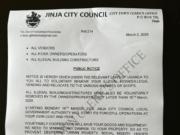

The Uganda Human Rights Commission (UHRC) has formally petitioned Jinja City Council for land to build a permanent regional office that will serve 18 districts across Busoga and Bukedi sub-regions.
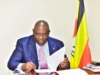
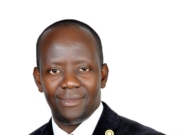
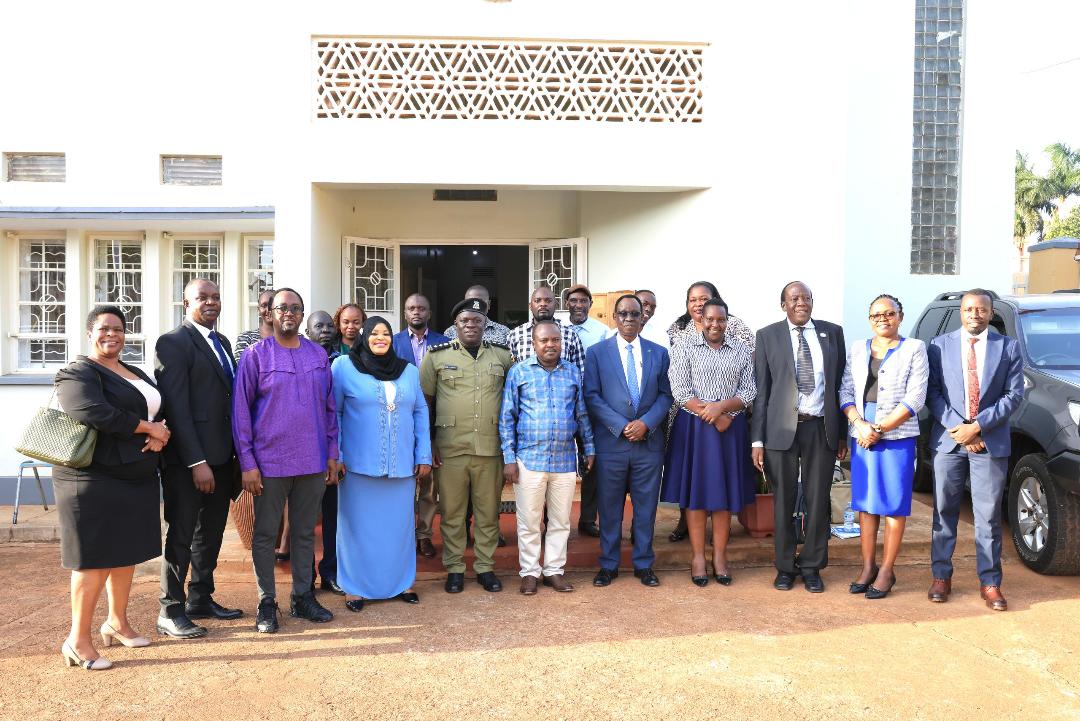
The request was revealed during a stakeholder engagement held at the UHRC Jinja Regional Office on Bell Avenue West. The meeting was led by the Commission’s acting chairperson, Hon. Lamex Omara Apitta, while Chairperson Hon. Mariam Wangadya is on leave.
“Rent money to be used for programmes” – UHRC
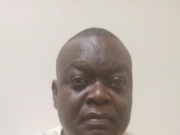
The Principal Human Rights Officer for Jinja, Farouk Nyende, told stakeholders that a permanent home would strengthen the Commission’s work in the region.
“If the plan eventually works out, it will go a long way in consolidating the work of the Commission in the region. Funds currently spent on rent will be redirected, especially to programme implementation to expand the breadth of Commission interventions in the region,” Nyende said.
The Assistant RCC Michael Kasede, who represented RCC Jinja City Salim Komakech, pledged to escalate the matter to both the political and technical leadership of the City Council.
UHRC urged to join City Security Committee.
Kasede also raised a separate concern, questioning why UHRC does not have a representative on the City Security Committee, a forum that brings together key stakeholders and is chaired by the RCC.
He noted that human rights issues regularly feature in those meetings and promised to report back to his boss so that UHRC is brought on board.
Coverage To Expand To 21 Districts.
Nyende gave an overview of the Jinja office, which has been operational since 2002. He said the office maintains good working relations with political leaders, security agencies, the judiciary, the Directorate of Public Prosecutions (DPP), CSOs and the media.
“The Commission is also an active member of the District and Regional Chain-Linked Committees that bring together institutions within the Justice Law and Order Sector in the region,” he noted.
However, he flagged operational challenges. Top among them is the wide area of coverage.
“This coverage is quite extensive and the location of the seat of the regional office further compounds the situation. Consequently, interventions end up being thinly spread, leaving a significant portion of the population unreached,” Nyende said.
He added that the coverage area will soon increase to 21 districts following Parliament’s planned split of Tororo District into four new districts, hopefully to be approved under Speaker Rt Hon Jacob Oboth Oboth.
Prison Congestion, Delayed Justice Flagged.
Nyende also highlighted congestion in prisons, noting that facilities meant for a given number are overstretched almost 10-fold. He cited UN Standard Minimum Rules for the Treatment of Prisoners, Rule 13, which provides that:
“All accommodation provided for the use of prisoners and in particular all sleeping accommodation shall meet all requirements of health, due regard being paid to climatic conditions and particularly to cubic content of air, minimum floor space, lighting, heating and ventilation”.
This is part of the Nelson Mandela Rules which the UN’s 2015 revised minimum standards for prisons. They replaced the 1955 version and Uganda uses them as the benchmark when UHRC inspects places like Kirinya Prison.
While other parameters may be met, he said minimum floor space is “glaringly lacking” in Uganda’s prisons. Female wards are comparatively better, with some inmates sleeping on beds.
He attributed the congestion to slow court processes, citing cases of inmates who filed appeals more than 10 years ago with no mention of their fate, others detained for years without police or court files, and capital cases where state witnesses have already recorded additional statements yet the DPP has not withdrawn charges.
Some have been on remand for over 5 years.
“UHRC Jinja received a compilation of some of these concerns and the Commission has since written to the DPP and Court Registrar. As we meet here today, there is an ongoing Court of Appeal Pre-Session meeting at Jinja High Court Circuit. We hope some of these concerns will be addressed,” Nyende appealed.
Other human rights concerns.
Nyende also raised child labour in sugarcane plantations and gold mines leading to high school dropout rates, and over-dependence on sugarcane farming by smallholders causing food insecurity and high malnutrition levels in Busoga.
On Gender-Based Violence(GBV), he said Kamuli District has reported three cases of women cutting off their spouses’ genitals over alleged infidelity. UHRC has used radio programmes to urge communities to resolve family disputes through “curtain lectures” or legal channels.
Kiira Police report improved compliance with 48-hour rule.
The Kiira Region Police Command was also represented at the engagement by Deputy RPC SSP Christopher Katumba and D/SSP Daniel Batte. The duo presented a positive assessment of police performance in the region, highlighting strict adherence to the constitutional 48-hour rule for holding suspects at police stations.
On equipment and operational tools, they said significant improvements have been made to enhance the force’s capacity to handle its mandate.
“Arrest only after thorough investigations” – Batte.
The newly transferred D/SSP Batte told stakeholders that detectives have been instructed to effect arrests only after thorough investigations, to avoid detaining suspects beyond the 48-hour constitutional requirement.
This statement, however, sparked heated debate among participants who questioned why police still seek court adjournments citing “investigations still underway” or “investigations incomplete”.
D/SSP Batte, who sought to defend the image of the Uganda Police Force, said such cases are limited to capital offences like murder, aggravated robbery and rape. He explained that these require forensic tests conducted at Kampala laboratories, which take time to release results.
He added that consultations have been held with relevant agencies to expedite the process and reduce delays.
Commission cites constitutional mandate.
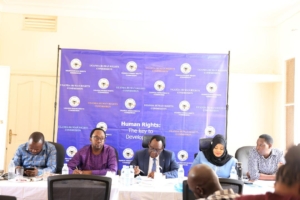
Addressing stakeholders, Acting Chairperson Hon. Lamex Omara Apitta said the prison and office visits are part of UHRC’s constitutional mandate to take services closer to the people.
He cited Article 52 of the 1995 Constitution, which gives UHRC the following functions: to investigate, at its own initiative or on a complaint made by any person or group of persons, against the violation of any human right; to visit jails, prisons, and places of detention or related facilities with a view to assessing and inspecting conditions therein and make recommendations.
It is also to establish a continuing programme of research, education and information to enhance respect for human rights.
Apita was accompanied by Commissioners: Hon. Shifra Lukwago, Advocate of the High Court and Commissioner for Oaths; Hon. Jacklet Atuhaire Rwabukurukuru, former Sheema Woman MP; Hon. Simeon Muwanga Nsubuga, former UPF Spokesperson; and Hon. Crispin Kaheru, human rights defender and former head of CCEDU.
Also in attendance was the director Regional Services Ms. Sarah Nakumitsha who coordinates the regional offices handling complaints, human rights education and channeling regional requests to the headquarters.
On arrival, the team visited Kirinya Government Prison where they interfaced with prison authorities and inmates at both the Remand and Main prisons located in the waters of Lake Victoria.
The Exposure Uganda (TEU) Explainer: UHRC’s origins and its place in international law.
The concerns raised in Jinja, from prison congestion to child labour and GBV, sit within a larger framework that predates the current engagement by nearly three decades.
The Uganda Human Rights Commission was established in 1995 under Article 51 of the Constitution of Uganda, and began operations in 1996 after Commissioners were appointed.
The UHRC Act followed in 1997 to operationalize its mandate. The Jinja Regional Office, which hosted this week’s meeting, was set up in 200 to decentralize services to Busoga and Bukedi.
UHRC was created to align Uganda with global human rights standards. It is designed to meet the UN Paris Principles of 1993, which require National Human Rights Institutions to be independent, broad-mandated, and adequately resourced. Because of this, UHRC holds “A-status” accreditation from the Global Alliance of NHRIs, the highest level of compliance.
Article 52 of the Constitution directly tasks UHRC to “monitor the Government’s compliance with international treaties and conventions to which Uganda is a party.”
This is why Nyende could cite UN Standard Minimum Rules for the Treatment of Prisoners, Rule 13, during the engagement. UHRC uses these “Nelson Mandela Rules” as a benchmark when inspecting facilities like Kirinya Prison.
Through this mandate, UHRC tracks Uganda’s obligations under treaties such as the International Covenant on Civil and Political Rights, the Convention Against Torture, Convention on Elimination of Discrimination Against Women (CEDAW), and the Convention on the Rights of the Child.
The child labour in sugarcane plantations and the GBV cases in Kamuli flagged by Nyende are examples of issues UHRC documents for Uganda’s reports to the UN Human Rights Committee and the African Commission on Human and Peoples’ Rights.
In effect, the Commission serves as Uganda’s bridge between local human rights practice and international law. Its push for a permanent home in Jinja is not only about reducing rent costs. It is about consolidating capacity to meet constitutional and treaty obligations across a region that will soon cover 21 districts.
As UHRC, the RCC’s office, and Kiira Police commit to deeper coordination, the Jinja engagement underscores how domestic human rights work in Busoga and Bukedi is directly tied to Uganda’s standing under international law.