








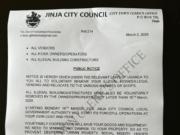






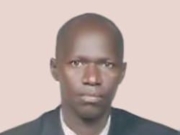



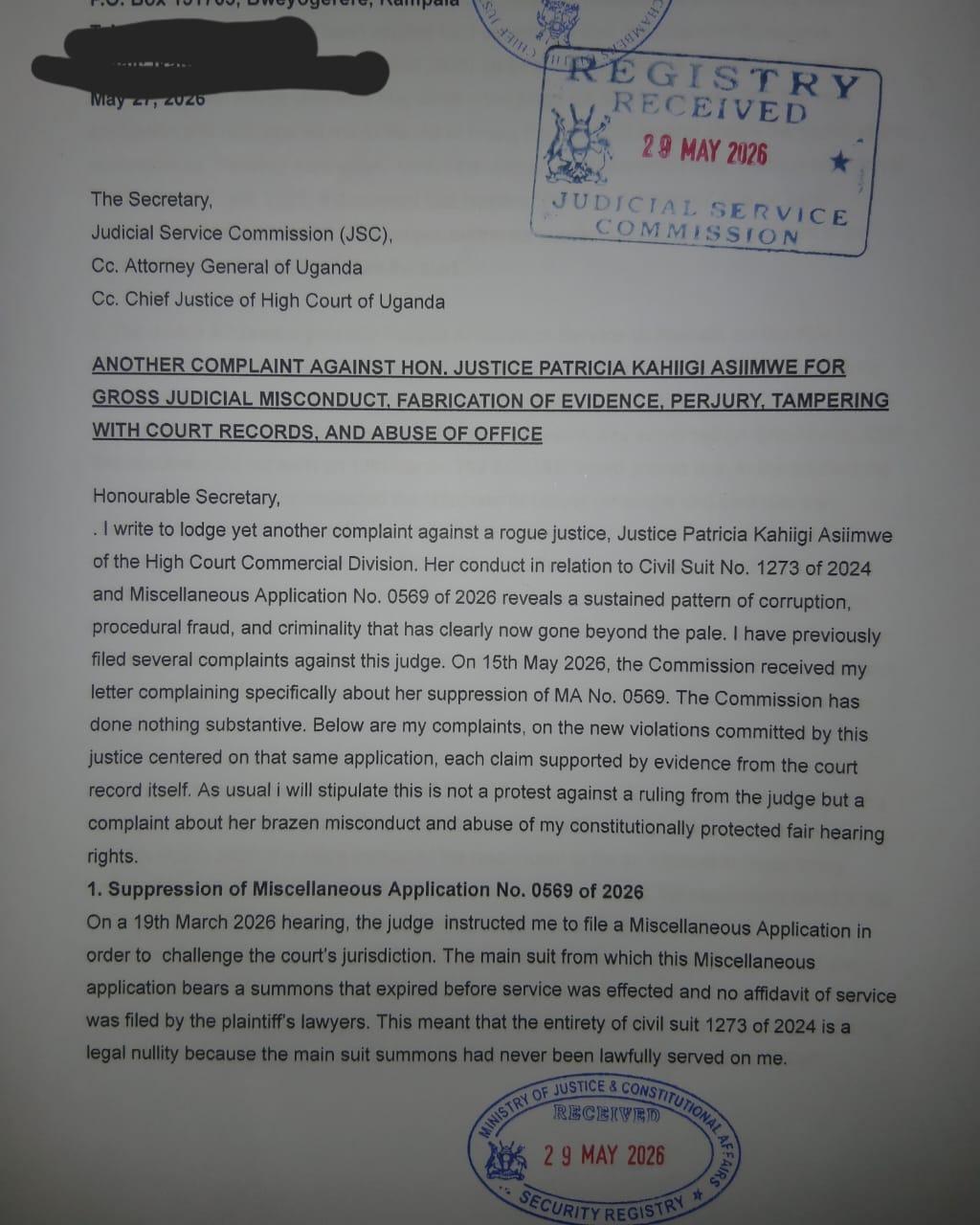
The Judicial Service Commission (JSC) is now seized of a fresh complaint against a High Court Commercial Division judge, after a self-represented litigant accused the court of suppressing his jurisdictional challenge, entertaining forged documents, allowing an unlicensed advocate to appear in Civil Suit No. 1273 of 2024, and presiding over proceedings he says have put his personal safety at risk.
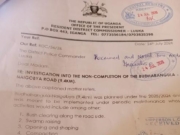
The complaint, stamped received by the JSC and the Ministry of Justice and Constitutional Affairs on 29 May 2026, targets proceedings before Hon. Lady Justice Patricia Kahigi Asiimwe.
The complainant, who asked not to be named citing ongoing litigation and personal safety, calls it “another complaint against a rogue justice” and says earlier petitions to the Commission have drawn “nothing substantive.” He further alleges there have been attempts to kidnap and harm him.
However, The Exposure Uganda has not been able to independently verify the allegations.
At the heart of the dispute is Miscellaneous Application No. 0569 of 2026, a jurisdictional challenge the litigant says he was instructed to file in open court on 19 March 2026. He filed it via ECCMIS on 24 March 2026.
Yet, he alleges, it sat “Pending Admission” for over 60 days, never reaching the official record, in breach of Rule 15 of the Judicature (Electronic Filing) Rules, 2025.
ECCMIS timestamps he attached show the judge accessed and signed the summons on 25 May 2026 at 09:46 am, a day before a “Call Mention” he insists has no basis in the Civil Procedure Rules.
The main suit was filed by private individual Mr. Kiplangat Jacob Chelogoi, seeking UGX 120,000,000 in alleged rent arrears tied to a 10 October 2023 tenancy agreement.

Kiplangat Jacob Chelogoi contested in the 2026 general election for Kween County MP seat as an independent candidate but lost to the incumbent Hon William Chemonges(NRM)who obtained 19,762 votes)against his of 12,704 votes coming in the second place.
The complainant argues the entire case is a “legal nullity” because the summons expired on 13 November 2024 without service, and no affidavit of service appears on file. Order 5 Rule 1(3)(a) of the Civil Procedure Rules states a suit “shall be dismissed without notice” if summons is not served within 21 days and no extension is sought.
Beyond jurisdiction, the complaint details a string of alleged forgeries. A process server, Kyambadde Ali, swore an affidavit claiming he served the Chamber Summons on 13 March and 17 March 2026, days before the judge ordered it filed on 19 March.
The complainant calls that “physical and legal impossibility” and provided copies with the contradictory dates highlighted. He further alleges the plaintiff’s advocate, Mr. Elau Emmanuel, has appeared without a valid practicing certificate since 18 November 2024, contrary to Section 14(1) of the Advocates Act.
The plaintiff’s own filings, the complaint adds, annex a promissory note imposing 20% monthly interest, or 240% per annum. The complainant argues that rate violates Legal Notice No. 21 of 2024, which caps moneylender interest at 2.8% per month, and that the plaintiff operated without a license under the Tier 4 Microfinance Institutions and Money Lenders Act, 2016.
“A court shall not enforce an illegal contract,” he writes, citing Section 10(4) of the Contracts Act.
The record of proceedings is also contested. For a 26 May 2026 hearing, the court clerk’s notes say the complainant was absent. The complainant says he has an 11-minute audio recording proving he was present, objected, and was threatened with removal from the courtroom.
Two earlier applications in the same matter, MA 1063 of 2025 and MA 0941 of 2025_, were dismissed by ruling on 13 October 2025. The complainant says he fired his former lawyers, Nabukenya Mularia and Co Advocates, for refusing to raise objections, and has a case against them at the Uganda Law Council, LCD 48 of 2025. He lists further complaints filed with the Deputy Registrar Commercial Court, Head Judge Commercial Court, Inspectorate of Courts, IGG, DPP, and UMRA, but says he has received “no substantive response.”
On next steps, the complainant says he has written to the Registrar to withdraw MA 0569 of 2026 because it was never admitted, and that he will not attend further hearings before the judge. “If the judge rules against me on the nullity of the main suit, I will appeal,” he states. He adds that a criminal case against the plaintiff for alleged impersonation of an advocate is proceeding this month.
Judiciary Responds.
His Worship Ereemye Jumire James Mawanda, the official Spokesperson and Public Relations Officer of the Judiciary in Uganda, provided the following response verbatim:
“As a Judiciary, we work for the people from whom we derive our mandate. In so doing, we serve the ends of justice. The ends of justice go through Substantive Law and Procedural Rules.
Many litigants often don’t understand the law and court procedures especially where for the ends of justice a Judge makes an order or directions in any matter.
This lack of knowledge often leads to complaints. Any part to a case who feels dissatisfied with the conduct of a judicial officer may lodge a complaint. If the dissatisfaction is on a decision, he has recourse to Appeal, Review or Revision.
The matter was filed before the JSC, who have the mandate to Inquire into it and until then, we can only wait for the decision of the JSC on the matter who will advise the complainant and the Judiciary.”
What Happens Next.
Under Article 147 of the Constitution, the JSC is mandated to investigate complaints against judicial officers. Parties aggrieved by rulings may seek appeal, review, or revision under the Civil Procedure Rules and Judicature Act. The Judiciary has not commented on the specific allegations, citing the ongoing JSC process.
The claims in the complaint remain untested. All individuals mentioned are presumed to have acted lawfully unless a competent authority finds otherwise.
Conclusion.
In a constitutional democracy, no institution operates above scrutiny. The Judiciary, by its very design, is the temple of justice and the final arbiter of disputes. Its mandate is sacred, its independence non-negotiable. Yet independence is not insulation from accountability. It is here that the media assumes its own constitutional duty-not as a rival, but as a necessary companion to justice.
The Exposure Uganda (TEU) does not fear to tackle any topic or issue, however sensitive, however powerful the actors involved. We interrogate power because the public has a right to know, and because sunlight remains the best disinfectant.
We do so with a high level of professionalism, guided by facts, balance, and the law. We are not for or against any entity or individual. We are a watchdog — loyal only to truth, to public interest, and to the Constitution that binds us all.
The Judiciary interprets the law. The media interprets reality. When the two work in their proper spheres, each checking the other, the citizen is protected from both tyranny and silence. A courtroom without a free press is a room with the doors shut. A press without ethics is a flashlight with no beam.
The Exposure Uganda chooses to be the beam, steady, unblinking, and pointed where the public needs it most.
Our mandate is not to convict in print, nor to exonerate on a page. It is to place the record in the public square, to ask the questions the files alone cannot answer, and to ensure that the machinery of justice is not left to run in the dark.
We report the complaint. We report the defense. We report the process. The verdict belongs to the institutions empowered by law. The vigilance belongs to us all.
Our acclaimed slogan We Expose, You Decide remains unchanged.