




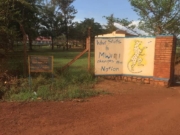












Uganda’s science and innovation story is being rewritten from the slopes of Mwiri Hills in Jinja, where Viva College, a premium secondary school that has become a household name across Busoga, the Eastern Region, and the entire country, is producing the kind of problem-solvers President Yoweri Museveni has been calling for.
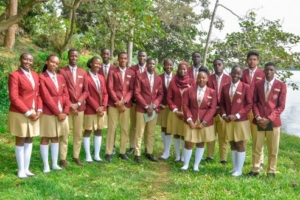
In just 10 years, Viva College has transformed from a new school into an academic powerhouse known for holistic education — where discipline, smartness, and academics are non-negotiable.
“7 Days Here And You Are Not The Same”
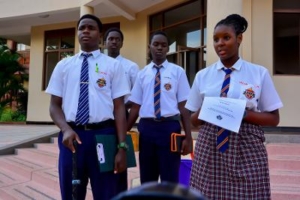
The Principal, Denis Alfred Anguyo, is visibly thrilled by what the school has become. “At this 10-year-old secondary school, any student who steps foot here even for only 7 days does not remain the same,” Anguyo said. “Everything here is top-notch — from discipline, smartness, to academics, dormitories, and the dining hall.”
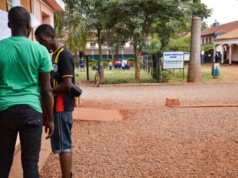
This was immediately evident to this reporter. From the school gate, through reception, to the principal’s office and into the computer and science labs, there were more than 7 dozen greetings. Students stopped to greet a visitor. Teachers and other staff bowed to greet.
It was respect without pretense — the kind rarely seen in some schools. Incredible.
That culture of respect, Anguyo says, is the foundation on which innovation thrives. “A disciplined mind is a creative mind.”
Science Is Now The National Catchphrase.
Science has moved from the classroom to the center of national policy. With a fully-fledged Ministry of Science, Technology and Innovation and a well-funded Department of Science Technology and Innovation in the Office of the President, President Museveni has made it clear: Uganda’s future will be built on homegrown solutions, not imports.
The goal is to move Uganda from a consumer of technology to a producer. From agro-processing to health tech, government is betting on young Ugandans to drive “Kisanja No Sleep 2026-2031” through innovation and value addition.
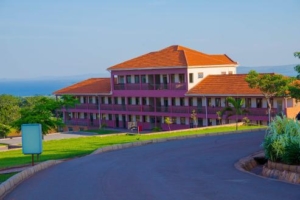
Viva College, perched proudly with a view of Lake Victoria and cooled by breezes from Africa’s largest fresh water body, appears to have answered that call early.
The Innovators: Katongole And Muganzi.
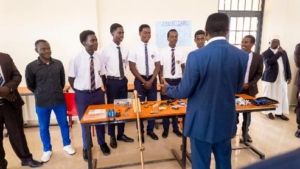
At the heart of it are two Senior Three students from the Computer Science class: Katongole Steven and Muganzi Leona Nissi — described by their teachers as great and inquisitive minds.
Katongole, who also serves as Head Boy and President of both the ICT Club and Robotics Club, is leading from the front. Muganzi is his driven lab partner. Together, under the guidance of Isaac Oketcho, the youthful Head of the IT Department, they are building solutions for real Ugandan problems.
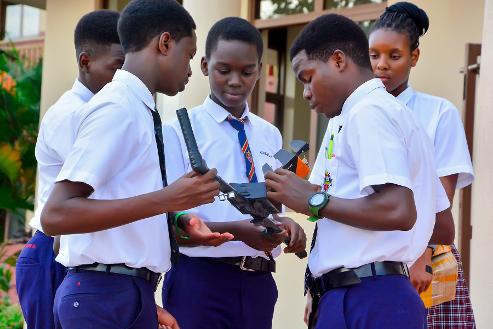
Through Katongole’s ingenuity, the school has come out with dozens of innovations. The latest, and most touching, is a sensor-sensitive Blind Man’s Walking Stick, now branded the “White Cane Stick”.
History Meets Technology: The “Smart White Cane”
The white cane was first introduced in the 1930s as a mobility and identification tool for the visually impaired. Traditionally, it helps a user detect obstacles through touch. But it cannot detect potholes, water, or objects above waist level.
The Viva College prototype changes that. Currently kept in the computer and science lab, the smart cane is a pipe fitted with multiple components for different tasks. It has a sensor to detect objects ahead, another sensor to detect water, a vibrator motor that alerts the holder, and an Arduino board that triggers different sounds depending on whether it’s an object or water.
“This is one of the premium projects which we want to advance, polish, and roll out to the country as part of indigenous innovation,” said Mr. Oketcho.
More Breakthroughs From The Lab.
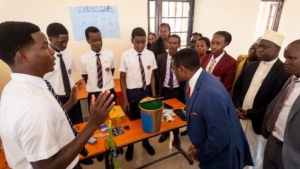
The same team is not stopping at the cane. They have also developed a sensor-sensitive trash bin that does not require any physical contact. The bin senses the holder of the trash, opens automatically for them to drop, and then closes by itself — a practical solution for hygiene in schools and public places.
Another innovation is a sensitive system that detects the level of humidity or warmth in an area and guides people to direct water to the affected spots. This has potential use in agriculture and fire prevention.
The group has also built a prototype river and lake cleaner that detects foreign pollutants in water through vibration and guides experts to remove them. It could become a critical tool for protecting Lake Victoria.
Katongole, a total orphan, and Muganzi are quick to say it’s about mindset.
“We have the potential to do basically everything once we have the right mindset, a conducive environment, and adequate financial and moral support and encouragement — like is being done at Viva College,” they said.
Appeal For Partnership To Save Innovations From The Lab
School leaders are now appealing to the country to take notice.
According to Rev. Fr. Richard Gonza Kayaga, one of the founding board members of Viva College, the school is seeking partnerships with interested stakeholders to push for support.
“We do not want these wonderful innovations to die in the labs. That would demotivate the students who are working so hard,” Fr. Kayaga said. “Individuals, ministries and corporate bodies should pick interest in the innovations and academic work taking place at Viva College.”
To move these projects from prototype to product, experts say funding and incubation through the Ministry of Science, Technology and Innovation, the STI Secretariat, and Uganda Industrial Research Institute will be critical. Fast-tracking testing and certification of the smart cane with the Ministry of Health and the National Union of Disabled Persons of Uganda can also open the door for use in schools for the blind.
Public-private partnerships with telecoms and manufacturers can further adapt the trash bins and water sensors for smart city projects in Jinja, Kampala and beyond.
Motivating The Next Katongole,Muganzi.
Katongole’s story proves that talent is evenly distributed, but opportunity is not.
To keep students like Katongole and Muganzi motivated, stakeholders propose scholarships and innovation grants to help scale prototypes, national science expos where students can pitch directly to investors, mentorship by linking them to engineers in the Department of STI, and intellectual property protection so they benefit when their ideas are commercialized.
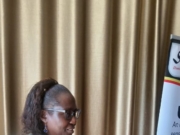
Muganzi in an interview says her ambition is to become a software engineer and to set up her personal private tech firm in which she will employ fellow youth, especially girls and motivate them towards the same.
On his part, Katongole says the sky is even no longer the limits meaning he will work extremely hard and smartly to not only establish a tech firm but to become a national consultant of repute.
As President Museveni continues to push science as Uganda’s development engine, schools like Viva College show what is possible when you combine visionary leadership, strict discipline, and youthful determination.
From a cane that can “see” to bins that open on their own, the message from Mwiri Hills is clear: the future is being built here, by Ugandans, for Ugandans.
The Battle Of The Hill: Who Owns And Rules Mwiri?
For decades, people have referred to Church-founded Busoga College Mwiri simply as “The School”. It was the undisputed name, the undisputed king of the hill.
But something has shifted on Mwiri Hills. Today, many are now referring to Viva College as “The College”.
And just like that, a friendly but fierce competition has been born — a quiet contest on who truly owns and rules the Hill.
Why Hills Matter — A Global Story.
Historically, whoever controls the hill controls the story. From the Acropolis in Athens to the Castle on Edinburgh’s Royal Mile, from Kampala’s seven hills to the Vatican on Vatican Hill — hills have always been about strategy, visibility, and prestige.
Hills mean fresh air, good drainage, a commanding view, and respect. To sit on a hill is to be seen. To teach from a hill is to shape a nation.
Mwiri Hill is no different. It has always been more than geography. It is identity.
Mwiri Today: Top Vs Bottom Slope. On Mwiri, the geography itself tells the story. Busoga College Mwiri sits— the crown, the watchtower, the old guard. Viva College sits literally on the bottom slope — smiling up at Lake Victoria, catching literally on top, the cool breeze, and building upward with speed.
For years it was quiet. One hill, one name. Now the hill has two voices.
The New Battlefield: Academics And Innovation.
But this is not a fight with sticks or slogans. The real battle today is in classrooms, labs, and innovation hubs. It is who produces the best results. Who builds the smartest solutions? Who turns students into problem-solvers?
Is it the cane that can “see”? Is it the bin that opens on its own?
Is it the discipline where a student stops to greet you 7 dozen times before you reach the principal’s office?
Whoever leads on that front will earn the new crown.
Whoever leads will be crowned the Academic Lion of Mwiri Hill.
Whoever leads will be called the Conqueror of Mwiri.
And the students know it. The teachers know it. Even the breeze coming off Lake Victoria seems to be watching.
Humor In The Rivalry.
Do not get it twisted — this is a healthy rivalry. Busoga College says: “We are The School because we were here first. We own the peak.”
Viva College replies: “We are The College because we are building the future. We own the momentum.”
One guards the summit. The other is climbing with robotics kits, Arduino boards, and smart canes in hand.
In the end, Mwiri Hill wins either way. Because competition on a hill does not destroy — it lifts. It pushes both institutions to be sharper, cleaner, smarter, and more innovative.
So let the games begin. May the best Lion of the Hill win.
And may Uganda’s children be the ones who benefit.
From the top of the hill to the bottom slope, Mwiri is teaching Uganda one lesson: when minds compete, a nation rises.
The Exposure Uganda (TEU)Editorial.
From Mwiri Hills, A Lesson for Uganda: Innovation Must Not Die In The Lab.
There is something deeply encouraging happening on Mwiri Hills in Jinja.
In a country where we often lament the “brain drain” and our over-reliance on imported solutions, a 10-year-old secondary school is quietly showing us what is possible when discipline meets curiosity, and when leadership decides that science is not just a subject, but a way of life.
At Viva College, Senior Three students are not waiting for graduation to solve Uganda’s problems. They are building a sensor-sensitive “Smart White Cane” for the visually impaired. They have designed a touch-free trash bin for hygiene.
They are prototyping a river and lake cleaner to protect Lake Victoria. And they are doing all this with Arduino boards, grit, and a Head of IT Department who believes young minds should be allowed to fail forward.
This is exactly the kind of patriotism President Museveni has been calling for under the Ministry of Science, Technology and Innovation. The future of Uganda will not be built by importing finished products. It will be built by Ugandan boys and girls who look at a pothole, at poor sanitation, at waste in our lakes, and say: “I can fix this.”
The Battle That Benefits Us All.
Mwiri Hill has long been home to Busoga College Mwiri — “The School”. Now it is also home to Viva College — increasingly called “The College”.
But this is not the kind of rivalry that divides. This is the kind of competition that lifts. The real battle on Mwiri is no longer about who sits on top of the hill. It is about who produces the best thinkers, the best innovators, the best citizens.
Whoever leads that battle will rightly be called the Academic Lion of Mwiri Hill. And Uganda wins either way.
But Innovation Without Support Is Frustration.
Here is where we must pause. As Rev. Fr. Richard Gonza Kayaga, a founding board member of Viva College, warned: “We do not want these wonderful innovations to die in the labs. That would demotivate the students.”
He is right. Uganda has a graveyard of brilliant school projects. Science fairs are full of prototypes that never see a factory, never get patented, never get funded. A child builds something in S.3, and by S.6 it is forgotten.
That cycle must end. Our Appeal for Action.
To Government: The Ministry of Science, Technology and Innovation and the STI Secretariat must create a fast-track lane for secondary school innovations. Test the Smart Cane. Certify it. Partner with UNAPD to deploy it in schools for the blind.
To the Private Sector: Banks, telecoms, and manufacturers in Jinja and Kampala pick interest. An innovation grant of 10 million shillings today can become a Ugandan product exported in 5 years. That is ROI (Return On Investment).
To Parents and Communities: Send your children to places where discipline and science are taken seriously. A school where students greet 7 dozen times is a school where character is being built alongside code.
To the Students: Katongole, Muganzi, and your peers — keep going. The nation is watching. Your mindset is your greatest asset.
Conclusion.
From the top of Mwiri to the bottom slope, from “The School” to “The College”, one message is clear: Uganda’s development will be won in classrooms and laboratories.
Viva College has shown us the spark. Now it is up to all of us — government, corporate bodies, individuals, and ministries — to make sure that spark becomes a fire.
Because when a child’s innovation dies in the lab, a nation’s future dies a little too.
The Exposure Uganda (TEU) believes in Uganda’s young innovators. And we will be watching Mwiri Hills closely. We Expose, You Decide.
Do you agree? Send your thoughts to exposureuganda000@gmail.com or call 0792140712 or WhatsApp 0776462509.