















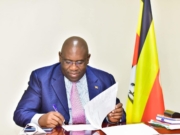




Jinja City is headed for a legal and political showdown after City Speaker Ssozi Juma ordered the suspension of the ongoing garbage management tender, only for the Town Clerk to reject the directive and insist the procurement process will continue.
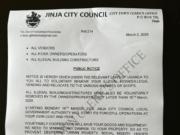
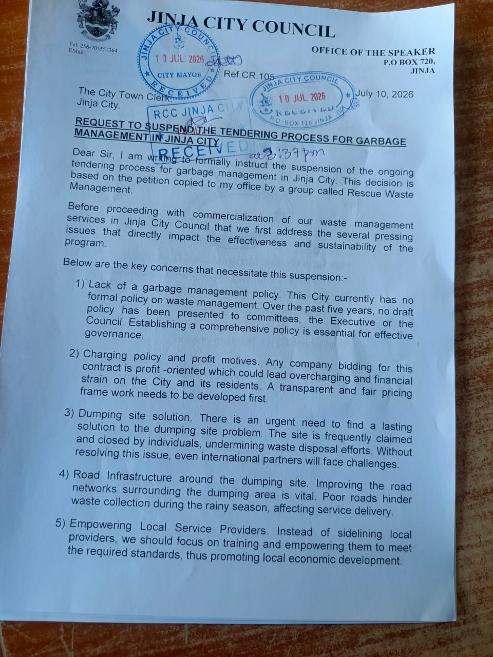
In a letter dated 10 July 2026, Ref. CR 105 and addressed to Town Clerk Godfrey B. Kisekka, the Speaker halted all procurement activities citing lack of a waste management policy, unresolved dumping site challenges, and concerns over profit-driven pricing.
“Before proceeding with commercialization of our waste management services in Jinja City Council, it is important that we first address the several pressing issues that directly impact the effectiveness and sustainability of the programme,” reads the Speaker’s concern.
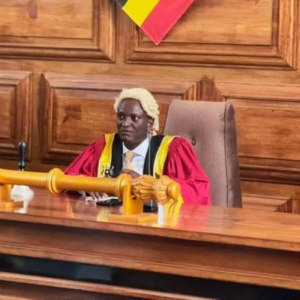
The Speaker further questioned the procurement procedures, arguing that the Council which he presides over had not given input, and wondered how the 3-year contract term was arrived at in the bidding process.
“In light of the above points, I respectfully call upon the Town Clerk and the Principal Procurement Officer, Ms. Janet Nabwonso, to halt all activities related to this tender until these issues are thoroughly addressed,” Ssozi’s two-page letter reads in part.
The letter was copied to Local Government Minister Hon. Balaam Barugahara Ateenyi, PS Ben Kumumanya, RCC Salim Komakec, Mayor His Worship Hajji Abdulhafidh Nagaya, and Division Mayors HW Simon Kasirye and HW Ayub Wabika.
Ssozi’s Argument: “We Need Systems First”.
The directive follows a petition by Rescue Waste Management, a local group opposed to the commercialization of waste services.
In laying out his position, Ssozi cited key issues that he said must be addressed first:
No garbage management policy. “This city currently has no formal policy on waste management. Over the first 5 years, no draft policy has been presented to committees, the executive or the council. Establishing a comprehensive policy is essential for effective governance.”
Charging policy and profit motives. The Speaker warned that any company bidding will be profit-oriented, which “could lead to overcharging and financial strain on the city and its residents.” He said a transparent pricing framework must be developed first.
Dumping site problem. He noted there is an “urgent need to find a lasting solution” as the site is “frequently claimed and closed by individuals” — undermining disposal efforts. “Without resolving this issue even international partners will face challenges.”
Poor road access. “Improving the road networks surrounding the dumping area is vital. Poor roads hinder waste collection during the rainy season affecting service delivery.”
Empowering local providers. Instead of sidelining them, the Speaker said the city should “focus on training and empowering” local waste service providers to meet standards and promote local economic development.
Procurement process and Council role. He raised concerns over “how the Procurement Officer arrived at the 3 year term specified in the bidding process” and insisted all procurement must align with Council decisions.
Ambassador Kezaala Weighs In, Urges Caution On Roles.
The former Mayor of Jinja Municipality, Hajji Mohammed Beswari Kezaala, who now serves as Deputy Head of Mission in Doha, Qatar, has also commented on the impasse.

Speaking in a guarded tone, Amb. Hajji Kezaala said the matter requires careful adherence to procedure to avoid legal and political missteps in a city already prone to speculation.
“With due respect, this letter/directive raises procedural questions that we must handle carefully. Whereas Local Government Speakers act as official spokespersons for Council resolutions, administrative direction is ordinarily premised on a valid council resolution. To my knowledge, that resolution is not available at this stage,” he said.
He added that the mayor, as the political overseer and executive head of the city, has a routine role of bridging the political and technical arms and representing community interests.
“It is important that we do not appear to step outside our respective mandates. The Speaker superintends over Council, not the city. Administration of the technical arm belongs to the Mayor through the Town Clerk. Matters to do with procurement are best handled through valid council resolutions or constructive administrative dialogue with the technical team,” Hajji Kezaala cautioned.
Town Hall: “Procurement Cannot Be Stopped By Letter”
In a swift response, Senior Town Clerk for Southern Division Nathan Kitakule said procurement under the PPDA Act cannot be stopped by administrative correspondence from a political office.

The Town Clerk noted that garbage management is an essential service under the Local Government Act and that halting the process mid-way would expose the city to legal and public health risks.
“Management has taken note of the concerns. However, the procurement process shall continue in accordance with the law while we concurrently address the policy and infrastructure issues raised,” he said in a brief phone interview after a consultative meeting.
Another Town Hall official, who preferred anonymity, stated that the Contracts Committee is the only body mandated under Section 45 of the PPDA Act to suspend or terminate a procurement, and that must be based on specific grounds like lack of funds or public interest.
Legal Question: Who Can Stop A Tender?
The exchange has sparked debate on separation of powers under the Local Government Act Cap 243 and the PPDA Act, 2003 as amended.
Under PPDA:
Section 58 gives power to suspend or cancel procurement only to the Accounting Officer – the Town Clerk – and only after approval by the Contracts Committee under Section 45.
Section 95 provides for administrative review. An aggrieved bidder must petition the Accounting Officer, then PPDA, then courts. A letter from the Speaker is not a recognized instrument to stop a PPDA process.
Under The Local Government Act:
Section 12 vests executive authority in the mayor. The Town Clerk takes administrative direction from the Mayor through the City Executive Committee.
Section 14 defines the Speaker’s role as presiding over Council and maintaining order. The Act does not grant the Speaker administrative authority to issue instructions to civil servants.
Legal experts say the Speaker’s letter amounts to political oversight, not an enforceable order. “Acting alone risks being seen as overzealous and acting ultra vires,” one official said.
Background: Other Burdens Weighing On Jinja City.
Garbage disposal and management is not the only challenge Jinja City faces. While the standoff over the waste tender has put the spotlight on sanitation, Town Hall is grappling with a much longer list of problems that have frustrated both residents and experts for years.
Roads In Horrible State.
The road network in Jinja City is in a dire state, and it remains one of the biggest complaints from industrialists, traders, boda-boda riders, and motorists. Potholes, dusty murram stretches, and sections that become impassable every rainy season have slowed trade and damaged vehicles.
Urban planning experts have long argued that at the current rate of funding and execution, it would take Town Hall not less than 200 years to fix all city roads. Their point is simple: by the time the last road in the queue is worked on, almost 90 percent of the earlier ones will already need renovation again.
Street Lighting: A Costly Thorn in The Flesh. Street lighting is another persistent headache. Many parts of Jinja go dark at night, creating security risks for residents and traders closing late. The issue of street children attacks on Radio Road and other poorly lit areas in December 2025 only underlined the danger.
Town Hall has tried to float solar street lights as an alternative. But experts say procurement has become a major hurdle. The cost of solar installations from contractors often comes with inflated rates, with the biggest beneficiary being the middleman who must “satisfy many invisible hands” to win the deal.
Because of this, some experts have been advocating for a concession model. Their proposal is that Uganda Electricity Generation Company Limited – UEGCL, the government company that owns and operates the Nalubaale and Kiira power generation dams in Jinja, or Uganda Electricity Distribution Company Limited – UEDCL, which owns all the electricity distribution network below 33kV across Uganda, should take on the responsibility of lighting all streets of Jinja City as part of the city’s host community benefits.
The argument is anchored in law.
Under The Electricity Act, Cap 157: The Act establishes the framework for generation, transmission, and distribution of electricity in Uganda. It mandates the Electricity Regulatory Authority – ERA to regulate tariffs, licensing, and service standards. Section 34 and related provisions also allow ERA to impose public service obligations on licensees, which can include community infrastructure support.
Under The Uganda Electricity Regulatory Authority Act, Cap 155:
This Act creates ERA as the regulator. Its role is to protect consumer interests, promote efficiency, and ensure that licensees meet their obligations to communities where they operate. Experts argue ERA could direct UEGCL and UEDCL to include street lighting for Jinja as part of corporate social responsibility and licensing conditions.
Street Kids and Urban Decay. The problem of street children has also evolved. What began as a social welfare issue has graduated into a public safety concern, with some of the children now grown into “street men” who are linked to petty crime and attacks on residents.
Lack Of A City Mortuary And Dilapidated Buildings.
In the health sector, Jinja City still operates without its own public mortuary. Bodies are often taken to the regional referral hospital or to private facilities, at a cost that many families cannot afford.
Compounding this is the state of custodian buildings. Several government and council properties in the city center are in a very sorry state — leaking roofs, cracked walls, and no maintenance for years. Worse, many of them are entangled in court cases over ownership, tenancy, and compensation.
The Political Tug-Of-War.
The standoff has laid bare the growing friction between Jinja’s legislative and executive arms. On one side, the Speaker is pushing for “systems first” — policy, infrastructure, and public consultation before any contract is signed. On the other, the Town Clerk and technical team argue that service delivery cannot wait for perfect paperwork while garbage piles up in markets and drainage channels.
Caught in the middle are residents. In Walukuba, Masese, Mpummudde-Kimaka, Central Market, and Bugembe plus Mafubira, traders and residents say heaps of waste have become a daily sight. “We don’t care who signs what,” said one vendor. “We just want trucks on the road and the stench gone.”
Council is expected to debate the matter in the next sitting. Until then, sources in the Procurement Unit say bid evaluation is ongoing and contracting will proceed.
Analysts say this is the first major governance test for Mayor His Worship Hajji Abdulhafidh Nagaya, barely four months into his 5-year term.

In the end, the question may not be “who is right” between the Speaker and the Town Clerk. The question Jinja residents are asking is simpler: “Are we being fair to the wananchi who deserve clean streets and working services, or are we nursing personal and political agendas?”
For now, all eyes are on whether Mayor Nagaya and Town Clerk Godfrey B. Kisekka can sit down and find a win-win formula before the garbage crisis — and the legal one — gets worse.
We Expose, You Decide…We are The Exposure Uganda (TEU)