












There are songs you hear in passing while the radio plays in the background, and then there are songs that stop you in your tracks and test the very core of who you are and where you come from.
For decades in Lango, “Ogwang Owoto I Nam Pe Dong Dwogo” has been one of those songs. If you know it, if it tightens something in your chest when you hear the first line, if you find yourself humming it without thinking while you hoe or while you wait for a taxi or on a boda-boda from Ngetta then you are Lango.
Translated plainly, it means: Ogwang went overseas and will never come back.
How It Started: One Father, One Son, One Path That Went Silent.
The story, as it has been told for generations around fires and in low voices, begins with an old man and his only son named Ogwang. One day Ogwang left home for a faraway place, and he left without letters, without messengers, and without giving anyone a return date.
The years rolled on with a quiet cruelty that only waiting parents understand. Planting seasons came and went. The rains fell and dried up again. And every night the father would sit outside under the moonlight, his walking stick resting against the wall of the hut, his eyes fixed on the same path that never brought footsteps.
And in the silence, he would sing, his voice breaking with age and grief:
“Ogwang owoto i nam, pe dong dwogo.
Ogwang owoto i nam, pe dong dwogo.”
Ogwang went across the waters, he will never return.
It was grief, but it was also a question, a prayer, and a surrender all at once. The old man eventually died waiting for a son who never came. The song, however, refused to die with him.
The Other Ogwangs: War, Schools, and the Road to Moscow.
Another version of the origin places the song in the years immediately after World War 2, when for the first time some Lango parents allowed their sons to go “overseas” for skills training.
But “overseas” was a frightening word back then, because the memory of the slave trade was still fresh in people’s minds. Many parents were deeply suspicious of mzungu, and so they sent the son they could afford to lose — the quiet one, the stubborn one, the one who was never the favorite.
From that suspicion, two different Ogwangs entered our folklore.
Ogwang Ber Idwogo meaning Ogwang, it’s good you returned.
Oral accounts say he was the son of Okwir Enoka from what is today Aboke. At that time Aboke was still part of the larger Lango District, because the whole of Lango was one district until during Amin’s regime when it was split to create Lira and Apac.
Today Aboke falls under Kole District. This Ogwang walked on foot all the way to Misiri, (Egypt), through Khartoun(Sudan), and then down to Mombasa port in Kenya. From there he found his way to Moscow in the then Union of Soviet Socialist Republics (USSR) for training, and later he lived in London. Fifteen years later he walked back home, and his return was considered so unlikely that it earned him a new name: Ber Idwogo.
The Ogwang Who Never Came Back.
The other account speaks of a bright boy, possibly from the Rwot Icaya Ogwang Guzi royal line, who was given to a mzungu.
Family accounts say he had already been written off at home, that he was the one they gave away so that whatever happened to him would no longer be their business.
The father liked the arrangement because apparently this son was naughty, but the boy proved sharp, and the mzungu kept him, schooled him, and gave him a new world.
So why should Ogwang return to a home that had already let him go?
He left — and he never returned.
It is this second Ogwang that the song remembers, the one who was sent away, found a new life, and chose not to look back.
What The Song Became: The Anthem of Absence.
Over time, “Ogwang Owoto I Nam” stopped belonging to just one family, and it became the song for every Lango house with an empty chair.
It became the song for the daughter who left for Kampala and stopped calling. For the brother who crossed into Sudan during the wars and was never heard from again. For the cousin who got papers, took a new name, and decided the past was better left across the water.
Lango people have always expressed what cannot be spoken in words through song, and so when a parent is missing a child, or when a clan is missing a name, they sing it quietly:
“Ogwang owoto i nam, pe dong dwogo.”
It carries the specific weight of absence without answers, the kind of loss where you don’t get a body and you don’t get closure. All you get is a melody.
The Many Ogwangs of Today.
The truth is, there are so many Ogwang Owoto I Nam walking among us today,scattered in many parts of the country and outside, they just answer to different names now.
They are the son in Dubai,in war torn Ukraine who does not send money back home and does not called home now for years. The daughter in California who changed her last name and told her children her parents “are late.” The brother in South Sudan or Central African Republic who crossed during the war and whose phone now rings into nothing. They have chosen, or been forced, to live and to die across whatever water they are in, because going back feels more painful than staying away.
And some of them have already died. Quiet deaths in bedsit rooms in Kampala, in labor camps in the Middle East, in hospital wards in Europe, and no one from the clan bothered to find out, to claim the body, or to ask what happened. The news came months later, if it came at all, in a WhatsApp forward: “Do you know this person?”, share the photo widely until it reaches the relatives”.
They left in anguish, not just because of poverty or war, but because some people had already built walls around them long before they left. Walls that said: you are not my brother. You are not my sister. You are a stranger, the same way one brother treated another over a small piece of less than 4 acres of land in Oyam.
And then, in a cruel irony, those who were left behind helped to pour concrete on those walls. By refusing to ask. By refusing to know. By changing the topic when a name is mentioned. By saying “let them be, they chose their path.”
So today they prefer to push wheelbarrows in faraway places for those with little credentials while others have since acquired citizenships and do not want anything call home.
There are those who prefer to be cleaners of toilets in foreign countries. They prefer to be anything from a watchman, a farmhand, a name on a work permit — other than going back home to the people who pushed them.
That is why the song still aches. Because Ogwang is no longer one boy from Aboke. Ogwang is every name we do not speak at funerals. Ogwang is every empty chair we have agreed not to talk about.
“Ogwang owoto i nam, pe dong dwogo.”
Why Some People Don’t Want To Hear It.
And in the same way, you will meet Lango people who flinch the moment they hear the name of a certain relative. They will change the topic, or they will quietly leave the room.
You don’t know the story behind them. You don’t know who left them waiting under the moonlight. You don’t know who chose the “Ogwang way” — to go, and never come back. Sometimes because they were pushed, and sometimes because they chose it themselves.
Some wounds are not spoken, they are sung. Some people are not forgotten. They are mourned with a melody.
That is why this old tune remains an identity marker. To sing it is to say: I know what it means to wait. I know what it means to be left.”Ogwang owoto i nam, pe dong dwogo.”
Why We Build Walls: The Story of Aguda and Igwir.
Above all, this story is about walls — walls created by an individual, and walls created by others. And to understand that, you have to hear what happened three years ago in Adagayela village, Okii Parish, Otwal Sub- County, Oyam District.
There lived an elderly man called Mujee Aguda Teramot. His compound used to be the address everyone knew. When a family was broke, they knocked at his door. When clans quarreled, elders would say, “Let’s go ask Mujee Teramot.” The mentally disturbed (opoyi/jo awiigi obale) found food and rest there, and passersby on their way to Cuk Station better known as Cuk Tyen Gar or Aneka Piri in Alito sub county, Kole district would quench their thirst under his mango tree. Aguda was the man who opened his gate to everyone.
Then trouble came from inside the home, the family, just over a dispute on family land, his younger brother Igwir — in Lango that means “the stunted one” — turned violent and chaotic.
One night Igwir attacked Aguda with a panga but the old man survived by a whisker. Later, he sent hired youth to threaten him again. Clan elders could not do anything because Igwir had money but friends and well-wishers intervened and gave Aguda one warning: “Leave this place, or you will not survive.”
As the Lango say, Odyek ka oko iceng, igwoko romini — when the hyena laughs in daylight, guard your sheep.
So Mujee Aguda Teramot abandoned the land he had lived on all his life and bought another piece in Bedamanono village some miles away in another sub county. And there he has built and resettled. Eight feet high. Razor wire. One iron gate. A camera in the mango tree. And the veranda was closed.
“I am still a good person, but I can only help through the gate”,he says to anyone who bothers to listen.
Mujee Aguda’s story is not really about bricks. It is about what happens when the person who is supposed to be your blood becomes your enemy. It is about the wall that goes up in the heart long before the wall goes up in the compound.
Three Kinds of Walls.
Some walls are physical with bricks, razor wire, gates, and borders. The wall Mujee Aguda Teramot built in Bedamanono village. The ocean Ogwang crossed and never came back across.
Some walls are psychological, blackmail, shame, fear, trauma and memory. The wall that tells a single mother to stay silent. The wall that tells a rejected son: “don’t come back, we wrote you off.”
Some walls are spiritual — pride, greed, doctrine, and tribalism. The wall that makes a brother like Igwir chase another over land. The wall that makes us feel too holy to share a pew with someone else. All three keep people in. And all three, in the end, keep love out.
If Jesus Landed Today At Entebbe International Airport.
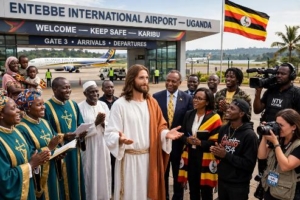
Caption: AI-generated image-Jesus Christ welcomed by a section of Ugandans of different backgrounds at Entebbe International Airport. We created it to illustrate the question: “Who Lets Him through the gate of their heart?”
Now imagine it is a cool weekend at Entebbe International Airport, and the breaking news comes that Jesus Christ has landed in Uganda, the Pearl of Africa.
Its dominating all news outlets both local and international like BBC, CNN, Aljazeera, New York Times, The Guardian and The Economist, with JUST IN or NEWS FLASH, among others.
Who would get the front row?
Would Ndere Troupe or the Larakaraka dancers from Nwoya or the Otule dancers from Otuke and the Ebonies be on the tarmac with drums? Would the Archbishop’s choir lead with Alleluia,or the Tukutenderza anthem? Would Pentecostal teams from Watoto and Miracle Centre arrive with flags, and would the Mufti assemble imams because “Isa al-Masih is also our prophet”?
Protocol would demand State House. The CDF would deploy SFC. The bands would play or the UPF band of IGP Abbas Byakagaba would come in handy since they maintain law and order?
And the ghetto boys from Kamwokya, Bwaise and Katwe would push to the front and shout:
“Bredda Jesus, mwana, yuh see di struggle weh deh yah? We nuh have nuff, but we have heart. Walk with we, show we di way.”
Politicians (NRM, PLU, FDC, UPC, PFF, ANT, JEEMA et al) would want photos. Businessmen would want blessings. Universities would want a lecture. Rivals who have not spoken all year would suddenly stand side by side.
And then there are us. The media personalities — the presenters, reporters, anchors, bloggers, vloggers, comedians, talk show hosts — who are now more in number than the trees left standing in Uganda’s forests. We would all want an exclusive, and we would all want Jesus to hold a news conference. Some would want him in the studio for a live talk show.
And what question would I ask? Would I ask about jailed Col Dr. Kizza Besigye and Erias Lukwago and their health in Luzira?
Would I ask about Uganda’s CDF General Muhoozi Kainerugaba(MK), and 2031?
Would I ask about President Yoweri Museveni’s endorsement of Olara Otunu and the succession question? Would I ask about KCCA and the potholes, the garbage, and the demolitions?
Would I ask about the floods and famine in Karamoja, or the frequent landslides in Bududa and Kasese? I might be tempted to ask whether he is going to attend Pastor Patience Rwabogo’s consecration as bishop.
Or would I ask about my own issue?
“Jesus, I want to manage the gold zone at Okemer in Abim District for just 6 months. After all, the riches are all Yours. So, handing the site over to me shouldn’t be a problem, right?”
In short, we would turn the Creator of the universe into a press secretary, and we would turn a moment of salvation into a chance to sort out our personal files.
But we would also bring our walls to the airport — the Catholic wall, the Anglican wall, the Pentecostal wall, the Muslim wall, the tribal wall, the political wall, and the class wall. The Igwir wall that chases brothers over land. The “new money” wall that chases wives from homes. The “too holy” wall that refuses a handshake.
We would argue over who sits next to Him, and we would debate the order of service before He even speaks.
The One Who Breaks Walls.
But Jesus does not come to admire our walls. He comes to break them.
He spoke to a Samaritan woman when Jews and Samaritans did not share cups. He touched lepers when the law said “stay away.” He ate with tax collectors and Pharisees in the same week, and He chose 12 men who disagreed on politics and tribe and made them family.
Paul wrote: “There is neither Jew nor Gentile, neither slave nor free, nor is there male and female, for you are all one in Christ Jesus.” Galatians 3:28.
Jesus breaks the wall of betrayal that drove Aguda from Adagayela to Bedamanono. He breaks the wall of greed that turns a brother like Igwir into an enemy. He breaks the wall of pride, of religious superiority, and of “what will people say.” He does not ask us to live with no walls. He asks us to live with gates.
Ogwang’s story began with a physical journey across water. It was sustained by a psychological wound of being written off. And it endures today as a spiritual question: who are we walling out, and why?
The Real Question: So, who would be there to welcome Jesus?
Everyone. And no one. Everyone, because Uganda would empty itself to see Him. No one, because if we came with our walls intact, we would miss Him standing in the middle asking for water, asking for the stranger to be fed, asking why His children are still divided.
The airport would be full, but the real question is not who meets Him at the gate. The real question is: who lets Him through the gate of their heart?
Because the walls we build to protect our doctrine, our money, our status, and our reputation are the same walls that end up keeping Him out.
Jesus is coming for Ubuntu: “I am because we are.” He will not ask your tribe, your church, or your mobile money balance. He will ask: “Who did you chase away? Who is eating alone tonight?”
A home with 8-foot walls and razor wire can still be empty if love is not inside. An air-conditioned SUV is a white elephant if pride remains in every seat.
“By this everyone will know that you are my disciples, if you love one another.” John 13:35.
That is the welcome He is looking for at Entebbe. Not banners. Not bands. But brothers who are no longer chasing brothers over a small piece of land.
So next time you hear a woman, or an old man, singing Ogwang Owoto I Nam Pe Dong Dwogo under the moonlight, be slow. Because behind that melody is a wall someone built. And behind that wall is a person who decided it was better to push a wheelbarrow far from home than to come back to the people who called them a stranger.
Is the wall around your life protecting your peace, or is it keeping the only One who can heal your heart on the outside?
For comments, story tips or to share your own experience:
WhatsApp / Call: 0776462509 | Call: 0792140712 | Email: exposureuganda000@gmail.com
TEU — We Expose. You Decide.