


















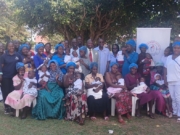











Senior Presidential Advisor on Poverty Alleviation, Hon. Florence Mutyabule, has warned that the upcoming school holiday must not become a season of child labour, as economic pressure pushes children, especially girls, onto the streets to supplement family incomes.
Schools across Uganda are scheduled to close for the second-term break on Friday, 21st August 2025, and reopen for Term Three on Monday, 14th September 2025, according to the Ministry of Education and Sports calendar.
Speaking on the sidelines of a three-day regional workshop for RDCs, RISOs and DISOs at the Source of the Nile Hotel in Jinja, Mutyabule, a former teacher and headteacher of CMS-founded Buckley High School, said both parents and schools are under strain.
She acknowledged that schools must meet obligations such as salaries, utilities and learning materials, while many parents are struggling with the rising cost of living. However, she stressed that the relationship between the two must be handled with mutual understanding.
According to Mutyabule, schools need learners and parents just as families need schools and teachers. She argued that dialogue, not confrontation, is the only way to protect children’s right to education without crippling school operations.
Children Vending Late Into The Night.
Hon Mutyabule raised alarm over the growing number of children vending in trading centers across Jinja, Iganga, Kamuli and Bugiri until late hours. She said it was common to find girls as young as 8 selling bananas, maize, beans and greens up to 9pm and 10pm.
She questioned whether such activity should be described as business or as exploitation, and asked who takes responsibility for the safety of children on the streets at night.
Many of the children, she explained, come from extremely poor households. Others are brought to town with promises of schooling, only to be given trays and abandoned.
The risks, she noted, are severe. For girls, they include defilement, teenage pregnancy and exploitation. For boys, the lack of supervision often leads to drugs, crime and a rush for quick money. The result, she said, is a generation being prepared for prison instead of for productive futures.
During a recent visit to Jinja Central Market, she found four girls aged between 10 and 13 selling oranges until 9:30pm. In Mayuge, she cited cases of boys dropping out after Primary 6 to load trucks at taxi parks for as little as Shs 5,000 a day. Once a child begins earning Shs 10,000 daily, she said, they start to see themselves as adults, but at the cost of their childhood and education.
Fees And The Case For Payment Plans.
Hon Mutyabule identified school fees and arrears as the main driver of holiday child labour. In Busoga, Term Three charges range from Shs 300,000 to Shs 800,000 in both day and boarding schools.
She urged parents and school administrators to return to dialogue instead of resorting to threats, phone blackouts and sending learners home. Such actions, she said, only harm the child.
Drawing on her experience as headteacher, Hon Mutyabule recalled a time when schools and parents signed formal payment plans.
Under those arrangements, a parent would pay a portion of fees upfront and clear the balance in installments, sometimes extending into the holiday. Once an agreement was signed, the child remained in class and sat exams, while the school planned with the funds received.
She lamented that many schools have abandoned that approach, and now send children home over balances as small as Shs 20,000, causing learners to lose weeks of instruction.
She also advised parents to select schools within their financial means, arguing that planning, not debt, is what sustains a child’s education.
Home-Based Enterprises As A Buffer.
To address the root cause, Hon Mutyabule proposed strengthening household incomes through mini cottage industries run from home.
She said equipment available through the Parish Development Model and Emyooga programs, such as sewing machines, fruit blenders and baking trays, could be used to start small enterprises.
She defined cottage industries as small, home-based businesses where parents and children work together after school to bake, sew, make juice or produce soap. This, she said, keeps children supervised, teaches them skills and generates income without exposing them to danger.
Hon Mutyabule pointed to countries like India, Japan, China and Italy, where global brands began as small family workshops. She argued that Uganda could follow the same path, growing from one sewing machine to a tailoring shop, or from one blender to a juice business.
She urged households to use PDM and Emyooga funds productively. Rather than spend Shs 1 million in a month, she said, families should invest in tools that can work for them for years. She cited a women’s group in Bugweri that used Emyooga money to buy three sewing machines and now supplies uniforms to four primary schools, while their children remain in class.
INTERNATIONAL EXAMPLES.
Hon Mutyabule said Uganda could learn from countries that reduced child labour by investing in children.
She cited Brazil’s Bolsa Família program, which tied cash support to school attendance and cut child labour by more than half between 2004 and 2015. She also mentioned Ghana, where cash transfers and school meals reduced hazardous labour, and Tanzania, where law enforcement and savings groups cut agricultural child labour by nearly a third.
She added that Bangladesh’s garment industry began with home tailoring and is now a $40 billion export sector. With cotton and tailoring skills already present in Busoga, she said the missing element is organization at household level.
GOVERNMENT PROGRAMS.
Hon Mutyabule commended President Yoweri Museveni for UPE, USE, PDM and Emyooga, saying the programs were designed to empower both households and schools.
She explained that when a mother uses PDM to start a business or a youth group benefits from Emyooga, the pressure to send children to hawk diminishes. Combined with free education under UPE and USE, she said, these initiatives create a system that can keep children in school.
She encouraged parents to use the holiday to visit sub-county offices and register for the programs, and to treat the funds as seed capital rather than consumption money.
Social And Economic Costs.
Hon Mutyabule warned that reliance on children’s earnings destabilizes families. She recounted meeting a mother in Mayuge whose 12-year-old daughter brings home Shs 15,000 each evening. The child now refuses basic chores, saying she is the one feeding the home.
Beyond the family, she said, communities also suffer. A society living in fear cannot farm, trade or implement development programs effectively. Schools too are affected, as children returning from three weeks of hawking often come back tired, distracted or Pregnant, Forcing Teachers To Start Over.
What The Data Show.
According to the Ministry of Gender, 6 million children aged 5 to 17 in Uganda are engaged in child labour. Excluding household chores, 22% of children are affected, up from 14% before COVID-19, according to government estimates.
In Busoga, district labour officers estimate that between 30% and 34% of children are involved in labour, mainly in agriculture and street vending. Kamuli and Mayuge record the highest rates due to sugarcane cutting and fishing.
Globally, the ILO and UNICEF reported in June 2025 that 138 million children were engaged in child labour, including 54 million in hazardous work. Sub-Saharan Africa accounts for nearly two-thirds of the total, with around 87 million children. Agriculture remains the largest sector, accounting for 61% of all cases.
Research shows that each additional year a child stays in school beyond Primary 7 can increase lifetime earnings by up to 20%.
Closing Message.
As children break off on Friday, Hon Mutyabule said the focus should be on supervised activities such as fetching water, gardening, church camps and skills training. She stressed that a Primary 3 pupil should not be made the breadwinner of a household.
While acknowledging that poverty is real, she said it should not be used to justify endangering children. With existing government programs and lessons from other countries, she argued, communities have the tools to change the situation.
“Schools need parents. Parents need schools. We must work together. Protect the child today, and you protect Busoga’s wealth tomorrow,” she said.