























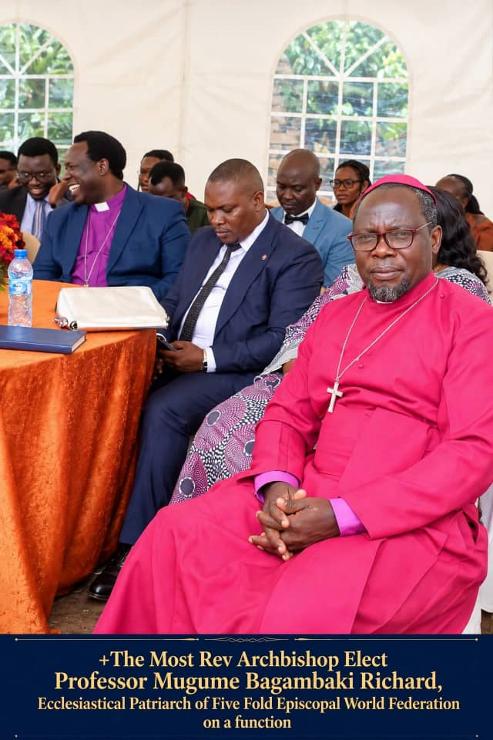
When the promise delays, the temptation to help God becomes almost theological, and that delicate moment when faith grows tired and reason offers a shortcut was the searching warning issued by the Most Rev. Archbishop Elect Professor Mugume Bagambaki Richard, Ecclesiastical Patriarch of the Five Fold Episcopal World Federation, Archbishop of Upper City Covenant Churches and President and Chancellor of UCCSAT University, in his Patriarchal Pulpit Sermon titled The Danger Of Birthing Ishmael When God Promised Isaac.
Preaching from Genesis 16:1 to 16 under the subtitle When We Try To Help God, Hagar, Ishmael and the Flesh Versus Promise, the Archbishop located the text in exact biblical chronology, in its Ancient Near East legal world and in its enduring theology of promise versus flesh, and then pressed it upon the conscience of the present day Church.
Current Place In Biblical Time.
Genesis 16, the archbishop explained, is the most chronologically precise chapter so far in Genesis because Moses gives exact ages that allow the reader to trace the delay with painful clarity.
Genesis 16:3 says Abram had dwelt 10 years in the land of Canaan before he took Hagar, and since Abram entered Canaan at 75 according to Genesis 12:4, around 1921 BC, ten years later he was 85 when the decision was made. Genesis 16:16 records he was 86 when Hagar bore Ishmael, around 1910 BC, while Sarai was about 75 to 76, already deep into menopause according to Genesis 17:17.
The setting remains Hebron, Mamre, inside a tent now filled with spiritual tension, before Hagar flees to the wilderness of Shur on the road that leads toward Egypt.
Why does Moses preserve this painful failure for Israel in 1445 BC, the Archbishop asked, and the answer is that Israel in the wilderness would be tempted to return to Egypt for help when the promise seemed slow.
Hagar is Egyptian and Ishmael is half Egyptian, and therefore the chapter carries a lasting message that covenant cannot be birthed through Egyptian help. The chapter also explains the origin of the Ishmaelites and prophesies in Genesis 16:12 A Wild Man Whose Hand Will Be Against Every Man, A Prophecy Whose Shadow Still Stretches Across History.
For The Five-Fold Episcopal World Federation And The Body Of Christ Today, The Archbishop Said, The Warning Is Direct And Pastoral, Because After Ten Years Of Waiting For Promise The Temptation Remains To Use The Hagar Method, Human Methods, Political Connection And Compromise Fundraising To Birth Ministry That Looks Alive. Ishmael Is Still Alive Today, And Many Churches Have Already Birthed Ishmael While Believing They Have Birthed Isaac.
Historical And Cultural Context: Why Sarai Gave Hagar To Abram.
To a modern Ugandan reader, Sarai giving her maid to her husband sounds like immorality that should never be justified, yet in the second millennium BC it was codified family law that carried legal protection and social honor.
Two archaeological sources explain it with remarkable clarity and remove any suggestion that this was a moment of mere carnal impulse.
The Code of Hammurabi, dated around 1754 BC, about 150 years before Abram, in sections 144 to 147, provides that if a wife is barren, she may give her maid to her husband to bear children, and if that maid then despises her mistress the mistress may afflict her, while if children are born to the maid and later to the wife, the maid’s children cannot claim equal inheritance unless the father formally acknowledges them. This legal pattern mirrors Genesis 16 and Genesis 21 with striking precision.
The Nuzi tablets, discovered in northern Iraq and dated to around 1500 BC, preserve Hurrian marriage contracts with almost verbatim language to Genesis 16:3, stating that if the wife does not bear, she shall bring a woman from Lullu as second wife, and if the wife later bears she may expel the second wife and her children.
Old Assyrian and Old Babylonian contracts add the same clause that if within two or three years she does not conceive she shall acquire a maid for him.
What Sarai did was therefore socially honorable within her world, because she acted as principal wife exercising her right to provide a womb for the continuity of the house. Hebrew ibbaneh in Genesis 16:2, that I may obtain children by her, literally means that I may be built up through her, and the child would be legally counted as Sarai’s. Rachel would later do the same with Bilhah in Genesis 30:3, and Leah with Zilpah in Genesis 30:9.
Hagar was not taken as a casual concubine for fleeting pleasure, because Genesis 16:3 calls her ishshah, wife, second wife with legal status and household recognition. Abram did not pursue her, for Sarai initiated, Sarai took and Sarai gave, and in that culture a wife who refused to provide an heir when barren could be divorced with public shame.
The theological problem, the archbishop stressed, was not that it was illegal but that it was legalism substituting for promise, since God had already declared in Genesis 15:4 that he that shall come forth out of thine own bowels shall be thine heir, implying Sarah as mother. Sarai used a culturally correct method to fulfil a covenant that required a supernaturally correct method, and that substitution became the root of a long sorrow.
The Weight Of A Male Heir.
In Abram’s world a male heir was not sentimental preference but survival itself, carrying meaning that touched every sphere of life.
Lineage and name depended on him, because in Semitic thought a man lived on through his seed and without a son his name was blotted out from remembrance. Abram cries in Genesis 15:2, What wilt thou give me, seeing I go childless, and the steward of my house is this Eliezer of Damascus, revealing a deep fear that a slave would inherit his name.
Property depended on him, because land, flocks, wells, tents and covenant blessings passed only through sons while daughters married into other houses, and without a son the estate would inevitably be absorbed by servants or distant kinsmen.
Security depended on him, because in a tribal economy with no police and no pension, sons were defense and manpower, and Genesis 14:14 shows Abram mustering 318 trained men born in his house to rescue Lot, a feat impossible for a childless patriarch who would have been militarily vulnerable.
Covenant depended on him, because God had said I will make of thee a great nation in Genesis 12:2 and I will make thy seed as the dust of the earth in Genesis 13:16, which meant that no son meant no nation, no Canaan and no Messiah to come. Sarai’s ten-year clock was therefore not only biological but profoundly covenantal.
Honor depended on him, because in Mesopotamian, Egyptian, Canaanite and Israelite culture a man with many sons was considered blessed according to Genesis 24:60, while a man without was regarded as cursed or forsaken. That is why at 85 and 75, Abram and Sarai felt the weight of a collapsing world, and why Ishmael at 86 looked like salvation, so much so that thirteen years later Abram would still plead in Genesis 17:18, O that Ishmael might live before thee.
Child Bearing Versus Infertility — Honor & Shame.
In that world fertility was regarded as the supreme sign of divine favor while infertility was interpreted as the supreme sign of disfavor, and that theology shaped the identity of every woman.
Child bearing gave a woman status, because a mother of sons moved from the margins to the center of the household and her voice began to carry weight. Each birth in Genesis 29 and 30 is announced with triumph, now will my husband love me and God hath taken away my reproach, revealing how deeply birth and worth were intertwined.
It gave security, because a barren wife could be divorced or demoted with little legal recourse while a fruitful wife could not be easily set aside, and her sons would sustain her in old age when no other safety net existed.
It gave spiritual validation, because Psalm 127:3 says children are an heritage of the Lord and Psalm 113:9 says He maketh the barren woman to keep house and to be a joyful mother, while barrenness was understood as God shutting the womb, as Sarai herself says in Genesis 16:2, The Lord hath restrained me from bearing.
It gave social worth, because the worst insult a woman could endure was to be called barren, and Peninnah taunted Hannah in 1 Samuel 1:6 and 7 precisely because the Lord had shut her womb. Elizabeth in Luke 1:25 after conceiving John says, Thus hath the Lord dealt with me to take away my reproach among men.
Sarai’s words are therefore not cold theology but anguished trauma spoken from years of public reproach, because ten years in Canaan and perhaps 25 years since the promise had passed with no child. In her world she had failed as woman, as wife and as covenant bearer, and giving Hagar was an attempt to escape shame through a legal loophole and be built up without a miracle.
Yet the cultural cure created a spiritual crisis that would echo for generations, because when you cure barrenness with Hagar you get a child who can walk but cannot inherit covenant. Ishmael lives, is loved and is multiplied according to Genesis 17:20 and Genesis 25:12 to 16, yet he is pere adam, wild ass of a man in Genesis 16:12, whose hand is against every man.
The Text Unfolds — Pride, Harshness And El Roi.
The narrative in Genesis 16:4 to 6 traces the immediate fallout with sobering honesty, because Hagar conceives at once, proving Abram is not barren and confirming Sarai’s condition.
Once blessed, flesh despises grace, and the fertile maid looks down on the barren mistress. Sarai erupts with the words My wrong be upon thee, using Hebrew hamas which means violence, and she blames Abram for a plan she herself authored.
Abram becomes passive and says Behold thy maid is in thy hand, refusing to mediate and refusing to protect either woman. Sarai afflicts Hagar with the verb anah, the same verb used for Egypt’s affliction of Israel in Genesis 15:13, and Hagar flees toward Egypt, returning to the world that once owned her.
Then comes the turning point that changes the chapter from tragedy to revelation, because Genesis 16:7 marks the first time in Scripture the phrase Angel of the Lord, Malak Yahweh, appears, and in covenant theology this is a Christophany, the preincarnate Christ. He finds Hagar by a fountain in the wilderness on the way to Shur, the border toward Egypt, and grace pursues the Egyptian who did not seek Him.
He asks, Hagar, Sarai’s maid, whence camest thou and whither wilt thou go, and like God asking Adam Where art thou, He seeks confession rather than information. She answers honestly, I flee from the face of my mistress Sarai.
The counsel that follows shocks every modern instinct, because He says Return to thy mistress and submit thyself under her hands, which is not go to Egypt and be free but return and submit, and God commands return to affliction for formation and for preservation of redemptive history.
Then comes promise, I will multiply thy seed exceedingly, showing that even flesh is blessed though flesh is not covenant. Behold thou art with child and shalt bear a son and shalt call his name Ishmael, because the Lord hath heard thy affliction. Ishmael means God hears, El shama, the first divinely named child before birth.
Verse 12 compresses 4000 years of geopolitics into one sentence, He will be a wild man, his hand will be against every man and every man’s hand against him and he shall dwell in the presence of all his brethren, describing one who is untamable, in perpetual conflict and dwelling near Isaac yet in defiance.
Then Hagar, the Egyptian maid, becomes the first person in Scripture to name God, saying Thou God seest me, El Roi, and she wonders Have I also here looked after him that seeth me. The well is therefore called Beerlahairoi, Well of the Living One who sees me, between Kadesh and Bered, and Isaac himself will later love that well according to Genesis 24:62 and Genesis 25:11.
Even when we fail with the Hagar method, God still sees and still hears affliction, and He cares for Ishmael, yet Ishmael is not covenant and cannot carry promise.
Genesis 16:15 and 16 closes simply and solemnly, And Hagar bare Abram a son and Abram called his son’s name Ishmael, and Abram was fourscore and six years old when Hagar bare Ishmael to Abram. Abram believes the promise is fulfilled and embraces Ishmael as heir. Then comes silence, Genesis 16 at 86 and Genesis 17 at 99, thirteen years of divine silence. Why does heaven go quiet, the archbishop asked, because Abram settled for Ishmael, and when we settle for flesh, heaven goes quiet.
Galatians 4:21 to 31 transforms history into doctrine by teaching that Hagar is Mount Sinai, law, flesh, bondage and earthly Jerusalem, while Sarah is promise, grace, freedom and heavenly Jerusalem. Ishmael is born after the flesh and Isaac after the Spirit, and Galatians 4:29 warns that as then he that was born after the flesh persecuted him that was born after the Spirit, even so it is now.
The False Gospel Of Self Help.
At this point the archbishop turned to confront two popular slogans that circulate among staunch Christians in Uganda and beyond with great audacity yet without any biblical warrant, and that continue to mislead many sincere believers.
The first says God Helps Those Who Help Themselves, while the second goes even further and says You Must Help God To Help You, and both, the archbishop declared, are theologically and biblically wrong, misleading and deeply Ishmael in spirit.
The phrase God helps those who help themselves is not in the Bible, and it does not appear in Genesis, in the Gospels, in the Epistles or in Revelation. Its origin is pagan and deistic, appearing in Aesop’s fables in ancient Greece and in Benjamin Franklin’s Poor Richard’s Almanack in 1736, where Franklin, a deist, wrote it as civic moralism that was later popularized as English proverb. It is proverb, not promise, and it contradicts the gospel.
He says the Bible teaches the exact opposite, because God helps those who cannot help themselves and who have come to the end of their own strength. Romans 5:6 says When we were yet without strength, in due time Christ died for the ungodly. Psalm 121:1 and 2 says I will lift up mine eyes unto the hills, from whence cometh my help, My help cometh from the Lord. Psalm 46:1 says God is our refuge and strength, a very present help in trouble. If self help were the condition, then the cross itself was unnecessary.
The second slogan, you must help God to help you, is even more dangerous because it makes God dependent and man indispensable, as if the Almighty were unemployed and in need of assistance.
Scripture never presents God in such a way, because Psalm 50:12 says If I were hungry I would not tell thee, for the world is mine and the fulness thereof, and Acts 17:25 says Neither is worshipped with men’s hands, as though he needed any thing, seeing he giveth to all life and breath and all things. God does not need our help, He invites our faith and our obedience.
Genesis 16 is the divine rebuke of both slogans, because Sarai tried to help herself to escape reproach and tried to help God fulfil His promise, and the result was not help but harm, not Isaac but Ishmael, not peace but a house divided and not covenant joy but thirteen years of silence. God did not say thank you for helping me, God withdrew His voice until Abram learned that promise cannot be assisted by flesh.
True biblical pattern is not God helps those who help themselves but God helps those who wait on Him with patient faith, because Isaiah 40:31 says They that wait upon the Lord shall renew their strength, Lamentations 3:25 says The Lord is good unto them that wait for him, to the soul that seeketh him, and Psalm 27:14 says Wait on the Lord, be of good courage and he shall strengthen thine heart, wait I say on the Lord.
Salvation itself destroys Self-help religion, because Ephesians 2:8 and 9 says For by grace are ye saved through faith and that not of yourselves, it is the gift of God, not of works, lest any man should boast. If we cannot save ourselves from sin by helping God, we cannot birth covenant promises by helping God either, and the Church must unlearn this false gospel that inserts Hagar into grace.
When God promised in Genesis 12 and Genesis 15, He alone passed between the pieces in Genesis 15:17 as smoking furnace and burning lamp, and that was an unconditional covenant in which Abram slept while God alone walked. To insert Hagar into that covenant is to turn unconditional grace into conditional flesh, and that is the root of Ishmael.
APPLICATION: BRINGING THE GOSPEL HOME IN UGANDA, AFRICA AND THE WORLD OF FAST THINGS.
This is where the sermon left Hebron and entered Jinja, Mbarara, Kampala and the wider world where the same temptation now wears modern clothes.
Are we not always quick to pursue the Sarai way when waiting becomes painful, the Archbishop asked, and does not the contemporary Church prefer a quick Ishmael to a slow Isaac.
We live in a world of all fast things, and the culture now celebrates fast train, fast bus, fast foods, fast internet, fast cars, fast planes, fast money, fast ministry, fast anointing, fast prophecies, fast marriages and fast ordinations. The world sells speed as success and treats patience as poverty, yet covenant does not travel by fast train and Isaac does not come by fast bus.
Promise does not arrive with fast foods or fast internet, and it is not delivered by fast cars or fast planes, because promise matures in slowness while flesh boasts in speed, and that contrast exposes the impatience of our generation.
In modern Uganda and across Africa the pressure to birth Ishmael is relentless, because a young pastor who waits ten years for a small congregation is told to bring a political godfather, bring a financial Hagar and bring an Egyptian fundraising method and he will have numbers tomorrow. A business person who waits for God’s provision is told to use the Hagar method of corruption and he will build quickly. A student who waits for promotion is told to use the Hagar method of sexual compromise, and a couple waiting for a child is told to try a traditional shortcut that promises quick results.
This is precisely where the two false slogans become pastoral poison, because they tell the young pastor God helps those who help themselves, so help yourself to Hagar, and they tell the believer you must help God to help you, so give God a hand while He struggles. Genesis 16 shows where that logic inevitably leads, to a child who lives but persecutes, to a ministry that grows but despises grace and to a house that multiplies but cannot inherit.
The Church sings loudly yet lives impatiently, and every Sunday congregations across Uganda sing the classic hymn Standing on the Promises of God, written and composed by Russell Kelso Carter in 1886 after his own healing testimony, with words that declare Standing on the promises that cannot fail, When the howling storms of doubt and fear assail, By the living Word of God I shall prevail, Standing on the promises of God.
The question put to the congregation was piercing and personal, do we mean what we sing when we sing that hymn, or do we manufacture Ishmaels when standing becomes painful and waiting becomes costly. Carter wrote the hymn not because he helped God but because God helped him when he could not help himself, and that is the essence of true testimony.
Does God still speak and give promises today, the archbishop asked, and the answer is yes, He still speaks and He still promises, but promise requires waiting and waiting requires trust that refuses shortcuts.
When we use Egyptian maids to cure spiritual barrenness, we get a child who can count but cannot inherit, and ministries may grow in numbers but will mock true holiness, because Ishmael can make noise but only Isaac brings laughter according to Genesis 21:6.
This is because Romans 4:19 to 20 says Abraham considered not his own body now dead nor the deadness of Sarah’s womb but was strong in faith, and Hebrews 6:12 says promises are inherited through faith and patience, not through faith and speed.
Conclusion.
The final apostolic charge was uncompromising and pastoral at once, calling the Church back to El Roi, the God who sees, in Katwe, in Kisenyi, in Kibugambata in Jinja City,Teso Bar in Lira,Cereleno in Gulu and in every barren place where believers are tempted to help God.
God does not need your help to be God and He does not need Hagar to keep His word, and though He will multiply even Ishmael because He is merciful, covenant remains with Isaac and promise cannot be transferred to flesh.
The slogans must therefore be rejected with clear conviction, because the Bible does not say God helps those who help themselves, but rather teaches that God helps those who cannot help themselves and who dare to wait upon Him.
The Bible does not say you must help God to help you, but teaches that God helps you when you cease helping yourself and trust His promise with wholehearted faith.
Barrenness forced Sarai to look at her womb, yet promise forces us to look at God, and in Uganda today, in Africa today and globally today, the choice remains unchanged and unavoidable. Do not call Ishmael Isaac, wait for Isaac, and in a generation obsessed with fast things, dare to be slow enough to receive promise.
At the time appointed, Genesis 18:14 declares with eternal assurance, Is Any Thing Too Hard For The Lord, At The Time Appointed I Will Return Unto Thee, According To The Time Of Life, And Sarah Shall Have A Son.
Next in the series: Genesis 17, Covenant of Circumcision, Abram to Abraham, 99 years old, El Shaddai appears.
About the Preacher: The Most Rev. Archbishop Elect Professor Mugume Bagambaki Richard is Ecclesiastical Patriarch of the Five-Fold Episcopal World Federation, Archbishop of Upper City Covenant Churches, and President and Chancellor of UCCSAT University. He will be consecrated in Jinja City on 14th December,2026.