
























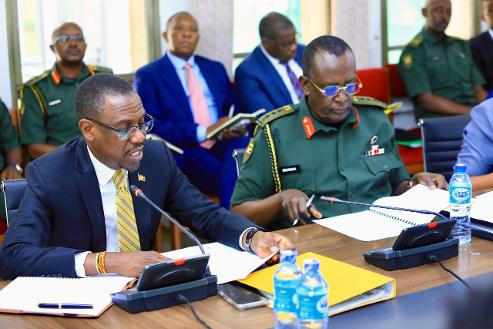
The National Enterprise Corporation (NEC) has appeared before the Defense and Internal Affairs Committee of Parliament to explain its several joint ventures, in what is the very first appearance in 37 years since its inception.
The delegation was led by the Minister of Defense and Veterans Affairs, Hon. Kiryowa Kiwanuka, together with the Board of Directors of NEC Uganda and the Ministry Under Secretary for Finance and Administration, Mrs. Edith Buturo, who represented the Permanent Secretary Mrs. Rosette Byengoma.
Minister Kiryowa introduced NEC as the commercial arm of the Ministry of Defense and Veterans Affairs (MODVA) and the Uganda Peoples’ Defense Forces (UPDF). He said NEC was established in 1989 under the Act, Cap 199, to produce goods and services beneficial to the Defense Forces and the general public.
He explained that its mandate includes undertaking commercial and industrial activities in areas such as agriculture, manufacturing, transportation and motor assembly, while supporting national security, technology transfer, skills development, employment creation and welfare of soldiers.
Hon. Kiryowa said NEC enters into joint ventures principally to facilitate technology transfer, skills transfer, mobilization of capital and local capacity building.
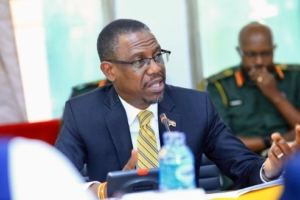
He noted that the joint venture model enables NEC to partner with entities possessing specialized technology, expertise, equipment and financial resources that may not otherwise be readily available to NEC or locally.
This, he said, enables Ugandan engineers, technicians, farmers and other personnel to acquire practical skills and expertise.
The model is also important because NEC has limited resources for major capital investments. The Minister revealed that NEC Headquarters has received approximately UGX 2 billion annually from the State over the last 15 years, largely for salaries and operational expenses. Consequently, joint venture partners provide much of the capital required for factories, equipment, technology and operations, while NEC generally contributes land, infrastructure and other support.
Minister Kiryowa told the Committee that NEC currently has nine joint ventures and one partnership covering both classified and non-classified projects.
He said the classified ventures relate to maintenance, repair and overhaul of military helicopters, development and deployment of advanced military and non-military technologies, manufacture and assembly of armored vehicles, and manufacture of explosives.
The non-classified ventures, he said, cover manufacture of military garments and shoes, automobile manufacture and assembly, beef and beans processing, oil-waste management, pharmaceutical production and an integrated agricultural model farm.
These ventures spread across strategic areas including defense manufacturing technology, agriculture, automotive manufacturing, pharmaceuticals and industrial services.
He underscored the contributions of NEC and its partners to Uganda’s economy, highlighting land contribution, existing infrastructure, warehouses, goodwill and access to the Ugandan market.
He said that for defense-related ventures at the Nakasongola Military Industrial Complex, NEC has provided land, including approximately 30 acres for Pro-Heli, 20 acres for NEC Technologies and 20 acres for NEC-Streit.
For the agricultural ventures, the Minister clarified that NEC has provided approximately 640 acres at Kisozi, Gomba District for the meat and bean processing projects, while the partner provides the requisite technology, skills and financing. Under the Egypt-Uganda Joint Model Farm Project, NEC has provided up to 500 hectares at Katonga, Gomba District, while the Egyptian partner provides financing, infrastructure, agricultural machinery and technical assistance.
He further explained that the partner generally provides technology, equipment, financing, construction, operational expenditure and specialized training.
The Minister also elaborated on the reinvestments of joint ventures, saying the model has enabled NEC to generate dividends and internally generated funds which, with board approval, have been reinvested into productive projects.
These include the oil waste management project at Kyangwali worth USD 4 million, the new NEC Uzima factory production line worth USD 1.2 million, NEC Security capitalization worth USD 500,000, a high precision workshop worth USD 500,000, a state-of-the-art incinerator worth UGX 900 million, research and development infrastructure worth UGX 4.2 billion, a 500 KW solar plant with 1.2 MW storage capacity worth USD 560,000, and the masks factory worth USD 500,000.
He added that the funds have also supported infrastructure development, including roads and accommodation at the Nakasongola Military Industrial Complex.
The Minister said the joint ventures have contributed to technology and skills transfer, development of local industrial capacity, employment creation, payment of taxes, local procurement of raw materials, development of local markets, export promotion and import substitution.
He noted that these joint ventures have enabled NEC to leverage private-sector and international expertise and investment while utilizing NEC’s available land, infrastructure and other assets. The overall objective, he said, is to build productive capacity and strengthen NEC’s ability to generate resources to support its statutory mandate.
Minister Kiryowa concluded by emphasizing that the Ministry of Defense and Veterans Affairs will continue to exercise oversight on NEC to ensure that its commercial activities remain aligned with its mandate and contribution to national development, while supporting the operational and welfare requirements of the Defense Forces and Veterans.
How Modern Armies Operate Commercial Arms – A Simple Research by The Exposure Uganda for Our Esteemed Readers.
To enrich this article for our esteemed readers, The Exposure Uganda (TEU) conducted simple research into how modern armies around the world operate commercial arms and why they do it.
Our research shows that an army that cannot feed, clothe, equip and sustain itself cannot effectively defend a nation. This is why most modern armies have moved from being purely budget consumers to wealth creators through legally established corporations under the Ministry of Defense.
In the United States, the Army runs the Army and Air Force Exchange Service, a retail business worth over $20 billion, alongside giant contractors like Lockheed Martin.
In China, the People’s Liberation Army streamlined its over 20,000 businesses into giants like NORINCO and AVIC, which produce both military weapons and civilian products. In Egypt, a model close to Uganda’s NEC, the military runs the National Service Products Organization, which produces cement, food, medicine and runs large farms. In Turkey, the Armed Forces Foundation owns ASELSAN and Turkish Aerospace Industries, which manufacture the famous drones now sold worldwide. Israel’s Elbit Systems and Rwanda’s Horizon Group operate on the same principle.
These armies generally use three models. One is the Joint Venture Model, which NEC is using, where the army contributes land, security and market while the partner brings technology and capital.
Another is the Defense Industrial Complex Model, where a factory that makes boots or uniforms for soldiers also produces for the civilian market to make profit. Yet another is the Welfare Model, where the commercial arm employs retired and wounded veterans and produces affordable goods for soldiers’ families.
The motivation behind this global trend comes down to five strategic realities.
At the foundation is the need for self-reliance and technology transfer, so that sanctions cannot stop a country from repairing its helicopters or producing its own ammunition.
Closely linked to that is the challenge of budget limitations, as state funding alone, like the UGX 2 billion NEC receives annually, can only cover salaries and cannot build modern factories.
Beyond survival, there is the economic logic of dual-use and import substitution, where products like beef, garments and vehicles serve both military and civilian needs and save the country foreign exchange.
There is also the matter of national security, since sensitive work like helicopter overhaul and explosives manufacture cannot be left entirely to private foreign companies.
Finally, there is the broader duty of employment and national stability, by keeping soldiers productive in peacetime and creating jobs for the youth.
This global context helps explain why NEC’s appearance before Parliament, after 37 years, is a significant step toward aligning Uganda with modern defense commercial practice.