

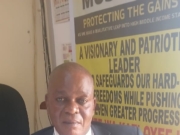


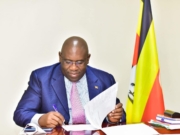
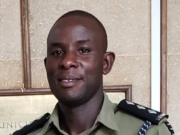


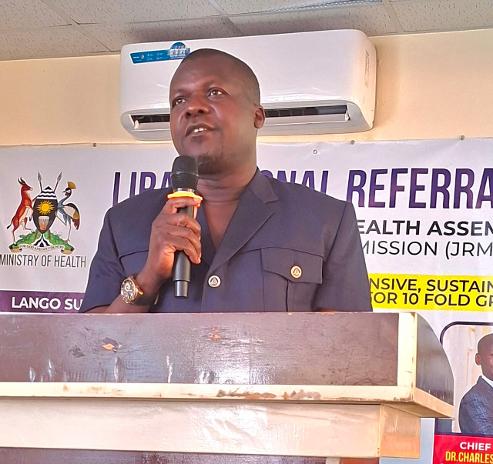
About one hundred and forty days after taking office, Dokolo District LC5 Chairman Peter Ogwang fondly referred to as “Petero” says his administration has moved from rescue to recovery, saving government funds from being returned to Treasury, restoring discipline in public service, and winning back public trust in schools and health centers.
Ogwang, a teacher by profession who abandoned chalk for the microphone as a radio presenter and later a business consultant, won the seat on a Uganda People’s Congress ticket. He now says the politics is over.
 AI-generated image to illustrate that Petero Ogwang was a classroom teacher.
“A winner wins for all. I was elected on UPC but I serve everyone. It is time to serve the people,” he told TEU.
Ogwang assumed office at the end of May 2026, just a month before the close of the 2025 /2026 Financial Year on June 30. He says he found a district at risk of losing millions.
“Most Districts received Quarter Four releases from Central Government towards the end of the Quarter. Therefore, I saved all funds from being returned to the Treasury as used to be the case by instructing the Accounting Officer to move all those monies to the Imprest Account of the District to allow us use these funds outside the Financial Year. Most of these funds were already committed into contracts,” he said.
The Chairman said he immediately convened all Heads of Departments to receive their work plans for the current Financial Year and share his vision for the district. The engagement, he says, gave him a clear understanding of department operations and allowed him to intervene in key sectors like education, health, production and finance among others.
Discipline was his next target. Dokolo District Local Government staffs had the problem of late reporting and abscondment from duty. Ogwang says he improved this by being exemplary.
“My reporting time is eight am and you know it is hard for a civil servant to reach work before the Chairperson. This has automatically improved on service delivery in these first one hundred and forty days,” the UPC-sponsored LC5 boss said.
Ogwang, who also had a stint as Speaker for Dokolo District Council, says he does not want war with anybody and stresses teamwork between the political and civil service wings saying both are working for the same people and hence the need for close working relations.
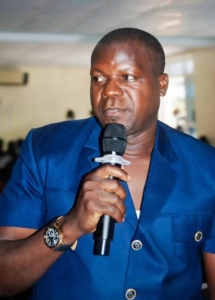
“I do not want war because even the name of our district tells us who we are. Dokolo comes from Adag kolo, meaning we are a peaceful people, we do not want aggression. If there must be war, let that war be against poverty, ignorance and disease, and against vices like corruption, abuse of office, drug theft, late coming and absenteeism. Those are the enemies of our people, not each other,” Ogwang said.
He added that his office has continued to engage with the RDC, DISO and CAO on the best administrative partnership in order to serve the people and that their working relationship is good.
“We do not put politics amidst us, but rather move together as a team to give oversight to government programs. This has as well helped CAO supervise lower local government well,” he said.
On education, Ogwang says at a time when there have been issues throughout the country on UPE and USE Capitation grant contributions by Government, he found education in Dokolo almost ignored by both politicians and civil servants, with teachers complaints not attended to and pupils not attended to.
Ogwang in an interview reported that he called for interactive meetings with both parents and teachers and headteachers. We have encouraged our parents to contribute in addition to the Capitation grant to help pay PTA teachers and student welfare at schools.
“This is very much welcomed by our parents and we expect our children to perform in the academic year with the motivation our teachers have got from my leadership. I keep reminding them that I am a Chairperson who treats education as priority to development, and so education in our district shall be compulsory,” he stated.
On infrastructure, Ogwang says school infrastructure shall improve, with money to renovate schools and supply desks for learners.
“In the past, these moneys come and are misused right from the Procurement stage up to contract implementation. We have stringent measures in place right from planning and figures to monitoring these projects implementation. We are working on this infrastructure according to their priorities,” he said.
On government programs of PDM, Emyooga and Restocking, Ogwang says he joined office and found them being implemented.
“Few incidents of corruption are handled by arresting and recovering the funds. We are going on radio to sensitize our community about these programs, who the beneficiaries are and my office is being appreciated for reinforcing the community,” he said.
On roads, Ogwang says the District Council has agreed that road maintenance work must adhere to national quality.
“Most roads shall be graveled with murram so that these roads can last especially with the rainy season. Therefore, we shall reduce on the number of kilometers to achieve quality,” he said.
Members of Parliament in Dokolo district and the office of the Chairperson are working well and together especially on road maintenance and other developments and Ogwang is hopeful that this shall move the district to the direction they all desire.
“What is most important and under control in the one hundred and forty days in office is that there is accountability in all government programs and projects presented to my office every month in the DEC meeting by CAO and HODs. Monitoring of government programs and projects does not wait for the quarter. We voluntarily monitor and advise within the project period. We have also reviewed the budget for the better understanding of our councilors,” he revealed.
On health, Ogwang says he reached the District and found that the population of Dokolo had abandoned Health Centre services because there was high rate of extortion. This he has stamped out.
“Few medical staffs involved were arrested and cautioned, while those reported on drug theft are interdicted. Our people now access medical services freely and at all times,” he said.
Ogwang says their only front line is poverty and that all must focus on that.
“Research findings show a happy population is sweeter to work with and lead than an angry, hungry and frustrated people,” he said.
This is backed by Oxford University’s Saïd Business School study by De Neve, Ward and Bellet which found happy workers are 13% more productive, and University of Warwick researchers Oswald, Proto and Sgroi who found happiness makes people around 12% more productive. The findings are published in Management Science and the Journal of Labor Economics.
His leadership mantras now echo in Dokolo.
“Leadership is not a war drum, it is a consultation table. The political wing proposes, the technical wing disposes, but both serve the same master, the people. Corruption is the most expensive tax on the poor. Poverty is the only opposition party worth fighting. A happy people will carry their leader, an angry people will bury him. A new broom does not need to sweep angrily, it just needs to sweep clean.”
Ogwang continues to do a lot of community engagement through both radio talk shows and direct communication at burials and all other gatherings.
“The community are appreciative and this gives me courage to work for and with them,” he said.
“My modus operandi is management by consultation and absolute detest for corruption,” he concluded.
Why a Good Start in the First 140 Days is Crucial.
In leadership, the first days are not just days. They are a statement. What a leader does in the first one hundred and forty days tells the district whether the next five years will be about service or about survival.
A good start is crucial because government systems have a memory. If you allow Quarter Four releases to be returned to Treasury in your first month, staff will believe that is the norm. If you allow extortion in health centers in your first month, patients will continue to stay away for five years. If you allow late coming in your first weeks, abscondment becomes culture. But if you report at eight in the morning in your first week, you teach service without shouting. If you move funds to the Impress Account to save them from return, you teach accountability. If you arrest those who steal drugs in the first sixty days, you teach that public trust is not for sale.
Political scientists call the first one hundred days the honeymoon period, the window when the council, the RDC, DISO, CAO, Members of Parliament and the public are all willing to listen and work together. After that window, camps form and resistance grow.
Ogwang used the 140-day window to build teamwork, not turf wars, and that is why his good start matters. It is the foundation on which the rest of the term will stand.