



















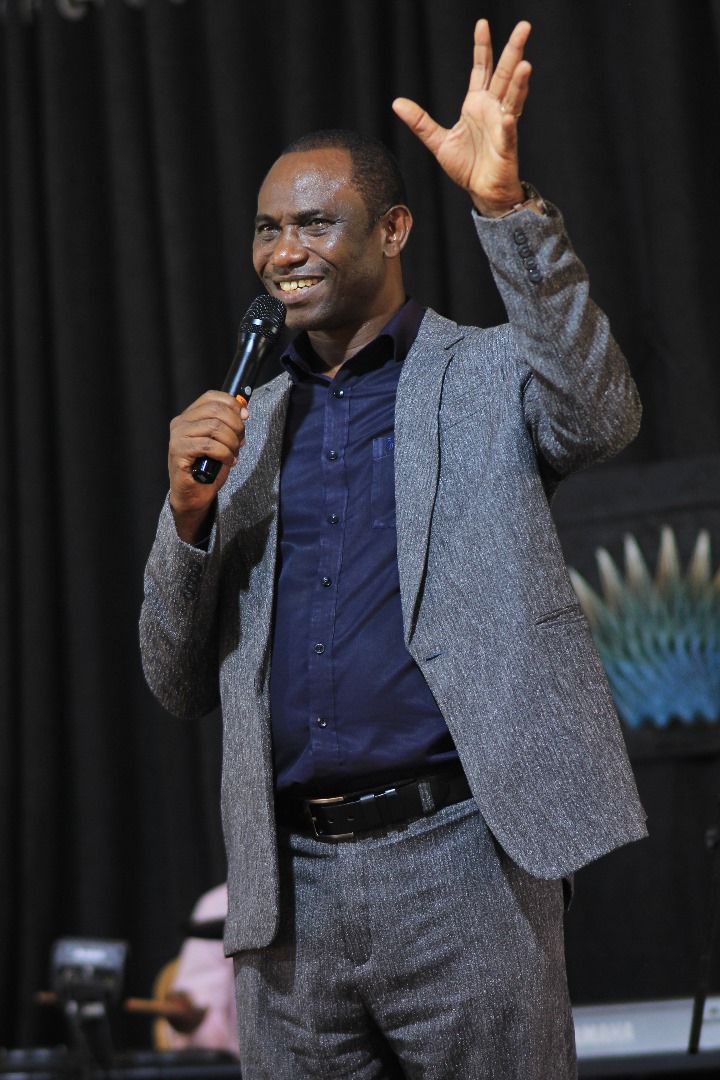
Congratulations, Bishop Patience Museveni Rwabogo. It is with great joy that I extend my heartfelt congratulations to Bishop Patience Museveni Rwabogo upon your consecration to the sacred office of Bishop.
This is a significant milestone in your journey of faith and service to our Lord Jesus Christ. We thank God for His grace upon your life and for entrusting you with this greater responsibility in His vineyard.
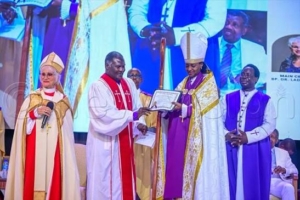
With those words, Bishop Fredrick Makka, General Overseer of Elim Pentecostal Evangelistic Fellowship of Uganda, has released one of the most theologically profound and spiritually discerning tributes to the newly consecrated Bishop Patience Museveni Rwabogo, daughter of President Yoweri Kaguta Museveni, who was on Sunday, 23rd August 2026, consecrated as Episcopal Bishop at Covenant Nations Church, Luzira.
His message, however, is more than congratulations. It is a prophetic commentary on the state of the Church in Uganda today, a contextualization of Jesus’ burden, and a clear distinction between crowd and calling, between many churches and genuine labourers.
Putting Jesus’ Concern In Context: Why Did Jesus Say The Labourers Are Few?
To understand Bishop Makka’s celebration, we must put Jesus’ concern in its original and present context.
In Matthew 9:35-38, the Bible says: “And Jesus went about all the cities and villages, teaching in their synagogues, and preaching the gospel of the kingdom, and healing every sickness and every disease among the people. But when he saw the multitudes, he was moved with compassion on them, because they fainted, and were scattered abroad, as sheep having no shepherd. Then saith he unto his disciples, the harvest truly is plenteous, but the labourers are few; Pray ye therefore the Lord of the harvest, that he will send forth labourers into his harvest.”
Jesus said this not in a season of no churches. In Israel then, there were synagogues in every village, Pharisees, Sadducees, Scribes, priests in fine linen. Religion was plenty. But labourers were few. Why? Because many were in ministry for status, for tithe, for seats, for robes, but not for the bleeding sheep. They had religion without compassion. They had temples but no travail.
In Matthew 20:1 and Matthew 21:33, Jesus explained that the Lord of the vineyard goes out to hire labourers to work in HIS vineyard. Pastors, bishops, evangelists, prophets are not owners; they are hired workers. The vineyard remains the Lord’s.
This is why ministry cannot be treated as a source of livelihood or employment through tithes and offerings. A hired worker does not eat the whole harvest; he cares for the owner’s crop and will give account to the owner.
Bishop Patience Rwabogo, therefore has not acquired a business; she has accepted employment under the Lord of the harvest. The souls are His. The Church is His. 1 Peter 5:2 says, “Feed the flock of God… not for filthy lucre, but of a ready mind.”
What Does “The Lord’s Vineyard” Really Mean? – For Readers To Understand.
The phrase “Lord’s vineyard” is Bible language that simply means God’s own farm, God’s own field, God’s own people. In John 15:1, Jesus said “I am the true vine, and my Father is the husbandman” – meaning the farmer.
The Church is not a private business, it is not a man’s company, it is not an employment bureau for survival. It is God’s farm that He planted with His own hands, watered with the blood of Jesus, and fenced with His protection.
The Bible calls it vineyard and not just church because a church can become a building, a signpost, a long name on a wall with no branch elsewhere. But a vineyard speaks of ownership, labour and fruit.
A vineyard belongs to one owner – the Lord. It requires daily labour – pruning, weeding, watching. And it is expected to produce fruit – not leaves, not noise, not offertory, but souls saved, families restored, and lives transformed. That is what God checks when He visits His vineyard. In Isaiah 5:7, God says, “For the vineyard of the LORD of hosts is the house of Israel.” He cleared stones, built a wall, and planted choice vines. He expects fruit.
Bishop Makka says this is exactly Uganda’s context today.
Uganda today is seemingly full of churches. On every street in Kampala to Gulu via Luwero, Kigumba, Karuma to Arua, on every trading centre from Jinja to Tirinyi-Kumi to Soroti-Dokolo-Lira, there is a church.
Some with very long names, some with no branch anywhere else except that one rented hall, some with glittering titles – Apostle, Prophet, Major Prophet, Seer – some whose founding seems more aligned to getting employment and a source of livelihood through offertory, tithes and different forms of giving, seed sowing, and first fruits, than to winning souls.
We have many signboards, but do we have many shepherds? We have many microphones, but do we have many altars? We have many who gather crowds, but few who carry the burden of the flock. Jesus’ concern is still valid today: The harvest – the lost, the broken, the drug-addicted youth, the prostitute, the corrupt official who needs Jesus, the homosexual, the despairing mother – is still plenteous. But genuine labourers who will weep for them, fast for them, feed them with the pure Word and not fleece them for money, are few.
This Is Why Bishop Patience’s Consecration Is Different – She Is Beyond That.
In this context, Bishop Makka says Bishop Patience Museveni Rwabogo comes as a different breed, a clear distinction.
“Patience is beyond that,” a senior pastor in Walukuba-Masese in Jinja City said, echoing Bishop Makka’s sentiment. “She does not need offertory to survive. She does not need tithe to 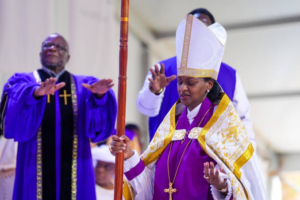 pay rent. She is a daughter of State House. She could live in luxury without preaching a single sermon. If she wanted employment, she would be in a blue-chip company or in government.
That she chose 20 years of hidden labour – starting a house fellowship in Luzira, interceding for the nation, teaching the Word, building Covenant Nations Church through sacrifice – proves her calling is genuine.”
Bishop Makka’s message says this is not a career move; it is a calling. It is not after livelihood; it is after souls. The First Daughter who could demand protocol chose to kneel for a towel to wash feet. The one who could sit on corporate boards chose to sit on her knees in prayer for Uganda.
In a generation where many enter ministry because they have failed elsewhere, where the pulpit has become a refuge for the unemployed and a platform for extortion through manipulative giving, Bishop Patience enters as one who had everything to lose and nothing material to gain. That is the mark of a genuine laborer.
Like Samuel with Eli: Called from Childhood, Raised in The Temple.
Bishop Makka, in his spiritually laced reflection, draws a powerful Old Testament parallel that Pentecostals will understand: Patience joins hundreds of thousands or millions of other genuine men and women who are called like Samuel with Eli to the gospel.
Remember Samuel as recorded in 1 Samuel 3, Samuel was not a man who opened a ministry because he needed a job. He was a child dedicated to God by his mother Hannah, raised in the temple under Eli.
He heard the voice of God as a boy. He did not call himself; God called him. And Eli, the old priest, had to help him discern that call: “Speak, Lord, for thy servant heareth.”
This is Bishop Patience’s story. Like Samuel, she was raised by a praying mother, Mama Janet Kataha Museveni, a known intercessor and teacher who dedicated her children to God. Like Samuel, she grew up around the altar, not around the nightclub.
Like Samuel under Eli, she has submitted for years to spiritual fathers and mothers – Pastor E.A. Adeboye and Mama Folu Adeboye, Bishop Dr. LaDonna C. Osborn whose family has ministered in Uganda since 1985, and her own parents who taught her Scripture.
She did not wake up and print posters and erected billboards. She labored under Eli. She learned to hear God. And now, like Samuel, God has established her as a prophet to the nation. 1 Samuel 3:19 says, “And Samuel grew, and the LORD was with him, and did let none of his words fall to the ground.”
This is why her consecration on 23rd August 2026, witnessed by President Museveni, Mama Janet, Vice President Maj (Rtd) Jessica Alupo, cabinet ministers, MPs, and the cream of Uganda’s populace, and coinciding with 20 years of Covenant Nations Church, is not an event. It is a confirmation. The boy who slept in the temple is now the prophet who speaks to the nation.
Bishop Makka says Uganda must discern this: God still raises Samuels in a time when Eli’s sons are abusing the offering. In 1 Samuel 2, Eli’s sons Hophni and Phinehas were priests who made the offering about themselves, sleeping with women at the tabernacle and stealing meat.
They were in ministry for livelihood and lust. But God had a Samuel in the same temple who was after the heart of God. In a Uganda with many Hophnis, God has given us a Samuel. Bishop Patience is that, Samuel.
Another Laborer to Add Value In The Lord’s Vineyard.
Bishop Makka therefore welcomes Bishop Patience not as a competitor, but as a co-laborer.
He writes: “As you enter this new season of ministry, may the Lord grant you wisdom, grace, courage, humility, and fresh anointing to shepherd His people and advance His Kingdom. May He enlarge your influence and make your episcopal ministry a blessing to the Church in Uganda, Africa, and beyond.”
This is Pentecostal language. Fresh anointing. Enlarged influence. Shepherding. Kingdom advancement. These are not Anglican formalities alone; they are Pentecostal travail.
He quotes the apostolic charge that remains the gold standard for every genuine Bishop, whether Pentecostal, Anglican or Charismatic: “Take heed therefore unto yourselves, and to all the flock, over the which the Holy Ghost hath made you overseers, to feed the church of God, which he hath purchased with his own blood.” — Acts 20:28
Take heed to yourself first – character before charisma. Take heed to the flock – not to their wallets, but to their souls. Remember they were purchased not by your eloquence, but by blood – the blood of Jesus. Feed them – not fleece them. This is what genuine labourers do. And this is what Bishop Patience has done for 20 years, and will now do with greater authority.
Bishop Makka notes that she joins hundreds and millions of other genuine men and women across Uganda, Africa and the world – unknown intercessors, village pastors who walk miles, missionaries in Karamoja, bishops in small huts – who have no long names, no TV, no entourage, but have a genuine call like Samuel. Her consecration validates them. It says God still calls the sincere.
Why We Should Pay Attention Now.
The timing is prophetic. Uganda in 2026 is at a crossroads – youth unemployment, moral confusion, drug abuse, family breakdown, corruption. The harvest of brokenness is plentiful. The Church cannot afford hirelings who run away when the wolf comes (John 10:12-13). We need labourers who will stay.
Bishop Patience Rwabogo, who could have run to comfort, stayed for 20 years in ministry, praying for Uganda through its seasons. That is a labourer. That is what Jesus prayed for.
Bishop Makka concludes with a fatherly blessing that every Pentecostal understands as impartation:
“Congratulations once again, Bishop Patience Museveni Rwabogo. May the One who has called you remain faithful to equip, strengthen, and sustain you for every assignment ahead.”
It is the prayer of Eli over Samuel: May the One who called you keep you. May He who entrusted you with this greater responsibility in His vineyard equip you.
Indeed, while many churches with long names and single branches may be after offertory and livelihood, God has not left Himself without witness. He still raises Samuels.
And on 23rd August 2026, He raised another labourer for His harvest – Bishop Patience Museveni Rwabogo. The Lord of the harvest has answered Jesus’ prayer again.
With prayers and warm congratulations,
Bishop Fredrick Makka
Elim Pentecostal Evangelistic Fellowship of Uganda.