




























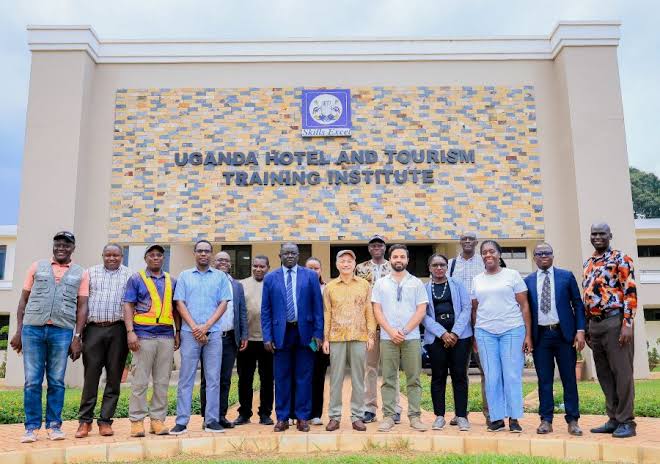
There will be tears of joy on November 20, and they will fall freely on the campus of the Hotel and Tourism Training College (HTTC) in Jinja City, because graduands will hug their instructors with gratitude, and they will hold their parents, some single mothers and single fathers, their guardians, relatives and friends, who sacrificed land, money and meals to keep them in school.

Some graduands will cry for another reason, as they remember the odd jobs that kept them going, working as maids, washing clothes for neighbors, carrying luggage as porters, or at building sites as helpers and riding boda-boda at night, all just to pay tuition and remain in class.
It will be the kind of happiness that is almost too much to carry, the kind that writers have tried for centuries to capture, and it will recall a moment in Lorraine Hansberry’s play A Raisin in the Sun, when Mama Younger holds the dream of a new house in her hands and can hardly believe it is real, because after years of waiting and praying, the blessing arrives so suddenly that joy itself feels like disbelief.
That is how November 20 will feel in Jinja, like a dream that has finally refused to remain a dream, as 782 graduands walk across the stage at the College’s 17th Graduation Ceremony, which will be presided over by the Minister of Tourism, Wildlife and Antiquities, Col. (Rtd) Tom Butime, under the theme Advancing Service Excellence and Innovation for Africa’s Hospitality and Tourism Future.
As you read this article, know one thing that changes the meaning of that day completely, because all the students called graduands here are already working, in kitchens and bakeries, at front desks and in housekeeping corridors, in restaurants, lodges and tour operations, doing the very work their certificates will soon confirm, so November 20 will not be their beginning, but their coronation.
The numbers tell a powerful story, for of the 782, 553 are apprentices who benefited from sponsorship by the International Labour Organization(ILO), the Ministry of Tourism, Wildlife and Antiquities, and Inter-Seed Sector Development under the Enabel-supported WeWork project, while the remaining 229 are regular students, and of the whole group, 561 are female and 221 are male, which means about 72 percent of this graduating class are women, a quiet revolution in an industry where women have long carried the work while men took the titles.
To feel the weight of November 20, you must know the place, because HTTC, once called the Uganda Hotel and Tourism Training Institute, is Uganda’s only government-owned institution for tourism and hospitality training, and the lone government school charged with training the labour force for the whole sector.
In tourism circles across the region, it is now fondly referred to as the Utali College of Uganda, a comparison that carries real meaning, because Utali College in Kenya has long been the benchmark for hospitality training in East Africa, and it is not an exaggeration to say that HTTC has earned a place among the best in East Africa and Africa.
It has earned that reputation not by claiming it, but by building it, through disciplined training, through a working hotel that doubles as a classroom, and through networking with internationally respected institutions in the United States, Europe and Asia, partnerships that expose its trainers and students to global standards, global kitchens, and global expectations, while keeping their feet firmly on Ugandan soil.
It began 35 years ago as an ILO project at Fairway Hotel in Kampala, before moving to Jinja, to the Crested Crane Hotel, and it was established in 1989 as a pilot school under the International Labour Organization and United Nations Development Programme, taken over fully by government after the Fairway Hotel was repossessed, formalized by Statute Number 14 of September 1994, which transferred the Crested Crane Hotel and its assets to the new institute, and revived in mid-1996, before receiving a clear mandate through the UHTTI Act of 2015 and being rebranded in August 2025 to HTTC, to match the new TVET law that puts skills first.
The Principal Richard Kawere has always put the philosophy simply, that students must touch, practice and feel, because hospitality cannot be learned only from a blackboard, but must be learned from a hot kitchen and a full restaurant, from a guest who arrives late, tired and hungry, and from a room that must be made perfect in twenty minutes.
Today the College trains about 1,500 students, and it counts over 5,000 alumni working in hotels and tourism establishments across Uganda and beyond, and the 782 are the latest proof that the model works.
It’s important to note that November 20 matters far beyond Jinja, because it lands in the middle of Uganda’s biggest economic question, which is how a country that adds 1.2 million job seekers every year, with projections showing only half that number of jobs available, can still create work at scale.
Tourism has emerged as the clearest answer, for it is already Uganda’s fifth-largest source of jobs, directly employing 876,512 workers, with every tourist dollar turning into 2.64 times as much spending in the local economy, and the sector earned $1.6 billion in 2025.
Uganda received 1.37 million international visitors in 2024, who generated about Shs4.8 trillion, roughly $1.28 billion, or 16 percent of total exports, before arrivals rose to about 1.64 million in 2025, with receipts reaching about UGX 5.83 trillion, or US$1.62 billion.
Yet a painful gap remains, because long-haul arrivals from the UK and US were just 26,416 in 2024, compared to nearly half a million for neighbouring Kenya, and the average tourist stays just 8.8 days in Uganda, against 12.1 days in Kenya, and what makes a tourist stay three more days is not a mountain or a river, but a person.
It is the guide who knows birds by call, not just by book, the chef who can cook matoke and pasta with equal respect, the receptionist who solves a problem before it becomes a complaint, the housekeeper whose room makes a guest extend a night, and the driver who makes a long journey feel short and safe, which is why the World Bank has warned that Uganda ranks 122nd of 140 countries on qualified tourism labour, and has called for specialist curricula for birding, adventure and cultural interpretation, the precise skills that serve high-yield, long-stay visitors.
November 20 is Uganda’s answer to that gap, and it is 782 answers walking across one stage.
Every great graduation has names that become legend, and according to Daniel Kazungu, the Institute Public Relations Officer, Ms Ssembatya Anna Maria emerged as the overall best graduand with a CGPA of 4.86, while Catherine Nabutiti topped the diploma category with a CGPA of 4.84.
Those are not just exam marks, Daniel Kazungu says they are battle marks, earned at 5 a.m. in kitchens, in laundries where linen must be perfect, at front desks where tired guests are sometimes angry, and on field trips where a tour must be both accurate and alive.
Kazungu says Ms Anna Maria is not an exception to the system, but proof of it, because she learned to set a table and then learned to read a guest, she learned food safety and then learned patience, and she learned theory and then learned to apply it when the power goes off, the guest is allergic, the van is late, and the show must still go on.
Her success answers a question many parents still ask, whether a daughter can truly build a career from this path, and the answer is written in the 561 women who will graduate, women who are already proving in kitchens, bakeries, front offices, tour operations and housekeeping leadership that hospitality is not a fallback, but a profession.
When Anna Maria and Catherine walk elegantly across that stage, they will not walk as job seekers, but as workers already in service, carrying certificates that will only confirm what employers already know.
That distinction matters because the job market has moved, and it no longer asks only what papers a person holds, but what a person can actually do, a shift that education leaders in Uganda are now naming openly.
Onesimus Oyesigye leads the Uganda Vocational and Technical Examinations Board, and he says the world now uses a skills economy, where they used to ask for qualifications, but now, when you present the paper, they ask what you can do, and skills defeat poverty.
A 2024 tracer study supports him, for it found that 90 percent of TVET graduates outperform university-trained counterparts in practical skills, that 63 percent secure employment within one year, and that 95 percent of employers are satisfied with TVET graduates’ hands-on competence.
Academic papers are still important, because they open doors, signal discipline, and prove a person can learn and finish, and in hospitality they matter for promotion, licensing, working abroad, teaching others, and starting a business that banks will trust.
Some experts now say papers alone are no longer enough, because no guest asks for a transcript before eating your food, and no tourist asks for a CGPA before trusting you in Bwindi, and what they ask instead, with their eyes and their wallets and their reviews, is whether you are competent, clean, kind and on time, and whether you can solve their problem.
That is why Uganda’s TVET reforms push for 70 percent practical training and 30 percent theory, judging learners not just on what they know, but on what they can do.
HTTC understood this shift long before it became fashionable, because its apprenticeship model combines work with education and leads to a recognised qualification, and through Enabel and ISSD, the College trains hundreds of apprentices, many of them young people who, after Primary Seven, could not access formal education.
The College serves those who passed well, and it also serves those the formal system left behind, giving them a second road into dignity and income, and that is precisely why its graduands are already working, because the apprenticeship was never a classroom exercise, but a job with training attached.
If skills are the new currency, two qualities are the new bank account, discipline and multi-tasking, and discipline in hospitality is not abstract, but the daily practice of reporting at 6 a.m., wearing the uniform correctly when no supervisor is watching, washing hands, checking temperatures, labelling food, recording stock, refusing to cut corners when tired, and keeping a guest’s privacy, which HTTC apprentices swore to uphold when they took an oath before placement in hotels across Jinja.
Multi-tasking is now equally real, because the modern worker is not a single-task worker, but a receptionist who must check in a guest, answer WhatsApp, handle a complaint, upsell a tour and calm a child, all with a smile, a chef who must cook, cost, plate, manage waste and supervise a junior, and a guide who must tell stories, manage safety, handle first aid and manage time so the group catches the boat back.
Technical skill alone is not enough, for employers also want soft skills such as communication, time management, flexibility, self-discipline, innovativeness and resilience, because a brilliant worker who cannot communicate or keep time will not last long.
Employers test this in week one, when they watch attitude and ask whether you will show up, greet and take correction without sulking, when they watch hygiene and safety and ask whether you understand that one dirty chopping board can close a hotel, when they watch communication and ask whether you can explain a menu, apologise without blaming and write a clear handover note, when they watch adaptability and ask whether you can move from housekeeping to restaurant service when the hotel is full, and when they watch entrepreneurship and ask whether you can see a gap and turn it into income.
Daniel Kazungu says the 782 have been trained for exactly that test, because their training included hotel attachments, kitchens, restaurants, tour companies and travel systems, the places where theory either works or fails, and because they are already working, employers have already seen the answer.
The message to them is simple, that their papers have opened the door, but their skills are already keeping them in the room, and they should not despise small beginnings, because the best general managers started as waiters and housekeepers, the best tour operators started as drivers and porters, and the best entrepreneurs started by selling one cake or one tour, and doing it so well that customers came back with friends.
They should not wait to be employed to be useful, because Uganda’s tourism sector needs founders, not just employees, young people who will start guesthouses in their villages, run catering for weddings, guide birders in Mabira, bake for Jinja’s cafes, and market Busoga’s culture to the world with professionalism.
They should not stop learning, because technology is changing hospitality through online bookings, digital payments, AI for customer service, food safety apps and energy-saving kitchens, and the worker who stops learning in 2026 will be outdated by 2028, while the worker who keeps learning will never lack work.
Above all, they should not forget discipline, because in a world of shortcuts, discipline is the real distinction, and punctuality is a skill, cleanliness is a skill, honesty is a skill, and kindness under pressure is a skill that no machine can replace.
November 20 is therefore not just a celebration, but a test for the country, because HTTC has already removed one excuse by placing its students in work before graduation, and proving that training and employment are one continuous road.
The Government of Uganda and hotels must now meet them halfway, along with banks and tour operators, by offering internships that become jobs, start-up capital that is accessible, standards that reward quality, and marketing that brings more tourists to stay longer and spend more.
The College itself still needs support, and through Principal Kawere, it has asked for increased funding, because it needs modern kitchens and training restaurants, language labs and ICT, and trainers who are regularly retrained, and a Centre of Excellence cannot run on goodwill alone.

But the biggest investment is not in buildings, but in belief, belief that a certificate in pastry or tour guiding is not a failure option, and that housekeeping or front office is not for those who missed university, but a first-choice profession for a country that wants to be known for service excellence.
On November 20, when Minister Butime presides and Dr James Musinguzi of the Uganda Wildlife Authority delivers the commencement lecture, that message should ring clearly across Jinja and across Uganda.
So let Jinja City countdown to November 20 with pride, to the music and the ululation, to the tears of parents who sacrificed everything, and to the moment when 782 names are called, 782 workers already in service being formally recognized for what they already do every day.
Let it count down to the moment when, according to Kazungu, Anna Maria’s name will be called as overall best with her 4.86, and to the moment when, according to Kazungu, Catherine’s name will be called as best in diploma with her 4.84, and to the moment when the other 780 names are called and remembered not as statistics, but as cooks, bakers, waiters, housekeepers, receptionists, guides, managers and entrepreneurs in the making.
Like Mama in A Raisin in the Sun, they will look at what they have achieved and find it almost too wonderful to believe, and like her, they will discover that the tears were never wasted, because Jinja has spoken, the Nile City has not just trained workers but sent them out, and Uganda’s tourism future will be built by hands that can do, hearts that can serve, and minds that can adapt.
Papers are important, but November 20 will prove something more powerful, that skills pay, discipline sustains, and work, real work already begun, is the true graduation, and on that day, Jinja will not just graduate 782 students, but present to Uganda a workforce that is already working, already serving, and already ready.